
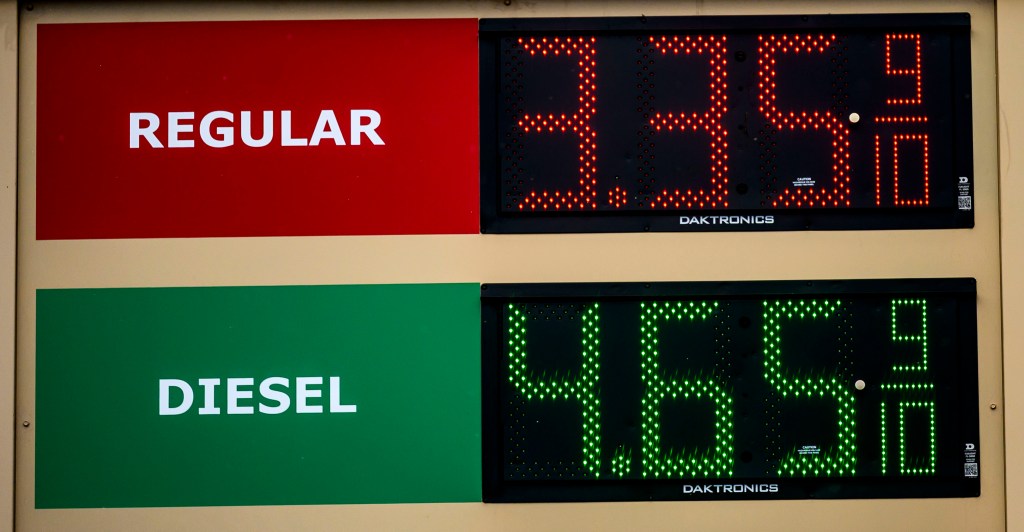
After armed conflict between the U.S., Israel and Iran began over the weekend, drivers in the Lehigh Valley are already seeing the impact at the gas pump.
According to GasBuddy, prices in the Lehigh Valley are up more than 13 cents per gallon since last week and about 20 cents over the month, with an average of $3.22 on Wednesday morning. AAA’s average in the Valley was $3.26, an increase of 17 cents over the week and 23 cents from last month.
GasBuddy, which tracks prices at individual gas stations, reported that prices around Allentown ranged from $2.71 to $3.25 per gallon.
Nationally, AAA’s national average was $3.19, which is 20 cents more than Monday and 31 cents higher than a month ago.
“Consumers should prepare in case gasoline prices rise even further,” said Jim Garrity, director of public affairs at AAA East Central. “At this point, all eyes are on crude oil, which accounts for 50 to 60 cents of each dollar you spend at the pump. Also, demand is increasing and refineries are beginning their annual transition to summer blend gasoline, which are both trends that typically push prices higher in the spring.”
Patrick De Haan, head of petroleum analysis at GasBuddy, said the national average was expected to rise above $3 per gallon, even if the war didn’t come.
“We are in the midst of seasonal changes,” De Haan said. “Summer gasoline is more costly. It’s more expensive. We were all set to rise to $3.10-$3.25 a gallon with a peaceful Persian Gulf. We’ll now get there very quickly.”
De Haan said it’s important to keep an eye on the situation, but it isn’t necessarily alarming. He doesn’t expect the national average to reach $4, though that could change if the situation deteriorates.
“The biggest risk right now is the Strait of Hormuz,” he said, referring to the waterway between Iran and the Arabian peninsula used by many oil tankers. “Confidence is the name of the game. Nobody really has confidence right now to transit through the strait.”
The market is signaling “caution” rather than “alarm,” De Haan said. “If the U.S. and other producers can secure the strait and restore transit confidence, oil prices are expected to improve.”
West Texas Intermediate crude prices were down slightly Wednesday morning at $74.01 per barrel after going over $80 earlier in the week.
Fuel efficiency tips
AAA East Central said adopting responsible driving practices can contribute to savings at the pump.
“One of the simplest ways to keep your fuel costs lower is to slow down, as speeding drastically decreases how efficiently your vehicle burns fuel,” Garrity said.
To improve vehicle gas mileage, AAA recommends the following tips:
• Drive the speed limit. On the highway, aerodynamic drag causes fuel economy to drop off significantly as speeds increase above 50 mph.
• Reduce trips and lighten your load. Limit the amount of cargo in your vehicle when possible. Combine errands and possibly aim to get them all done on one day of the week. Also, consider using the more fuel-efficient vehicle in the household more often.
• Avoid “jackrabbit” starts and hard acceleration. These actions greatly increase fuel consumption. Accelerate smoothly with light to moderate throttle. This allows the automatic transmission to upshift into higher gears sooner, reducing engine rpm and saving fuel.
• Avoid extended idling to warm up the engine. Even in winter, idling and warming up an engine are unnecessary and waste fuel.
• Look ahead. When approaching a red light or stop sign, let off the gas early and allow the vehicle to coast down to a slower speed until it is time to brake.
• Use cruise control to help maintain a constant speed and save fuel. However, never use cruise control on wet roads because a loss of vehicle control could result.
• Keep tires properly inflated. Underinflated tires reduce fuel economy, but more importantly, tires low on air affect handling and braking, wear more rapidly and can overheat and blowout.
• Maintain the vehicle according to the manufacturer’s recommendations. Regular maintenance will ensure optimum fuel economy, performance and longevity.
• Make all necessary repairs. Take the vehicle to a trusted repair facility as soon as possible if the “Check Engine” light comes on.