

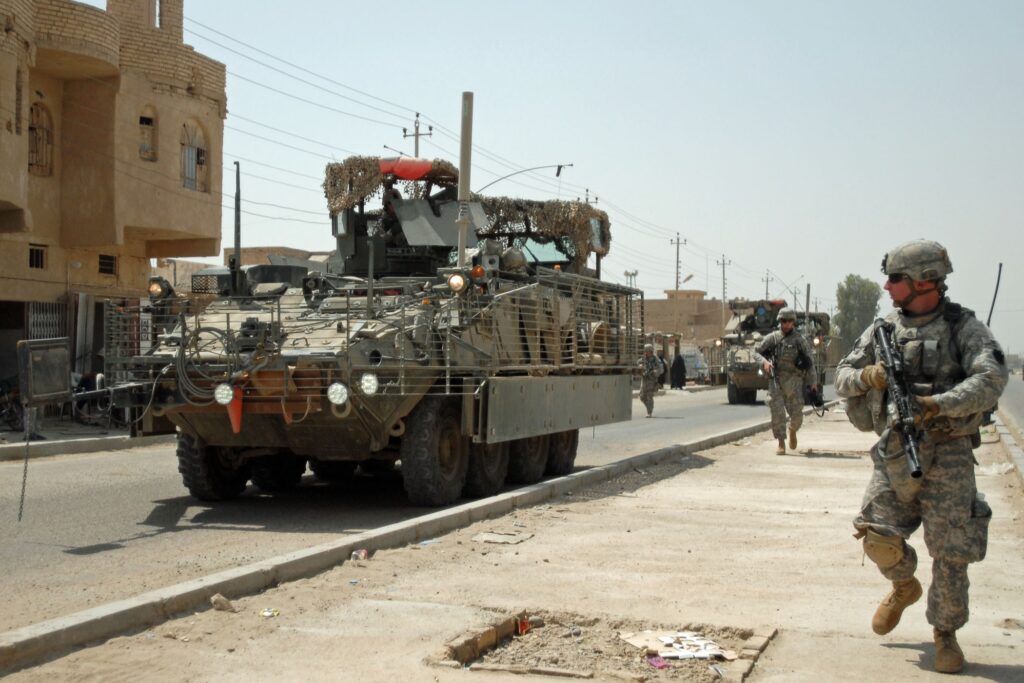
Staff Sgt. Andrew Frengel of Lebanon, Pa., other soldiers and Stryker vehicles of A Troop, 2nd Squadron, 104th Cavalry Regiment, 56th Stryker Brigade Combat Team move through Sab al Bour, southwest of Taji, July 20, 2009. (Pennsylvania National Guard photo by Sgt. Douglas Roles)
The Pennsylvania Army National Guard will be transformed as part of a larger national initiative from the U.S. Army with a focus on agility, trading out heavily armored vehicles in favor of lighter and faster options.
The move will impact every unit of the guard, which is made up of about 15,000 soldiers. The effort will start with the 56th Stryker Brigade Combat Team, a 4,400-soldier brigade that was deployed to Iraq in 2009, five years after its introduction.
The brigade, one of six under the guard’s 28th Infantry Division, will become a Mobile Brigade Combat Team by the end of the month — though it will take longer for it to be properly equipped.
 Virginia National Guard soldiers with the Staunton-based 116th Mobile Brigade Combat Team conduct Infantry Squad Vehicle Operator New Equipment Training on Nov. 14, 2025, at Fort Pickett, Virginia. The 116th is the first National Guard infantry brigade to convert to the mobile brigade combat team. (U.S. National Guard photo by Cotton Puryear)
The 8-wheeled Stryker vehicle will be replaced by Infantry Squad Vehicles, which are unarmored trooper carriers designed to rapidly transport up to nine soldiers at a time. Cavalry soldiers will become infantrymen, who operate under different military occupational specialty codes and oversight structures.
“I have directed my staff to develop comprehensive options that enable soldiers’ continued service while minimizing negative impacts on careers and that provide support across the commonwealth,” said Adjutant General of Pennsylvania Maj. Gen. John R. Pippy in a release. “We will also engage at the national level in pursuit of force structure, such as additional infantry and sustainment battalions, that will allow us to retain our highly trained and talented soldiers.”
Retired Lt. Col. Cory Angell was part of the team that transitioned to the Stryker vehicles, which had greater communications capabilities and required specialized training. The former Pennsylvania Army National Guard anti-tank company commander, who later served as its public information officer, said the Stryker came with more responsibilities for each person involved.
“We ended up drilling twice as much as other soldiers did because we had to not only do our unit collective training where the unit trains together, (but) individuals had to go to individual schools to learn new things,” said Angell.
SUBSCRIBE: GET THE MORNING HEADLINES DELIVERED TO YOUR INBOX
The new Infantry Squad Vehicles won’t require the same mechanics, for example, so soldiers with that expertise will need to retrain.
“You’ve got a new way to fight. You’ve got new equipment to fight with,” said Angell, who retired after 32 years of service. “There’s a lot to learn.”
According to the guard, another element under the 28th Infantry Division is expected to be converted to a Mobile Brigade Combat Team in the spring.
The 28th is the oldest continuously serving division of the U.S. Army. The division fought in World War I, World War II and Iraq. Known as the Iron Division, the 28th was dubbed “bloody bucket” by the Germans in the Second World War, because of the red keystone patch they wore on their shoulders.