
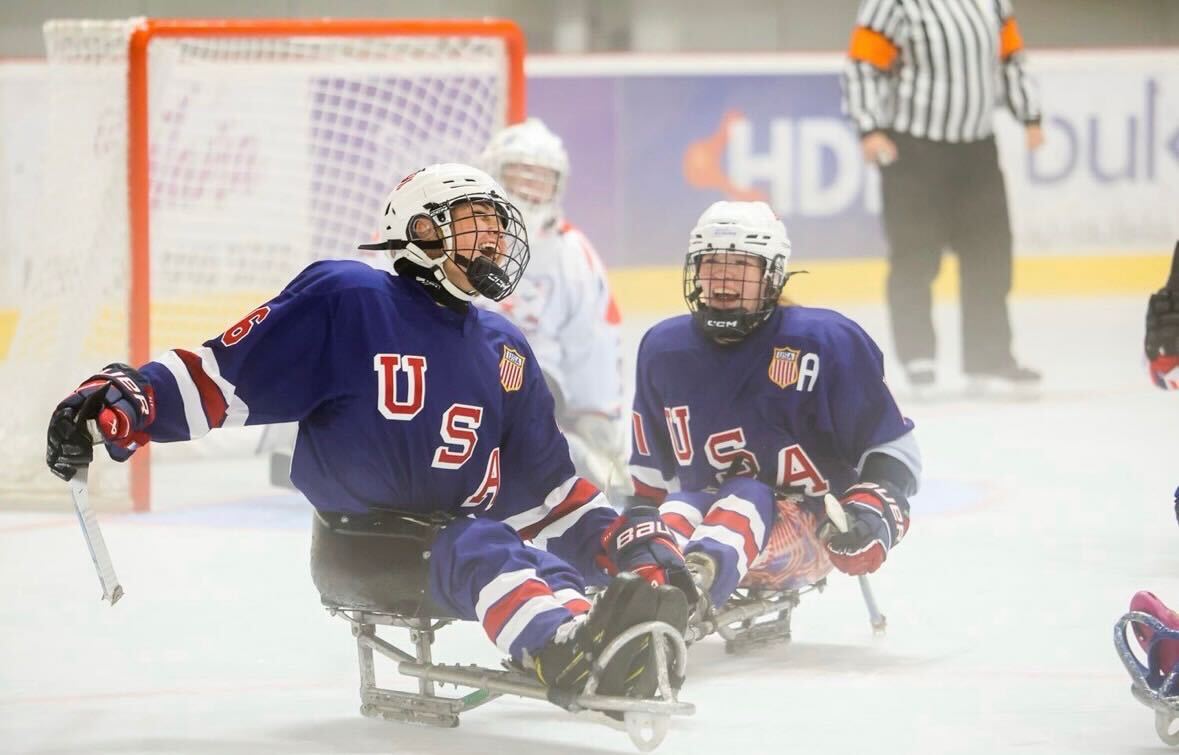
As the clock winds down to its final moments, the United States women’s national sled hockey team watches intently, waiting for the last horn to blow. Even then, there is still fear that their rival Team Canada could make an unexpected comeback.
“As soon as the clock hit zero, everyone burst off the bench and jumped into this huge huddle,” Kaden Herchenroether, a junior sociology major at Pitt, said.” “It’s chaotic — sticks and helmets are everywhere — but everyone is just so happy.”
The moment came in August at the Women’s World Challenge in Dolný Kubín, Slovakia, where the U.S. team faced Canada in the championship game. The victory secured the tournament title for the Americans.
Herchenroether lives with spina bifida, a birth condition that affects the development of the spine and can impact mobility. Still, Herchenroether competes with the U.S. women’s national sled hockey team as an accomplished athlete and advocate for Para athletic visibility.
Although the 7-1 victory was by a larger margin than expected, the excitement of beating their historic rival is “an incredible feeling.” However, to Herchenroether and the rest of her team, this championship represents something bigger than just a win — it’s one step closer to earning the recognition they deserve in the Para athletics community.
Although coming from an athletic background with wheelchair basketball, hand cycling and skiing, she never seemed to find a love for any of those. Until one day, after a handcycling race, her then opponent and now teammate mentioned that she should give sled hockey a try.
“The first time I got on the ice, I was terrible,” Herchenroether said. “I was so bad. But I fell in love with it.”
From that day on, she began playing with the Pittsburgh Mighty Penguins, the local sled hockey team, where she developed a passion for the sport.
Sled hockey, also known as para ice hockey, is an adaptive version of ice hockey where athletes sit on sleds and propel themselves using two short metal sticks while handling the puck.
At first, it seemed like a recreational league where she could enjoy playing alongside her friends. That was until 2021, when Herchenroether’s parents encouraged her to try out for the national team. It was then that she realized this sport was much bigger and more competitive than she originally thought.
“That experience really opened my eyes because there were so many high-level athletes there, including players who are now on the national team,” Herchenroether said. “That’s when I realized I wanted to reach that level.”
The bonds Herchenroether made through the national team — where the competition and stakes were way higher — were “ride or die.”
“We’ve all been united by the same goal and also the same experience of being women in a male-dominated sport,” Herchenroether said.
Growing up, Herchenroether saw her sisters playing sports like volleyball and desired that kind of team bond. So when she was able to find that through sled hockey, it was an instant feeling of belonging and support.
Although sled hockey has come a long way, women are still battling to gain recognition at the regional and national level. On her Pittsburgh team, Herchenroether is just one of two girls, sometimes creating a feeling of separation on her co-ed team.
“Sometimes, you feel like you have to prove yourself more,” Herchenroether said.
The 2026 Paralympics are currently being played in Italy — without a women’s sled hockey competition. The national team hopes to change this by 2030. The biggest challenge for Herchenroether and other sled hockey athletes is that there must be eight established national teams in order for the Paralympics to include their sport.
“Right now, there are about five or six teams, so we’re really trying to grow the sport internationally,” Herchenroether said. “We’ve been posting about tournaments, running camps and spreading the word as much as we can. One of my teammates is even running a camp in Finland.”
However, expanding the sport internationally comes with challenges.
“It has to grow organically,” Herchenroether said. “Of course, a challenge with the Paralympics because only certain people can participate.”
This past August, Herchenroether and her national team travelled to Slovakia to compete in the world championship game against Team Canada. She reminisced about the atmosphere there and how the entire community knew about the tournament.
“There were posters everywhere, and during the opening ceremony, we walked across a bridge and people were cheering and waving flags,” Herchenroether said. “A lot of us were brought to tears because we had never experienced that kind of recognition before. It felt like we were finally getting a glimpse of what the men experience in the sport.”
This experience gave the team a glimpse of what recognition could look like at the Paralympic level, making them even more eager to pursue their goal of earning the title of Paralympic contenders — or better yet, champions.
Growing the game beyond the rink
As a national champion and a university student, Herchenroether leads a rigorous daily life. Often, Herchenroether’s professors are not as understanding as they would be toward a Pitt athlete.
“Sometimes, professors don’t fully understand the level of competition we’re competing at,” Herchenroether said.
Although Herchenroether experiences challenges at Pitt, her attendance has helped her expand her community and meet new people.
One member of that community is Harrison Burgess, a Pitt alum and Pittsburgh native. Coming from Upper Saint Clair, Burgess also was born with spina bifida. He found sled hockey at the age of 10 during a Penguins commercial break.
“They advertised it as a team for individuals with physical disabilities like myself,” Burgess said. “I was immediately intrigued. I remember telling my parents to call the coach that night because I wanted to get involved as soon as possible. We called the following week, and I was on the ice that same week. The rest is history.”
Growing up in a huge hockey family, this seemed like the perfect opportunity. From there, Burgess joined the Pittsburgh Mighty Penguins and then continued to the high school national development team.
Burgess played on the team for three years, where he was constantly travelling, going to tournaments and meeting people from all over the country.
“Hockey is unique because it’s not like other sports where you have tons of teams nearby and can just play locally every week. It was a bunch of guys coming from different ages, backgrounds, walks of life and disabilities,” Burgess said. “It was a really unique community experience, getting to come together and play a game we were all passionate about while trying to compete at the highest level.”
The team would have training camps throughout the season, and each year would end with a three-game weekend series against a Canadian development team, which was always its rival.
In 2010, when Burgess first began his sled hockey career, there were only two other national divisions and a couple of teams they would play against. Now, the sport has multiple divisions, many more youth players, and much more international attention than when he began.
“No matter the reason, sled hockey provides an outlet for people with disabilities to find community, improve their health and pursue whatever goals they have,” Burgess said. “The sport itself is growing rapidly, and it’s amazing to see the opportunities that younger generations now have.”
As for the future of women in sled hockey, Burgess believes, “For young girls with disabilities looking for an outlet or community, seeing women’s sled hockey on the biggest stage would mean everything. I’m really looking forward to the day when that happens.”
For Burgess, community plays a huge role in sled hockey’s importance to his life. The relationships he built through sled hockey came at an important time in his life when he was transitioning into adulthood and thinking about college and the future.
“Those experiences helped build my independence and confidence in my ability to shape my own future. I really credit sled hockey with helping me through those life transitions,” he says.
The Paralympics opening ceremonies take place today, Friday, March 6, at 2 p.m., airing directly from Verona Arena in Italy.
Watching the games gives viewers a chance to discover sled hockey and other Paralympic sports they might not be familiar with and better understand the dedication and talent behind them.
“Try it out. It might shape the rest of your life,” Burgess said. “You might even go on to win a Paralympic gold medal.”