
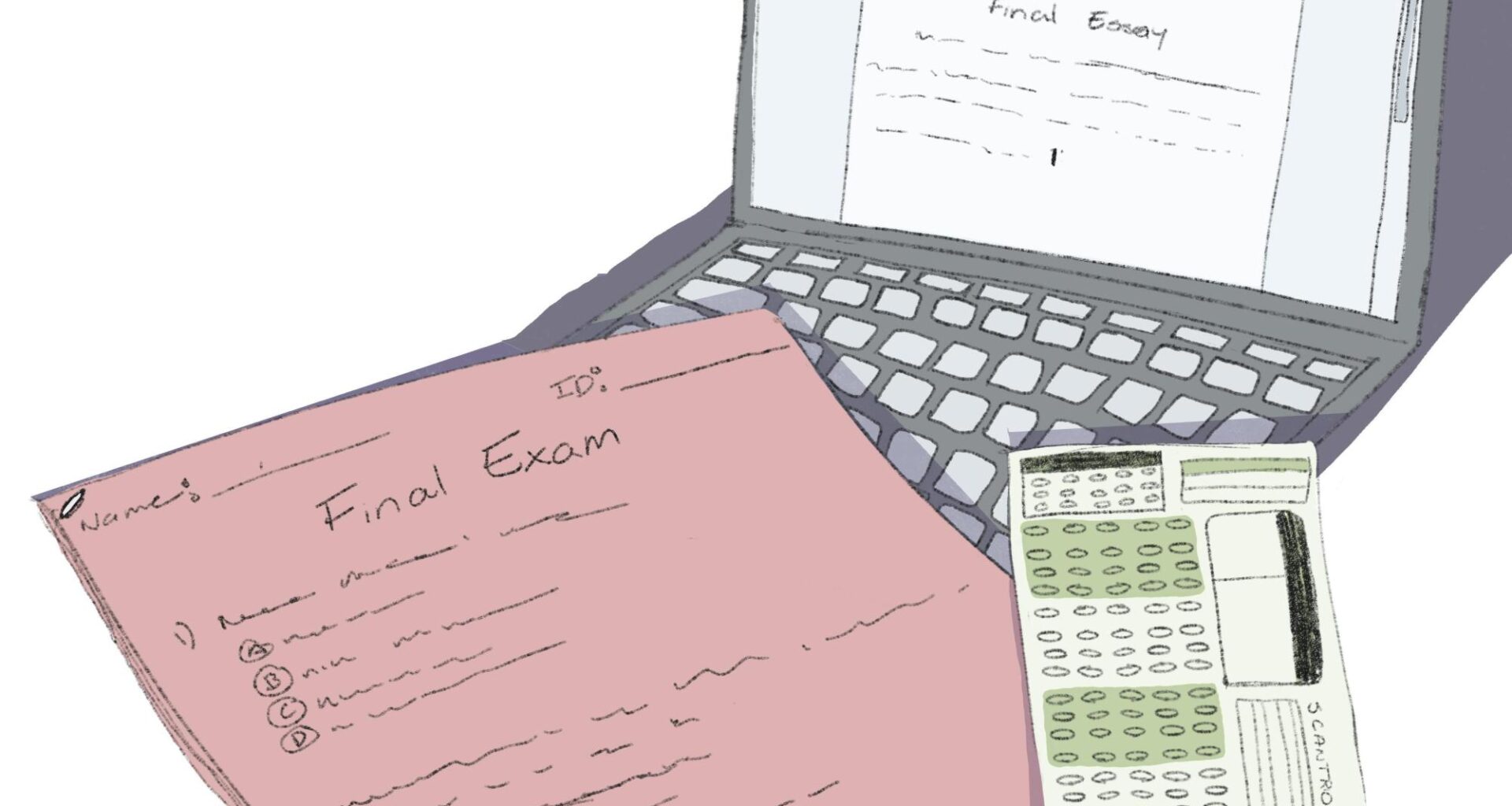
Happy midterm season to all who celebrate! It is that time of year again, with an endless to-do list and not enough hours in the day to study, complete assignments, write 10-page papers, eat and sleep. With spring break right around the corner, the last thing any of us Pitt students want to do is study for midterms.
As much as I try to push it off, the deadline always comes. Midterms have been a part of college since my grandparents were walking the halls at Pitt. Now, with technologies like artificial intelligence and classes no longer built around textbooks, midterms feel outdated. Society has transformed the way people learn, shifting from paper to iPads, chalkboards to projectors and in-person classrooms to Zoom. So why are universities like Pitt so scared of making exams and midterms a thing of the past?
I accept that tests can provide some benefits and are well intentioned. With an AI tab now open on everyone’s laptop, I can understand the perspective that multiple-choice exams on paper may be the only way to truly ensure that learning has occurred. I, however, disagree.
At the end of the day, yes, AI can give me the answers to most questions, provide me with study tools and aid in my learning process, but AI can not write a multipage paper with eight sources using my preferred verbiage or flow. AI also cannot articulate a 30-minute in-person presentation to my class. Learning in the real world is aided by AI and the internet, so why are we not given the same courtesy in school on exams? Moving away from typical assessments like midterms in college can allow for more experiential learning and encourage growth, not cheating.
At my future job — whether at a Fortune 500 company or a small local business with only 10 employees — I will always have access to resources like the internet. I can quickly look up formulas, learn how to use Excel functions or review concepts I learned in college whenever I need them. Removing exams could ensure students are not just spitting out information onto a bubble sheet during midterm season but are facing intellectual challenges, applying critical thinking skills and working with fellow classmates to solve real-world problems.
I am not anti-exam. I just strongly believe education needs to move away from the idea that there is one right answer. Yes, two plus two will always be four, but college is more than just grades.
Why should students take on an unpaid internship when we pay thousands to gain experience for our jobs? What are these classes actually teaching us if Pitt then tells us to also go take on a job or internship? What is the purpose of textbooks, exams, lectures and professors if I need real-world experience to be truly successful? College was always marketed as the stepping stone to a prosperous early career, but our classes do not give us the necessary skills to be successful in our first job if all we do is memorize for the next test. Hands-on skills, like writing an email, completing research or running a marketing campaign, are not learned in a multiple-choice exam worth half our grade. Moving away from typical exams into more creative, thought-based exercises in all classes allows students to be better prepared for life outside the walls of this university.
Most employers post-graduation couldn’t care less about your GPA or if you managed to get an A in biology. The real world cares about how you hold a conversation, manage challenges and understand how you got a final solution.
The classes where we had either papers, presentations or an alternative midterm or final are the classes I thrived in and felt I learned the most in. Papers allowed me to do more in-depth research on real-world cases and think out prompts I could never just memorize. Both the independent and group projects I completed have pushed me beyond base-level information and taught me how to synthesize information. Forcing myself to talk in front of my peers grew my confidence and professionalism. All these alternative forms of learning took just as much time as studying, but I took so much more away from them.
Anything and everything can be tested. From riding a bike to solving complex differential equations, an exam can be made and proctored. It is useless information if you can not apply it. You can be able to list every gear, part and step of riding a bike, but if you get on and only make it a foot, then you know nothing.
While we are all in college to learn, companies don’t sit us down each day and give a lecture followed by an exam in three weeks. Colleges and professors need to be more focused on offering students real-world examples that build skills needed to thrive professionally.
AI is a scary aspect of modern education, with many questions and concerns still left unanswered. I recognize the concern that exams are needed, since students are no longer actually doing work but instead allowing AI to think and answer for them. Students do need to seriously step back from AI as a crutch for the education they pay for. Regardless of where AI stands or how your professor teaches, exams are still not the best way of grading how much you learned.
Asking students to think for themselves in an intellectual manner is needed to test their knowledge. This should be done through discussion, papers, research and working within your class. Anyone can memorize answers or formulas and know how to get an end result, but it is that higher intellectual level that a test can never gauge. Schools like Hampshire College do not even use exams or letter grades.
With the way material is taught and in the wake of AI, colleges need to truly rethink the way they test our understanding. Exams were great before the internet — when people didn’t have a world of knowledge at their fingertips — but now students need to be challenged in new and creative ways to ensure their long-term success.
Sierra O’Neil is a junior marketing major who loves long walks, overpriced coffee and overanalyzing social media ads. A Pittsburgh native, she is always looking for different places to explore and companies to hire her as their new intern. Connect with Sierra by emailing her at [email protected].