
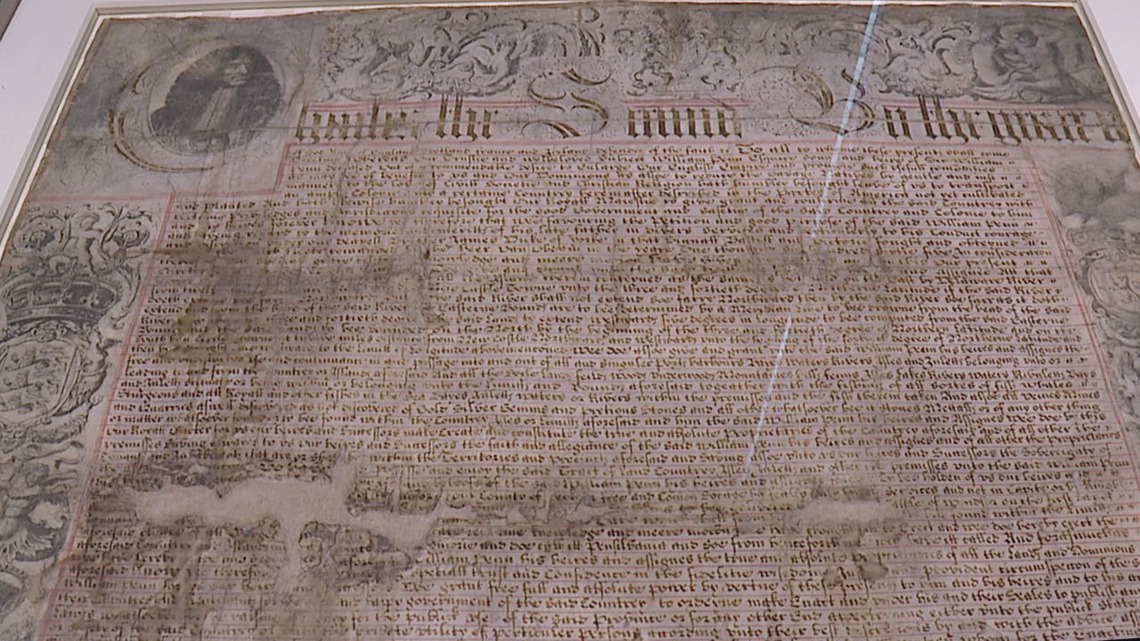
The Pennsylvania charter was signed on March 4, 1681, by King Charles II, granting the land to William Penn.
HARRISBURG, Pa. — Pennsylvania celebrated Charter Day on Sunday, commemorating the royal charter issued in 1681 that granted land in the New World to William Penn that would eventually become the Keystone State.
The Pennsylvania State Archives observed Pennsylvania’s 345th birthday by putting the original charter on display to the public in Harrisburg for the only time this year.
“March 4, 1681 is the date attributed to the charter,” said Josh Stahlman, chief of the State Archives Division. “We consider that to be sort of Pennsylvania’s birthday. The charter is Pennsylvania’s birth certificate, if you will.”
The charter, issued by King Charles II, officially created what was then the province of Pennsylvania and gave Penn control of the land. The province included modern-day Delaware along with most of what is now the Commonwealth.
While the charter itself is dated March 4, the state typically observes Charter Day on a weekend in early March so the public can see the historic document.
Because of its age and historical importance, the original document is rarely displayed for long periods.
According to Stahlman, the charter was tied to a debt owed to Penn’s father, Admiral Sir William Penn.
“Penn’s father was owed 16 million pounds for goods and services he had provided to the British Navy,” Stahlman said. “Penn approached the king about satisfying that debt with land in the New World.”
Penn, a Quaker, envisioned the new land as a place with greater religious tolerance.
“It allowed, at least to a certain degree, some degree of religious freedom for Penn,” Stahlman said.
Historians say those ideas helped shape the colony’s political culture and later influenced democratic ideals in America.
Stahlman said the charter’s principles helped pave the way for future political milestones, including the drafting of the Declaration of Independence in Philadelphia nearly a century later.
“The charter laid the groundwork for the land of Pennsylvania,” he said. “It also laid the foundation for the principles that ultimately led to those later monumental shifts toward democracy.”