
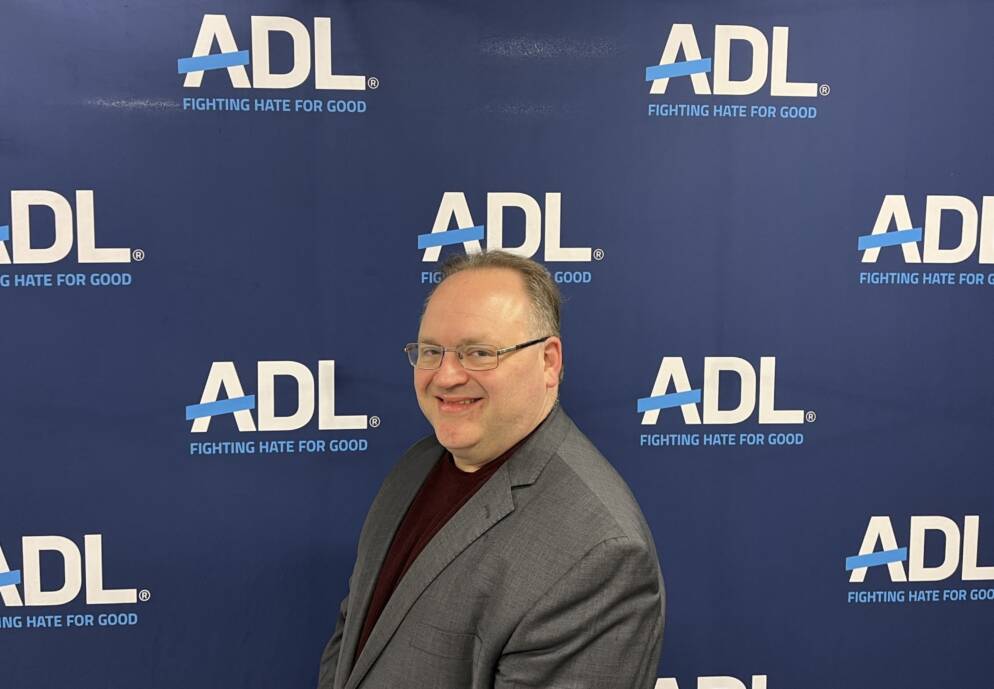
 ADL Philadelphia Senior Regional Director Andrew Goretsky (Courtesy of Andrew Goretsky)
The Anti-Defamation League released its third annual Campus Antisemitism Report Card on March 10, with half of the Philadelphia-area schools rating higher than last year.
Ten schools were assessed in the greater Philadelphia area, with one university being newly assessed this year. Franklin & Marshall College, a private liberal arts college located in Lancaster, received a B grade.
Each university was given a grade based on three different categories with 32 criteria points: publicly disclosed administrative action, Jewish life on campus, and campus conduct and climate concerns.
“It’s not about improving the grade, it’s not about the report card, it’s about the protection of our students on campus,” ADL Philadelphia Senior Regional Director Andrew Goretsky told Philadelphia Jewish Exponent.
One of the most improved was Temple University, which received a C on last year’s antisemitism report card and has now improved to an A grade.
“Philadelphia has world-class universities and all Jewish students here deserve world-class protection,” Goretsky said in a press release. “The strong results across this region reflect what is possible when universities take this work seriously. Temple’s president publicly crediting the ADL Report Card as a driver of their improvements is exactly the kind of institutional accountability we’ve been pushing for. In addition, the University of Pennsylvania has set up a Title VI office to address concerns. This is the progress we need, and we will continue to hold universities to a standard that protects our students.”
According to ADL’s 2025 report card for Temple University, in July 2024, Jewish fraternity students who lived in an off-campus house had an intruder who opened a roof hatch and made a crude gesture. The break-in came on the heels of other trespassing and vandalism reported on the property in May 2024. The university condemned the actions and launched an investigation. In September 2024, the university’s career fair was disrupted by student and non-student protestors using a bullhorn and leading to arrests. The administration addressed the disruption by outlining conduct violations, potential consequences and reinforcing university policies.
Temple has updated its student conduct code and policy on preventing and addressing discrimination and harassment to include ADL recommendations, which, according to the press release, is credited by the ADL report card.
“The campuses showing the greatest improvement are those that treat antisemitism as an ongoing responsibility, not a one-time response,” Shira Goodman, ADL vice president of advocacy and head of the Ronald Birnbaum Center to Combat Antisemitism in Education, said in the press release. “Treating progress as a finish line risks complacency; meaningful change requires sustained leadership, ongoing assessment and continued vigilance as campus climates evolve.”
Last year, Haverford College received an F for multiple incidents in 2024, including a federal lawsuit filed by a Jewish organization at Haverford alleging a hostile environment for Jewish students on campus that had gone unaddressed by the administration. According to the ADL’s 2025 report, the lawsuit was later dismissed by a federal judge. However, this year the college was given a D grade.
Swarthmore College was given a D grade in 2025 for multiple incidents on campus since 2023 and an open Title VI investigation with the U.S. Department of Education’s Office for Civil Rights. According to the ADL’s 2025 report card, one incident in May 2024 included a professor having said that “Holocaust exceptionalism is rampant.” This year, the school received a C grade.
The University of Pennsylvania also improved its rating. In 2025, the university received a C grade, an improvement from its 2024 grade of a D. In the ADL’s 2026 report card, the university received a B grade.
In November 2023, the U.S. Department of Education’s Office for Civil Rights opened a Title VI investigation following a complaint from the Brandeis Center alleging the school failed to protect Jewish students from harassment. The school came under criticism before Oct. 7 for antisemitic vandalism on campus and for hosting the Palestine Writes Literature Festival in September 2023, which featured speakers who had a history of antisemitism.
The university’s former president, Liz Magill, also came under public scrutiny for her testimony at a congressional hearing saying that calling for the genocide of Jews doesn’t necessarily violate the school’s code of conduct. Magill resigned shortly after.
The University of Pennsylvania has taken a multitude of actions in response, including investigating “Penn Against the Occupation,” removing them from the official student club registry and banning the student club from campus, implementing an updated security protocol providing additional security at 17 centers for campus religious life, and establishing the Office of Religious and Ethnic Inclusion, which oversees compliance with Title VI.
Lehigh University, located in Bethlehem, also improved to a B grade this year, having been given C grades previously. Lehigh has had few antisemitic incidents and has taken similar policy initiatives to protect Jewish and students.
“For me, when it comes to the report card, I see it as an important tool and a factor that parents and families can use when they’re determining what’s the best fit institution for their student,” Goretsky said. “The report card serves an important need of providing an assessment of how the institution is doing around addressing antisemitism on a college campus. From the time that this report card started we’re seeing, absolutely, significant improvements in [addressing antisemitism].”