
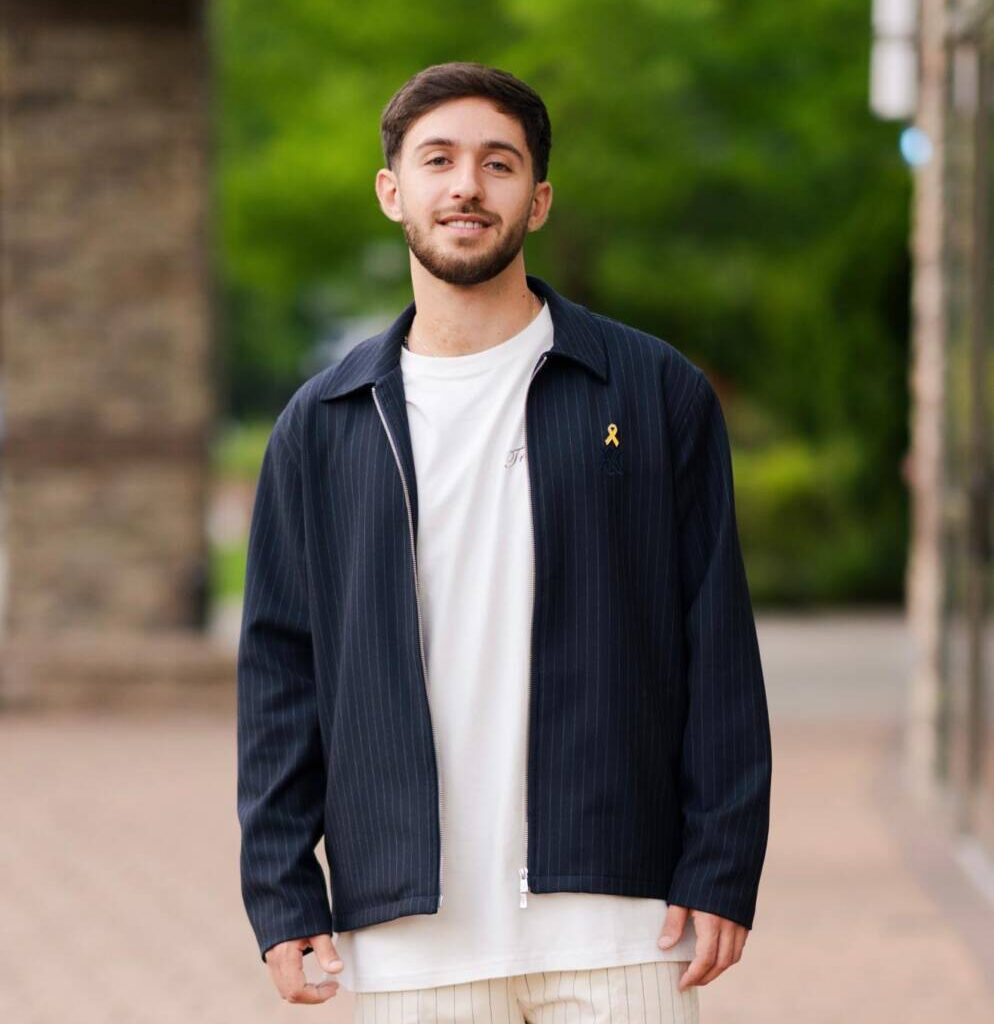
 Omer Shem Tov (Courtesy of Emet Advocacy)
Former hostage Omer Shem Tov is 23 years old. He completed his service in the Israel Defense Forces in 2023.
Prior to being captured at the Nova music festival, Shem Tov spent his time working shifts in a Tel Aviv steakhouse, putting aside money for a planned trip across South America.
Shem Tov had his whole life ahead of him.
And he still does.
The Israeli emerged from 505 days in captivity in the hostage deal of February 2025. Since then, he has been speaking at synagogues, on campuses and in other Jewish spaces about his journey.
And on March 18 at 7:30 p.m., he will speak at Chabad of the Main Line in Merion Station.
“Since his release, he has made it his mission to share his story of survival and resilience,” an event flyer states.
Shem Tov will speak at Chabad of the Main Line just two weeks before Passover. The Chabad’s rabbi, Shraga Sherman, believes that his story matches the theme of the holiday.
“Resilience and redemption,” he said.
Sherman heard that Shem Tov was going to be on the East Coast in March, and he reached out to the Israeli’s bookers.
“And thank God he was available,” the rabbi said.
The ordeal for Shem Tov began at the Nova music festival, which he attended with siblings Itay and Maya Regev. According to public testimony, their attempt to drive to safety was violently interrupted when Hamas militants ambushed their vehicle. Amidst the chaos and gunfire — which left both Regev siblings with leg wounds — the trio was forced into a truck and driven toward Gaza as their captors shouted religious slogans.
The 505-day ordeal took a devastating toll on the Herzliya native, who was eventually moved into deep underground tunnels and separated from his friends. Held in near-total darkness and isolation, he endured a starvation diet of little more than biscuits and brackish water. By the time of his release, the harsh conditions had caused him to lose roughly 37 pounds.
Life in the tunnels was a constant psychological battle. Shem Tov has recounted being subjected to verbal abuse and spat on, all while being forced to remain silent to avoid punishment. Perhaps his most defiant act occurred when he refused a direct command from his captors to detonate a building rigged with explosives over IDF troops. To endure these conditions, he adopted a survival strategy of being useful, taking on chores like cooking and cleaning to reduce the immediate aggression of his guards.
Shem Tov grew up in what he described as a secular Jewish household, but he said he found a deeper connection to Judaism while in captivity.
“He was able to get access to some Jewish books,” said Rabbi Sherman. “His desire to connect Jewishly in captivity is an incredibly powerful message. There is a true essence to the Jew, and we all access it at different times and in different situations.”
On Feb. 22, 2025, the U.S. brokered a ceasefire agreement between Israel and Hamas, and Shem Tov was airlifted to freedom. He emerged as the same energetic young man.
An iconic image from his February 2025 release shows Shem Tov aboard an IDF helicopter, scribbling a lighthearted request on a whiteboard: “Now everything is OK! Thank you to the dear people of Israel, and to all the soldiers! I want a hamburger.” At home in Herzliya, he tore his own hostage poster down before a cheering crowd. Taking his advocacy to the American stage in May, Shem Tov appeared at Fenway Park to toss the ceremonial first pitch for the Boston Red Sox. He used the high-profile moment to signal his ongoing commitment to those still in Gaza, sporting a yellow ribbon on his jersey and sneakers emblazoned with the plea, “BRING THEM HOME NOW.”
But he also emerged older, more religious and more focused on a purpose: telling his story.
Rabbi Sherman sees it as a self-help narrative.
“Here’s a guy who has made it his mission to overcome something,” he said. “That should uplift us to try to overcome all the challenges we have in our lives.”
The rabbi is expecting “a huge cross section of the Jewish community” to attend the event.
He also thinks non-Jews might come.
“It’s a message that has a certain ubiquity to it. I think people can relate to it,” he said.
Tickets to the March 18 event cost $36 and can be purchased on chabadofthemainline.org or by calling 610-660-9900, ext. 0.