
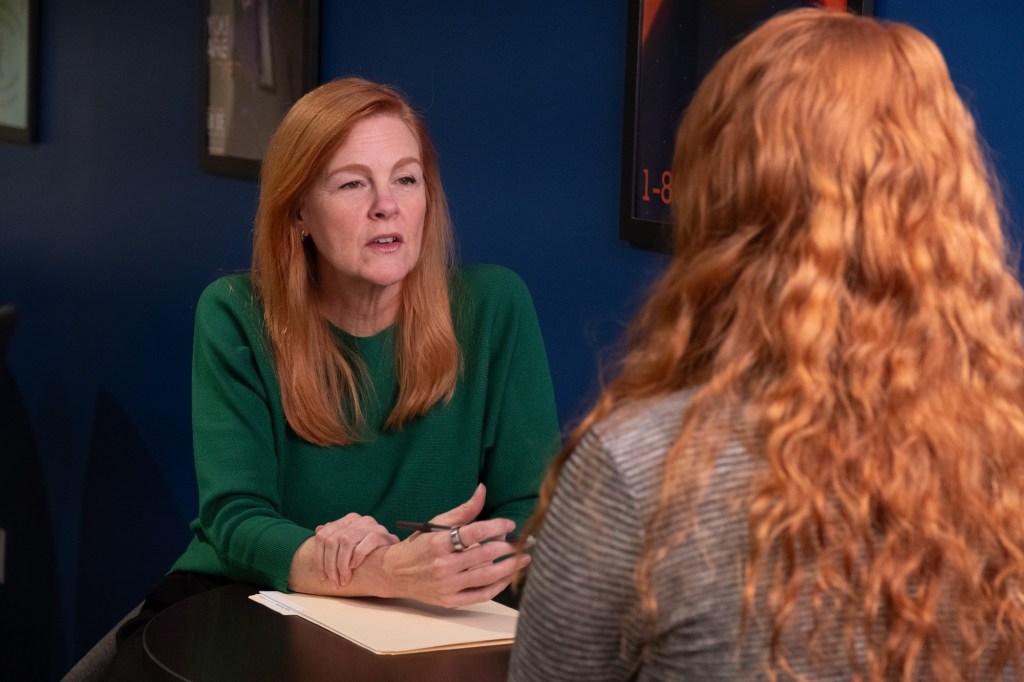
Losing a spouse and a child within four years would be an unthinkable tragedy for many.
And yet that is the reality for Amanda Blue, whose husband died by suicide in March 2008 and whose 14-year-old son followed him in March 2012.
“It feels odd to say it sort of came out of the blue because I think suicide does. I don’t think that was unique to me,” said Blue.
But this tragedy mobilized her. She said that before her son’s death, she’d been working as a graphic designer, but after, she started doing volunteer work around suicide prevention and went back to school to get a master’s degree in public health. She now works as education director at Jefferson Health’s David Farber Aspire Center, providing education and training.
People like Blue, who work to prevent suicide, are needed now more than ever, with suicide rates in recent years reaching all-time highs.
Over the last two decades, suicide rates in the United States have risen dramatically, to 14.1 deaths per 100,000 people in 2023 from a low of 10.4 per 100,000 in 2000. Suicide rates are highest among men older than 25, particularly among elderly men. Suicide is now one of the leading causes of death in the U.S., ranking 11th in 2023.
In the Lehigh Valley, the number of suicides rose somewhat dramatically from 2023 to 2024, from 98 to 111. This led Lehigh County Coroner Daniel A. Buglio to sound the alarm and remind people of resources available to them. Tentative bicounty numbers for 2025 show a slight decrease, to 105, but both counties said there were some deaths that still may be determined as suicides.
Data from the Centers for Disease Control and Prevention shows that the previous peak for the gross national suicide rate was in 1950, when the rate was 13.2 deaths per 100,000 people. It overall fell steadily up until 2000, when rates hit an all-time low for the duration that data was recorded. However, they have risen again over the last 20 years.
What is unique to our current time is suicide rates among children and young adults. Suicide rates in 2019 were 8.6 times higher for children ages 10-14 than they were in 1950. In 2019, people aged 15-19 were 4 times more likely to kill themselves, and those in their early 20s were 3 times more likely than they were in 1950. Other age groups saw less dramatic increases or outright declines in rates of suicide over the last 70 years.
Lehigh University professor Chrysan Cronin, a public health expert, said there are many theories for why the suicide rate may be increasing. She said some researchers speculate it could be because people are less resilient now than they were in the past, that people are too used to instant gratification and social media use, and the human brain is being exposed to more information than it can process. She added for men in particular, suicide rates may be so high because they feel that they may not be living up to the expectations that they hold for themselves or society holds for them.
However, she added that suicide and attempted suicide are complex public health issues to tackle because each death is different.
There are many known contributing factors, including depression, anxiety, substance abuse, trauma, abuse, serious illness, financial problems, job loss, relationship issues and social isolation. In children, bullying and academic failures can also increase risk.
Blue said her husband had gone through heart surgery six months before his death. Neither knew that brought with it an increased risk of depression.
Family members of those who have killed themselves are 3 times more likely to also kill themselves, data shows. However, Blue said, neither her husband nor her son had a mental health diagnosis.
“People often think that if they don’t have a significant mental health diagnosis, such as anxiety or depression, that they’re safe or their family members, children, etc., are safe. And I think it’s important to understand that it isn’t always the case,” Blue said.
Blue said on an individual level, focusing on risk factors among family members or friends is not necessarily the best thing. What people should look out for is if a person suddenly changes — for instance, when a person who is typically a social butterfly becomes withdrawn, or when someone starts sleeping a lot more than usual or withdraws from activities they usually enjoy. She said if you notice these changes, that’s when you should step in.
“There are some things that feel obvious and some that are less obvious, which is why I tell people don’t focus as much on their risk factors because you may or may not be aware of them as you do people’s behavior when you see dramatic change,” Blue said.
Blue said to open the door to conversation and let that person know you care and are available to them. But she added that you have to be able to accept being turned away; there is a limit to what you can do. She said the person may not be ready to share at that moment, or you may not be the person they want to share with. She said you can also always encourage them to reach out for professional support.
How to get help in the Lehigh Valley
The Lehigh Valley has multiple supports related to suicide. Last year, Lehigh County launched a 988 support line for people experiencing suicidal thoughts or another type of mental health crisis. Blue added the 988 support line can also be used by people who are concerned about a friend or family member to have a counselor help walk them through conversations and what to say.
Kristen Wenrich, director of the Bethlehem Health Bureau, said the city’s most recent Community Health Needs Assessment, as well as several previous ones, identified mental health as a top priority.
She also serves on Northampton County’s Suicide Prevention Task Force, monitoring trends in emergency department visits related to suicidal ideation and attempts among Northampton County residents. In addition to monitoring data, the task force focuses on raising awareness, advancing prevention strategies, providing training, and supporting families and loved ones impacted by suicide loss.
Similarly, Lehigh County has a Suicide Prevention Coalition with members of the Allentown Health Bureau serving in it. Lehigh County also established a Local Outreach to Survivors of Suicide, or LOSS, team, where trained volunteers respond in the immediate aftermath to provide resources and help the loved ones of people who die by suicide.
The Bethlehem Health Bureau’s Community Connections program, which sends social workers to accompany police officers, also screens people for depression and suicidal thoughts and connects them to services, Wenrich said. And Bethlehem recently offered question, persuade and refer training to all city staff, which is suicide prevention training designed to teach people how to recognize the warning signs of suicide and respond appropriately. This training is being implemented in schools, community organizations and workplaces throughout Northampton County.
If you or a family member is in crisis, you can call 988 Suicide and Crisis Lifeline to speak to someone in English or Spanish.