
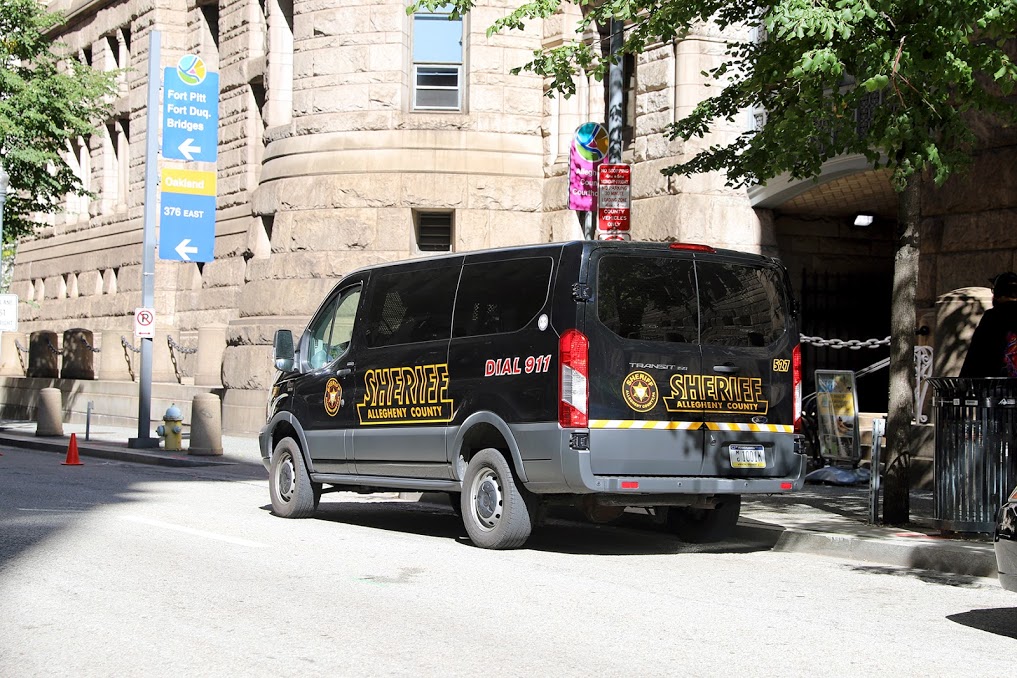
Every year, in an effort to give taxpayers a look at the single largest area of local public spending, Pittsburgh’s Public Source asks some of the largest governments in the region to provide payroll information. Last year and this year, the Allegheny County Sheriff’s Office declined to disclose the names of a substantial number of deputies, and the newsroom’s challenge to that decision is now heading to the Commonwealth Court.
The state Right-to-Know Law requires that governments at the state level and below disclose, upon request, records reflecting spending, including payrolls. The law explicitly includes the name, title, salary and other payments or expenses to any employee of an agency. It excludes some more personal employee records.
 Allegheny County police are reflected in a bank window as they block access along Craig Street along Forbes Avenue in Oakland during protest of President Donald Trump’s visit to neighboring Carnegie Mellon University on July 15, in Oakland. (Photo by Stephanie Strasburg/PublicSource)
Today begins the annual Sunshine Week, a celebration of the importance of government transparency to the function of democracy. Here’s a look into just one of Public Source’s efforts to bring agency decisions and spending to light.
Why Public Source challenged the withholding of law enforcement names
Our request was straightforward: the names and salaries of people employed by Allegheny County. Public Source makes such requests of the county, City of Pittsburgh and Pittsburgh Public Schools annually, and historically, these lists have been public records. They allow residents to know who is receiving public funds, and in the case of the county’s law enforcement agencies, who is exercising police authority in their communities.
Last year, Public Source and reporter Charlie Wolfson noted an unusual level of redactions in county law enforcement rosters obtained through Pennsylvania’s Right-to-Know Law.
The Right-to-Know Law allows agencies to “redact the name or other identifying information relating to an individual performing an undercover or covert law enforcement activity.” However, the Allegheny County sheriff, police and district attorney’s office all redacted far more employee names than in past years, citing concerns about officer safety and the possibility that some officers could be assigned to undercover work.
Public Source appealed those redactions.
Why we appealed
The county initially interpreted the law as allowing redactions of officers who have gone undercover in the past or theoretically could at any point.
We reached agreements with the county police department and the district attorney’s office. The county police agreed only to redact the names of officers who had been undercover the prior year, or were currently undercover, or would be undercover in the following year. As a result, the public ultimately gained access to a far higher percentage of those entities’ employee names than the county initially provided.
The sheriff’s office declined to settle out of court.
During testimony, the sheriff’s office acknowledged that fewer than 50 deputies were actively performing undercover or covert work. But it argued that the names of many more deputies should be withheld because they might perform undercover work in the future or could face threats if identified.
Allegheny County Court of Common Pleas Judge Daniel D. Regan sided with the sheriff’s office and upheld the redactions.
 Police tape crosses a street in Bethel Park. (Photo by Stephanie Strasburg/PublicSource)
The result is that a majority of the sheriff’s deputies remain unnamed in the public record. In the most recent roster, the sheriff’s office redacted 93 of 203 names, or about 46% of the force. The previous year, it redacted 155 of 199 names, roughly 78%.
Public Source is working with the Reporters Committee on Freedom of the Press, a pro bono legal services organization for journalists and newsrooms. Public Source and RCFP intend to appeal Regan’s decision to the Commonwealth Court, which hears matters involving state and local governments.
Why this matters
Law enforcement officers exercise significant authority on behalf of the public. They make arrests, carry weapons and make decisions that affect people’s liberty and safety. And this year, questions have surfaced among county legislators and activists over how the sheriff’s deputies are interacting with ICE agents as federal authorities seek to arrest people who appear in the county courthouse.
Knowing who holds those positions helps ensure accountability and allows residents to understand who serves in their communities.
Protecting the identities of officers engaged in sensitive undercover work has long been recognized as appropriate by government and journalists alike. But this ruling expands the use of a “personal security” exemption in a way that allows large portions of a law enforcement agency’s roster to remain anonymous in public records.
Police officers hold significant public authority and are paid with public funds. Knowing who they are has long been considered a basic element of government transparency. When that information can be withheld for the majority of a department, it represents a significant shift in how the public can understand and monitor those who exercise that authority.
Halle Stockton is the editor-in-chief and co-executive director of Pittsburgh’s Public Source. She can be reached at halle@publicsource.org.
RELATED STORIES
This story was made possible by donations to our independent, nonprofit newsroom.
Can you help us keep going with a gift?
We’re Pittsburgh’s Public Source. Since 2011, we’ve taken pride in serving our community by delivering accurate, timely, and impactful journalism — without paywalls. We believe that everyone deserves access to information about local decisions and events that affect them.
But it takes a lot of resources to produce this reporting, from compensating our staff, to the technology that brings it to you, to fact-checking every line, and much more. Reader support is crucial to our ability to keep doing this work.
If you learned something new from this story, consider supporting us with a donation today. Your donation helps ensure that everyone in Allegheny County can stay informed about issues that impact their lives. Thank you for your support!