
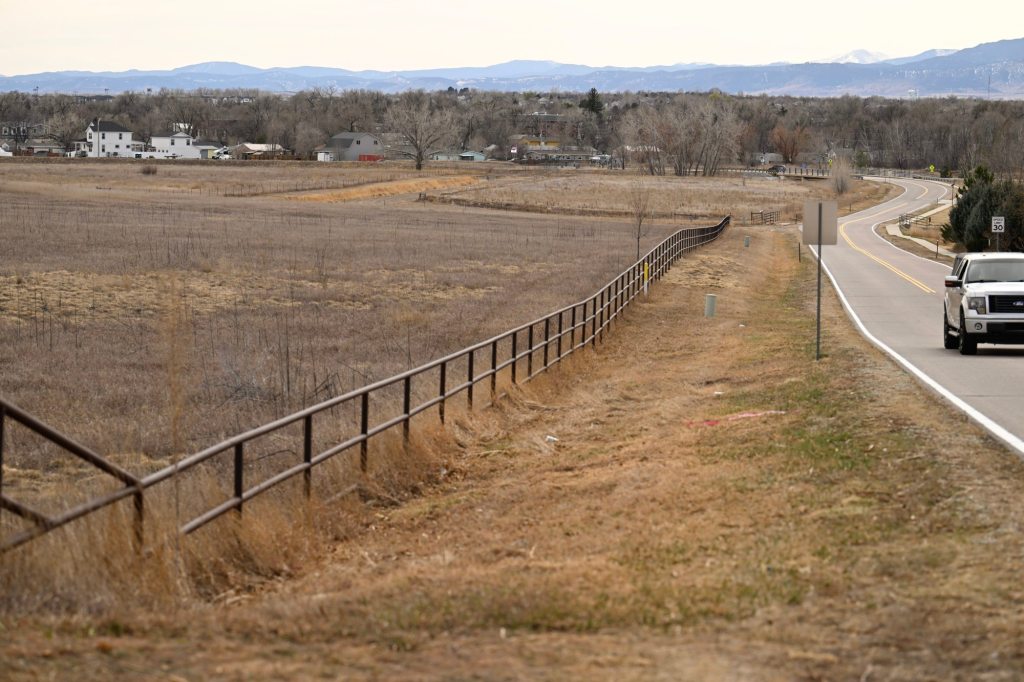
Erie town staff has received an early-stage proposal for St. Scholastica Catholic Church to build on a town-owned property near downtown Erie, referred to both as the Page Property and Village at Coal Creek.
Residents and some town leaders are questioning both the proposal itself and how it came to the table, after emails surfaced that showed discussion about the concept had been taking place months before it publicly came to light.
The church, which has a location along the town’s Main Street, in January submitted a preapplication, an early step where town staff can provide feedback before a formal development proposal comes forward. The initial proposal involves relocating St. Scholastica Catholic Church to a new location and potentially partnering with Catholic Charities, an affordable housing nonprofit.
That idea has drawn sharp criticism from some town residents and members of Erie’s Open Space and Trails Advisory Board, who say the property was purchased with a different vision in mind.
“This property was acquired by the Town for affordable housing and open space, not a 1,000-seat megachurch,” one resident wrote in a letter to the advisory board.
“Losing this beautiful property and allowing the construction of a megachurch with its traffic, enormous parking lot, lighting, noise, would be a travesty,” the resident wrote. “It also sets a troubling precedent for converting land designated for public benefit, purchased with our local and federal tax dollars, into large institutional use.”
That property — which is referred to both as the Village at Coal Creek site and the Page Property, after its former owner — sits east of Reliance Park just outside historic Old Town Erie.
The town purchased the 46-acre property in 2023 for $6.9 million, using $3.6 million in federal funding along with money from Erie’s Trails, Natural Areas and Community Character fund. At the time of the purchase, the land was envisioned as a place that could combine open space, trails and affordable housing.
But the land’s future has remained unsettled, with disagreement among the Town Council, residents and the advisory board over what should happen there.
OSTAB wrote a letter to the Town Council saying it “strongly recommends that the St. Scholastica pre-application be rejected and NOT proceed further.”
Criticism over early discussion
Some council members say they were caught off guard when the church concept was brought to the table by Mayor Andrew Moore during a November study-session meeting.
Councilmember Emily Baer said that was the first time she heard about the church’s interest in the property.
Baer then learned that discussion with the church had taken place months earlier, after emails surfaced showing that Moore and Mayor Pro Tem Brandon Bell had been on an email chain with St. Scholastica and Catholic Charities in June 2025. The Daily Camera also obtained such emails through an open-records request.
“My hope is that we can find a partnership where the town provides land for Catholic Charities to build the affordable housing helping meet our goals while also creating a new opportunity for a new church site. St Scholastica’s in the heart of Erie preserving its history would seem to be a good thing,” an email from Moore, dated June 22, reads.
That email was addressed to Don Fitzmartin, of Fitzmartin Consulting Company, and copied were the church’s Father Robert Wedow; Justin Raddatz of Catholic Charities; Bell; and Dan Woog, a former Erie town leader and current state lawmaker, listed as a parishioner at St Scholastica.
The conversation began, Moore told the Daily Camera, when the church approached him about a different undeveloped property it owns along Colorado 52, which sits in Weld County outside town boundaries.
“It all got started when the church contacted me about their property up on Highway 52 and about annexing it into the town of Erie, that’s when the journey started,” Moore told the Camera this month.
An agenda for a meeting between “St. Scholastica, the Town of Erie, & Catholic Charities,” dated June 27, outlines what could be built on the Page Property: a new facility that could host 800 to 1,000 parishioners, a parish hall and administrative office, and a potential grade school.
The discovery raised concerns for Baer about how the idea had been introduced during the November council meeting.
“It was misleading, the way that Mayor Moore said in the study session that this was an idea that just came to him suddenly,” Baer told the Camera.
“To find out that it wasn’t just an idea that came to him, that they had been having coordinated meetings, this had been going on for months and months,” Baer said. “The representation of ‘this is just an idea that we’re throwing out there’ felt very misleading to me.”
Part of the council and key town planning staff appeared to be excluded amid those early discussions, according to Baer. The result, Baer added, was that she, advisory board members and residents were effectively “side-swiped” by the proposal.
Moore said the early conversations played out just like “any potential negotiation” in its early phases.
“You’re just trying to see if there is even a possible match. And because of the open meetings laws, I can’t invite more than one council member with me to any meeting I go to. So that’s just the reality of it,” he told the Camera.
The church concept
The site on Colorado 52 could present challenges for a high-traffic use like a church, Moore said — one reason he began exploring whether the Page Property could offer a better location. The church’s current location, 575 Wells St., lies in the heart of town.
“I just look at an institution that’s been in Erie for 125 years in Old Town, and I’m like, OK — is there a way to help them?” he said. “Whether anything happens with it, I think we have a lot more discussion as a council.”
As envisioned in the preapplication plan, the new church campus, with a large amount of parking space, could potentially help address parking shortages in Old Town, Moore added.
“One of the biggest problems we have in Old Town is we don’t have enough parking,” he said. “If a place of worship locates there, can we use that parking lot for overflow events?”
Moore also said Catholic Charities, a nonprofit, could build affordable housing nearby.
“They do affordable housing for 60% to 80% AMI,” Moore said, using a term for area median income. “That’s a scenario we haven’t tackled yet, and it’s certainly a need.”
A St. Scholastica church leader could not be reached for comment for this story.
Questions about the proposal
The amount of parking space St. Scholastica could need is among the reasons Baer said she doesn’t believe a church is the best fit for the site.
“I have concerns about road capacity and traffic,” Baer said, adding the property might not be close enough to Old Town for it to be used for parking.
Instead, Baer envisions the property as a “thoughtfully planned” community that combines open space and affordable housing.
“In my mind, we could have a really incredible, well-planned community there that allows the whole community to access the open space and trails,” she said.
Councilmember Dan Hoback said the affordable housing component outlined in the church preapplication appears smaller than what was originally envisioned for the property.
“I think the affordable housing they sketched out is pretty minimal,” Hoback said. “I don’t think it compensates for what was originally planned.”
When Erie purchased the property, Hoback said, town leaders envisioned a roughly even split between open space and affordable housing. But a review of the land later showed only the middle portion of the site is buildable, which OSTAB said would leave fragments of open space scattered around development.
“We all went into that purchase a little blind,” Hoback said. “There was a hope to divide it more down the middle.”
OSTAB has pushed for the property to become entirely open space, in its letter to council writing that any options presented for development on the land thus far have “ degraded the open space values.”