
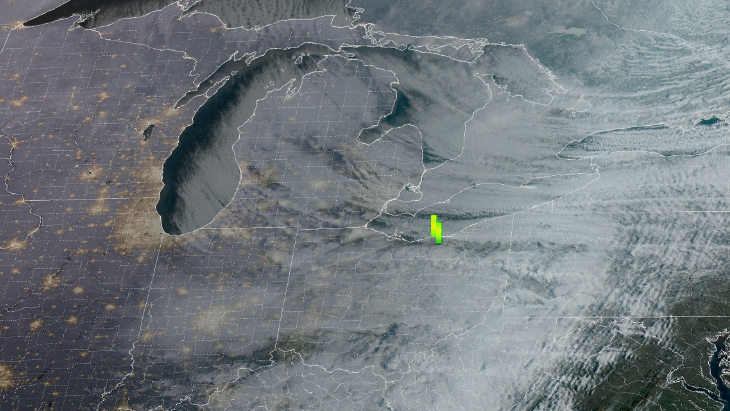
If you were in Western Pennsylvania, you may have seen what has been described as a fireball across the sky. In parts of Ohio, people reported hearing a boom and felt shaking. According to the National Weather Service, that boom was likely the result of a meteor. The National Weather Service said the latest Geostationary Lightning Mapper suggests just that. NASA’s website describes a Geostationary Lightning Mapper, or commonly called a GLM, as “a single-channel, near-infrared optical transient detector that can detect the momentary changes in an optical scene, indicating the presence of lightning.”GLM measurements also help officials improve their tornado and thunderstorm lead times and can give an early warning of lightning ground strike hazards. In addition to the GLM, seismographic, which are typically used to measure earthquakes, captured the boom from the meteor hitting the ground. Do you have images or videos of the meteor, send it to our web desk by emailing webstaff@wtae.com.
PITTSBURGH —
If you were in Western Pennsylvania, you may have seen what has been described as a fireball across the sky.
In parts of Ohio, people reported hearing a boom and felt shaking. According to the National Weather Service, that boom was likely the result of a meteor.
The National Weather Service said the latest Geostationary Lightning Mapper suggests just that.
NASA’s website describes a Geostationary Lightning Mapper, or commonly called a GLM, as “a single-channel, near-infrared optical transient detector that can detect the momentary changes in an optical scene, indicating the presence of lightning.”
GLM measurements also help officials improve their tornado and thunderstorm lead times and can give an early warning of lightning ground strike hazards.
This content is imported from Twitter.
You may be able to find the same content in another format, or you may be able to find more information, at their web site.
We’re receiving reports across western PA and eastern OH of a loud boom and a fireball in the sky. Our satellite data suggest it was possibly a meteor entering the atmosphere. https://t.co/v90lcimu6b
— NWS Pittsburgh (@NWSPittsburgh) March 17, 2026
In addition to the GLM, seismographic, which are typically used to measure earthquakes, captured the boom from the meteor hitting the ground.
Do you have images or videos of the meteor, send it to our web desk by emailing webstaff@wtae.com.