
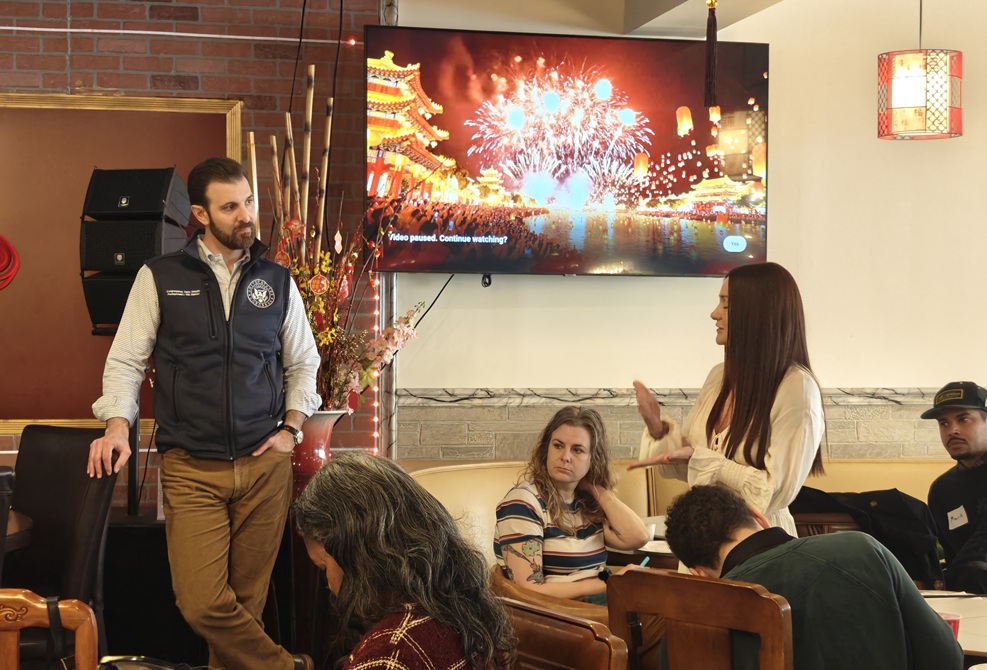
Last month, chefs, farmers and policymakers gathered at Chengdu Gourmet in the North Hills to discuss a growing pressure on Western Pennsylvania’s food system: climate change. Organized by the James Beard Foundation as part of its Climate Solutions for Restaurant Survival Campaign, the roundtable brought together restaurant owners, agricultural leaders and Congressman Chris Deluzio (D-PA) to examine how climate pressures are affecting farms, small businesses and regional food supply chains.
“I want a booming economy, and the restaurant and agriculture industries are a big part of making that happen here in Pennsylvania,” said Deluzio. “I’m interested in ways to strengthen our food system, give small businesses a fair shot to compete, connect local farmers and restaurants, and help our farmers get through extreme weather events like heat waves and floods.”
The event concluded with a Sichuan lunch prepared by multiple-time James Beard Award semifinalist Wei Zhu, whose Chengdu Gourmet has become one of Pittsburgh’s most celebrated destinations for regional Chinese cuisine. Over plates of kung pao chicken, mapo tofu and cumin lamb, the conversation continued informally, turning from policy ideas to a shared reality: the region’s food system is already adjusting to a changing climate.
A changing climate for Pennsylvania farms
“Independent restaurants and local farms here in Western Pennsylvania are deeply interconnected, and climate change is putting pressure on both,” said Anne McBride, vice president of programs at the James Beard Foundation in a press release.
Across Western Pennsylvania, farmers say weather patterns have grown increasingly erratic in recent years. Heavier rainfall can flood fields and wash away soil, while longer heat waves stress crops and livestock. Narrow and unpredictable weather windows make it harder to determine when to plant or harvest, creating uncertainty for farms that already operate on tight margins.
“We’re no longer talking about future climate risk. It’s already here,” said Rebecca Bykoski, director of programs at Sustainable Pittsburgh. “Pittsburgh experienced its hottest year on record in 2024, and we’re seeing heavier rainfall and flooding becoming part of our baseline climate experience.”
Those conditions ripple outward through agriculture and restaurant supply chains.
“Farmers are adjusting planting calendars. Crops fail more often. Chefs have to re-source ingredients mid-season,” Bykoski said.
Rising temperatures and more intense precipitation events are increasing the risk of pests and plant diseases. Urban growers across Allegheny County say those pressures are visible on the ground. Denele Hughson, executive director of Grow Pittsburgh, a nonprofit that supports community gardens and urban farms across the region, described a pattern of longer wet periods followed by intense heat and drought.
“We’re seeing two very different shifts happening at the same time,” Hughson said. “First, our seasons are wetter for longer periods than they used to be. But then after those wet periods, we often experience extreme drought and heat.”
In recent growing seasons, Hughson said, fields have remained saturated for weeks longer than usual, creating conditions that make crops more vulnerable to disease. When dry conditions arrive later in the season, farmers face the opposite challenge of keeping plants alive through heat waves and drought. Many growers have had to invest more heavily in irrigation systems to maintain production.
Climate change also affects the people working in agriculture. During extreme heat events, farm workers often shift their schedules to start earlier in the morning or shorten workdays to avoid dangerous temperatures.
“It’s not just about whether crops grow or not,” Hughson said. “These changes have real human impacts.”
Livestock farmers are seeing similar pressures. Ben Buchanan, a longtime butcher and founder of Unified Fields, a mobile butchering operation that travels directly to farms across Western Pennsylvania, said animals can tolerate both heat and cold but struggle with rapid shifts between the two.
“One of the biggest issues is extreme weather fluctuations,” Buchanan said. “Cattle can handle really cold weather and really warm weather pretty well. What they struggle with is the constant shifts — the rain, the mud and the temperature swings.”
The lack of frozen winter ground, which once made it easier for farmers to move equipment and manage livestock, has also created new challenges. In recent winters, Buchanan said, snow often melts quickly and fields remain muddy for long stretches, making pasture management more difficult and damaging the land.
Is climate change to blame for the high cost of potato chips? We crunched the numbers
The ripple effect on restaurants
When farms struggle with climate volatility, restaurants feel the impact quickly because local food systems are deeply interconnected. Farmers grow the ingredients that move through processors, distributors and local markets before landing in restaurant kitchens.
Processors play a critical role in that chain.
“The butcher is really the connection point between the farm and the plate,” Buchanan said.
Farmers raise animals, but turning livestock into retail cuts requires specialized facilities, trained workers and strict food safety standards. Without those processing links, locally raised meat cannot reach consumers or restaurants.
Climate pressures also affect the logistics of food processing. Buchanan’s mobile slaughter rig travels directly to farms, which means storms, fallen trees or flooded roads can interrupt scheduled work. Wet ground conditions can also prevent trucks and equipment from safely accessing farms.
Independent restaurants, many of which rely on seasonal ingredients and regional suppliers, often have limited flexibility to absorb disruptions in supply or rising costs.
“Many restaurants and food businesses are already making intentional decisions about responsible sourcing,” said Bhavini Patel, executive director of Sustainable Pittsburgh. “But there’s a limit to how much of those costs they can pass on to customers.”
That tension forces restaurant owners to balance sustainability goals with affordability.
Pennsylvania’s restaurant industry is a major economic engine. The state has more than 26,000 restaurants generating roughly $30 billion in annual sales and employing nearly half a million people. When climate pressures disrupt the food supply, the effects extend beyond farms and kitchens to workers, businesses and local economies.
Hughson said restaurants are increasingly paying closer attention to local supply chains.
“Supply chain disruptions — not just from climate but also from global markets — are making people rethink how food moves from farms to kitchens,” Hughson said. “When chefs build menus around what’s growing locally at a given time of year, they help educate the community about how food actually grows.”
Sarah Shaffer, owner of Tina’s Bar & Bottle Shop in Bloomfield, said her restaurant’s menu intentionally avoids ingredients that are difficult to source locally year-round. “Our menu focuses on breads, conserved fish and locally sourced cheeses,” Shaffer said. “We’re not trying to serve ingredients that aren’t seasonally appropriate.”
Building menus around what grows regionally can make restaurants less vulnerable to global supply disruptions, she said.
Strengthening relationships between farms, restaurants and consumers is part of building what Sustainable Pittsburgh calls a values-driven economy.
“For us, it starts with encouraging shops and restaurants to operate more sustainably,” Patel said. “Where you choose to eat and which businesses you support is a decision. Being more intentional about those choices helps create a more values-driven economy.”
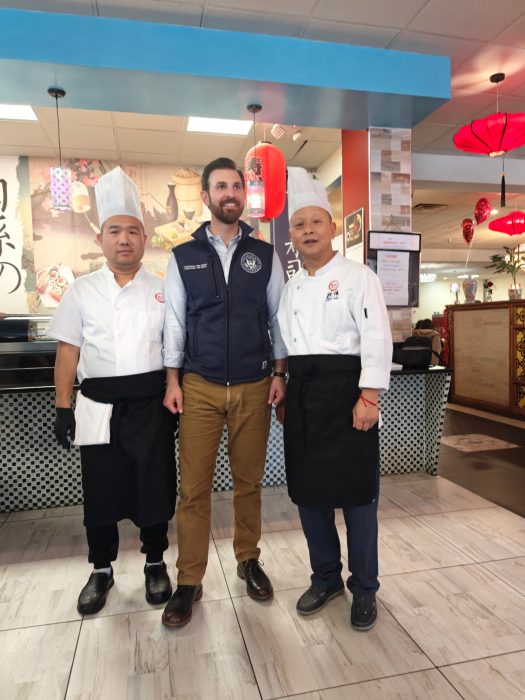
Wei Zhu, owner of Chengdu Gourmet, Congressman Chris Deluzio (PA-17), and Chef Wu. Photo: Aakanksha Agarwal
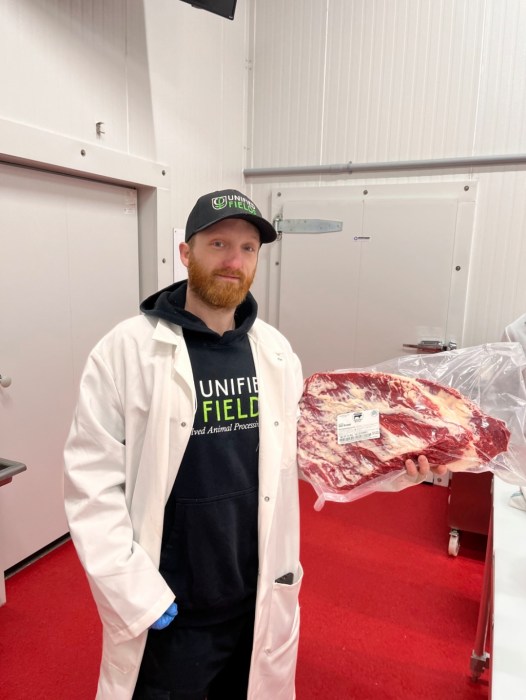
Ben Buchanan of Unified Fields. Photo courtesy Ben Buchanan
The policy question
The roundtable at Chengdu Gourmet also focused on the role of federal policy in helping farmers and restaurants adapt. The conversation comes as Congress continues negotiations over a new Farm Bill, the sweeping legislation that governs U.S. agricultural programs, conservation funding and disaster assistance. The current framework is still based on the 2018 Farm Bill, which lawmakers have repeatedly extended while debating a replacement.
Speakers emphasized the importance of climate-smart agriculture programs that help farmers improve soil health, manage water and reduce climate risks. These programs support practices such as cover cropping, erosion control and conservation planning, tools that can help farms remain productive despite changing weather patterns.
Participants also warned that funding alone is not enough.

Severe staffing losses at the U.S. Department of Agriculture, particularly within the Natural Resources Conservation Service, have made it harder for farmers to access those programs. Without enough staff to process applications and provide technical assistance, programs designed to support climate adaptation can become difficult to navigate.
Industry consolidation also remains a major concern. Buchanan pointed to the dominance of four large meatpacking companies that control most of the national meat supply. That level of concentration gives large corporations significant influence over prices paid to farmers as well as the prices consumers ultimately pay for meat.
“So farmers lose, restaurants lose and consumers lose,” Buchanan said.
Deluzio emphasized that strengthening regional food systems will require both conservation policy and stronger protections for smaller producers.
“Along with helping farmers with soil management and protecting our clean air and water in the Farm Bill, we need policies that promote competition,” Deluzio said. “Enforcers should do their jobs and make sure they’re using the laws on the books to give smaller businesses, farmers and ranchers a fair shot at competing. Giant corporations should face real penalties when they break the law.”
Bykoski said building a more resilient regional food system will require coordinated investment across the “multiple levels of policy involved — federal, state and local,” she said. “At the federal level, conservation and climate-smart agriculture programs need to be accessible and deployed in ways farmers can actually use.”
At the state and local levels, infrastructure investments are equally important.
“We need more investment in the infrastructure that connects different parts of the food system,” Bykoski said, citing regional processing facilities, cold storage and stormwater infrastructure that help communities prepare for extreme weather while strengthening local supply chains.
Pennsylvania has taken steps in that direction through its state Farm Bill, first enacted in 2019. The legislation includes funding for urban agriculture programs, an uncommon policy commitment among states. Since the program launched, Pennsylvania has invested millions of dollars in community-based farming initiatives across the state. The Urban Agriculture Infrastructure Grant Program distributes roughly $500,000 annually to support urban agriculture projects though Hughson said funding levels have remained unchanged since the program began.
Food for thought
Grow Pittsburgh’s Hughson said urban agriculture is increasingly viewed as a resilience strategy when it comes to climate change.
“Urban agriculture isn’t just about food access,” Hughson said. “In many ways it’s also about national security and resilience.”
According to Shaffer, “the question shouldn’t just be how climate change is affecting restaurants,” she said. “The real question is how our industry is contributing to climate change.”
Rethinking sourcing, packaging, agriculture and waste, she said, will be necessary if the hospitality industry wants to become part of the solution.
Buchanan said rebuilding local food infrastructure is a critical step toward strengthening regional food systems. In his view, each part of the food chain depends on the others. Farmers raise animals, processors transform them into food and consumers ultimately sustain the system through their purchases. When one link breaks, the disruption ripples across the entire network.
For that reason, Buchanan believes that “ smaller regional networks are often more stable than highly centralized systems that rely on long supply chains.”
Bykoski said that a lot of times the connections between different parts of the food system get lost. “Some people work on policy, others focus on regenerative agriculture, and others are focused on running businesses. But everyone eats. That makes food a powerful connection point. Helping people understand the challenges businesses face, as well as the opportunities within the food system, creates a much stronger connection.”
Patel emphasized that consumers also shape the future of regional food systems through everyday choices. Supporting local businesses, she said, helps strengthen the neighborhood economies communities rely on.
“When you spend your dollars, you’re showing what you support and what you believe in,” Patel said.