
Newswatch 16’s Jack Culkin spoke with an Irish historian about the importance of the day that many here celebrate year-round.
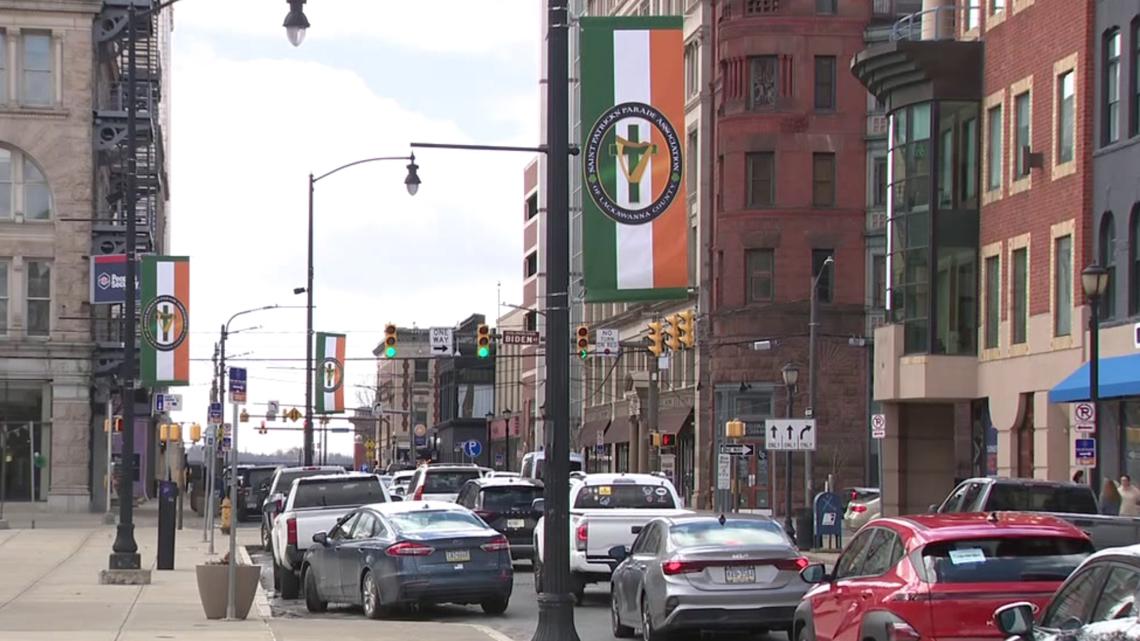
DUNMORE, Pa. — Irish cheer is in the air as displays of green, white, and orange can be seen on poles, draped over buildings, and outside of homes in communities across Lackawanna County.
“If you take a look at the census demographically, Lackawanna County ranges anywhere from 28, about 28.9 percent, as high as 33 percent of the population claims some degree of Irish lineage,” said Gary Duncan, Irish Historian
At his home in Dunmore, Gary Duncan’s shamrocks never go away.
Serving as a historian for several Irish groups across the area, Duncan is well-versed in the story of the Irish people’s journey to make places like Lackawanna County their home. “Remember in Ireland, you were denied the right to read and to study and to practice your own religion. America gave us all of that, northeastern Pennsylvania gave us all of that and then some because it’s here that we moved up through the ranks,” he said.
From the large immigration wave of Irish coming to the northeast following the 1860s to one of the largest labor strikes that occurred right here in Scranton, and is commemorated by a statue of John Mitchell, Irish roots run deep in our area.
“We’re a third of all of the ethnicities in northeastern Pennsylvania. We had the largest presence of the Irish miners here, and that was for decades up until the end of the anthracite coal industry. Of course, we’ve also segued. We’ve had the Sisters and Servants of the Immaculate Heart of Mary, the religious Sisters of Mercy, which started at the hospital, which used to be the Mercy Hospital in Scranton, of course. The Sisters and Servants of the Immaculate Heart of Mary are really largely responsible for the development of the parochial school education in northeastern Pennsylvania, starting as far back as the first Catholic church in northeastern Pennsylvania, which was Nativity Church, which was over in South Scranton,” said Duncan.
So whether you find yourself taking in the sights and sounds of Irish-themed parades or raising a glass in a local tavern, shouting the word sláinte, Duncan urges those celebrating the holiday to remember those who came before. “Language of my parents, my ancestors, your ancestors, Lá Fhéile Pádraig, which in the Irish means Happy St. Patrick’s Day to all.”