
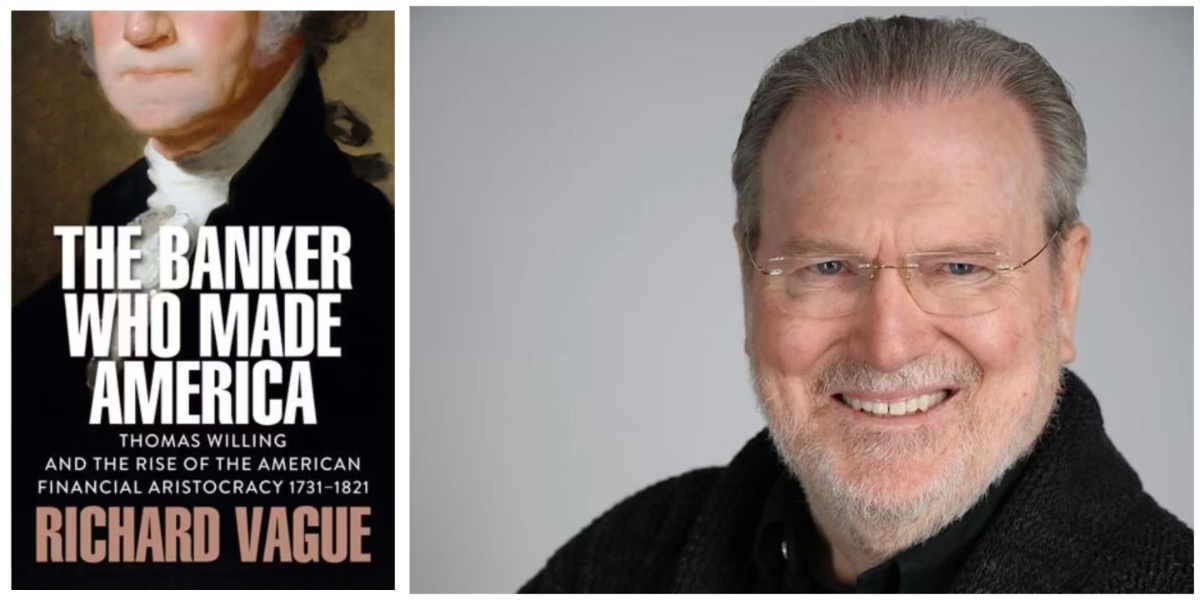
Never heard of Thomas Willing? Philadelphia author and thought leader Richard Vague hadn’t much, either, until he started looking into the 18th century banker and pre-, during and post-Revolutionary War-era power broker. In telling Willing’s untold story, Vague traces a bridge between two centuries, from colonial times to the Industrial Revolution, points to the rise of an American aristocracy, and introduces us to the fascinating man — and Geroge Washington doppelganger — who built that bridge.
Join Vague and Philadelphia magazine Editor Christy Speer Lejeune on April 14 from 6:30 to 7:30pm at the Fitler Club for a live Q & A with the author about his fascinating new book, The Banker Who Made America: Thomas Willing and the Rise of the American Financial Aristocracy, 1731-1821.
On July 1, 1776, at the Continental Congress being held in the stately building we now call Independence Hall, Pennsylvania delegate Thomas Willing cast a vote against independence.
In the stifling heat of that day, the Congress was meeting as a “committee of the whole” to take a preliminary vote on the question of independence in advance of the official consideration. Opinions ranged from a passionate endorsement to adamant resistance.
Willing, one of seven Pennsylvania delegates in attendance, was the very wealthy head of the state’s largest merchant trading firm and a towering presence — in Congress, in Pennsylvania, and in colonial life. Given his stature, Willing’s influence helped sway their collective vote against independence, four to three. South Carolina joined Pennsylvania in voting no, Delaware’s delegation was locked in a tie, and New York abstained.
Although the measure had passed and the question of independence would now advance to the full Congress, delegates who supported the measure realized uneasily that only nine states had voted yes — and given Pennsylvania’s large size and its location as the geographic linchpin of the states, it was inconceivable to declare independence without it. The tension was magnified by the alarming news that a large British fleet had just arrived at New York, where General Washington’s army was camped.
The prospect of a stalemate loomed. As the delegates scheduled the formal vote for the next day, they faced an anxious evening of persuasion and debate.
Most likely, Benjamin Franklin did much of the persuading deep into that night, and specifically with Pennsylvania delegates John Dickinson, an unwavering Quaker who categorically opposed war, and Robert Morris, who was Thomas Willing’s business partner and a fellow member of the very small and tight-knit community of Philadelphia’s merchant elite, all of whom had deep commercial ties to Britain. Whatever Franklin’s arguments might have been, both Dickinson and Morris chose to absent themselves from the next day’s vote.
But Thomas Willing did not absent himself. On July 2 he was present and cast another “no” vote, though it was not enough to change the new outcome.
Because with those two abstentions, Pennsylvania’s vote turned in favor of independence by three to two, and with the two smaller states now also both a yes, the momentous declaration of independence passed with twelve votes for, none against, and New York again abstaining (but adding its assent soon after).
…
With his fateful vote, Willing had consigned himself to an undeserved obscurity in early American history. As I learned more about Willing’s extraordinary life, I found myself mortified on his behalf when I learned of his votes against independence — in retrospect, a seeming act of
heresy at America’s most sacred moment. My curiosity pulled at the thread of that no vote until the story familiar to me about that vote gradually unraveled into a new one. This vote came in the throes of a virulent internal political class war in America that unfolded alongside its war with Britain. Thomas Willing’s life and times — and his vote against independence — opens up a much larger story of these two wars, which together profoundly set the course for the new United States.
But even as Willing cast his votes, he and his business partner Morris were supporting the Revolution in a more tangible and imperative way: they were financing it. And often on nothing more than their personal wealth, credit, and reputations. They were taking the lead and the risk in supplying much needed arms, gunpowder, and funds to the Revolution, likely saving it in its earliest and most perilous months.
This new book about Thomas Willing, unlike most books related to the American Revolution, “follows the money” — since money and debt (and who controls them) are the Archimedes levers that move the fate of nations. And yet this is the dimension of the American Revolution that has largely been overlooked.
Stated simply, Willing was the most powerful figure in early American history that you’ve likely never heard of. He was America’s dominant merchant and banker through the Revolution and the earliest days of the Republic and stood at the very heart of America’s founding financial elite. This elite’s political and economic clash with an emerging class of the so-called “middling and lower sorts,” terms widely used in that era, along with their creation of a new financial system for the young nation, profoundly shaped American history.
Pugnacious President John Adams would complain that “[George] Washington and [Alexander] Hamilton, with all their Understrappers Tools, Satilites and Puffers, were in the Way: all governed by Willings and Chews and Bingham and Yard” — an extended and powerful group that Thomas Willing dominated. Adams had often protested that Washington was unduly swayed by Hamilton, but here he made a more startling claim: that for all their influence and power, both men were under the sway of — nay, governed by — Thomas Willing and his associates. Adams viewed their wealth and influence — embodied in the two banks Willing helped create — as the epitome of a threat to democracy, fretting that Willing and his son-in-law William Bingham would “get possession of all Pennsylvania” through their extraordinary riches. This, after the country had just won its freedom from the King. “A banking Aristocracy,” Adams lamented, “is not better than any other Aristocracy.”
…
Willing and those in his orbit resisted American independence, and then they bankrolled it. They were crucial to financing a revolution of democratic and egalitarian ideals, and then they inscribed their financial self-interests into the new nation’s founding documents. They built their own wealth, and then they built the nation’s, because they accomplished one vital thing: they brought a finance and banking revolution to America that bridged the political revolution of 1776 and the industrial revolution of the 1800s.
Along the way, Willing and his ensemble gained, expanded, expended, and occasionally lost their fortunes; speculated on land; built the new republic’s largest homes; intermarried to consolidate power and riches; and forged America’s first culture of wealth with all its riveting scandals and celebrity.
 DIVE INTO MORE BOOK EXCERPTS
The Banker Who Made America: Thomas Willing and the Rise of the American Financial Aristocracy, 1731-1821, and author, Richard Vague.