
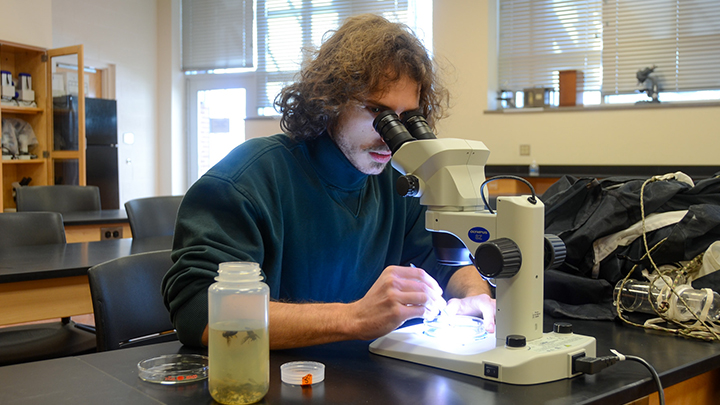
With flying insect populations rapidly declining around the world in the last decade, researchers at Slippery Rock University are taking the lead to identify the causes in western Pennsylvania.
Cory Shoemaker, SRU associate professor of biology, and Christian Mitchell, a senior biology major from Brownfield (Laurel Highlands HS), are at the forefront. After Shoemaker and Mitchell started collecting and assessing insects using traps last summer, they’ve been preserving and examining their samples in a lab at SRU during the school year.
“When the sun’s beating down on you and you’re on your third trap, and trying to work with poison ivy all over your hands, fighting through the heat, it gets a little rough, but the end goal is worth it,” Mitchell said. “That’s what’s been at the forefront of my mind, just getting the data and getting the answers to the questions I’ve been asking.”
Together, the pair are cataloging how insect populations differ across site types in the Slippery Rock area. This research will set a baseline reference for insect research, known as entomology, for years to come.
“We’re in the sorting stage of the project where I’m identifying all of the specimens that are present within each of the traps,” Mitchell said. “Then we’re going to be doing statistical analyses of those later on to determine the population dynamics in the different areas around Slippery Rock.”
“If you don’t have that baseline, you don’t know what’s changing over time,” Shoemaker said. “This research will benefit future generations of people who may want to know what the insects here were like in the past.”
Traps set in wetland, grassland, forested and developed areas like the Macoskey Center or the disc golf courses behind campus residence halls were most productive for Mitchell and Shoemaker.
Factors like changes in climate or loss of habitat lead to global declines in bees and wasps. While Mitchell had expected the more environmentally diverse locations to have a higher concentration of flying insects, research proved that developed areas on campus are home to more bugs than primarily natural sites. Mitchell served as an ecology intern at Powdermill Nature Reserve in Rector, Pennsylvania. The research methods he brings to his current study come from experience with Powdermill’s entomologists as part of the Carnegie Museum of Natural History.
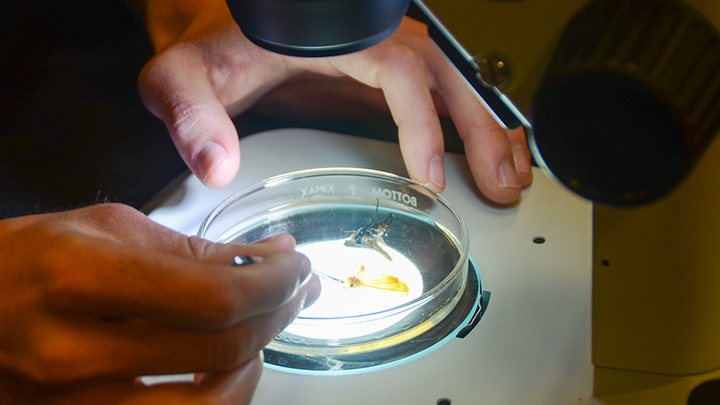 SRU researchers are assessing insect samples and preserving and examining them in the lab at Vincent Science Center as part of a study to examine the causes of population declines.
SRU’s biology courses brought Mitchell to Shoemaker, who allowed him to expand his understanding and experience in the small, highly specialized field of entomology.
“Innate curiosity is an amazing aspect in a scientist, and Christian has that in spades,” Shoemaker said. “He sees the world around him, asks questions, goes down the rabbit holes and starts to see the world around him in a different way.”
In a practical sense, Mitchell is gaining high-quality specialty experience in a hands-on manner that applies directly to his career aspirations. His faculty mentor sees this work as a promise to scientific advancement beyond the conclusion of the study.
“The purpose of science is to leave the world better than you found it, and people like Christian give me hope because he cares deeply about what’s going on in the natural world,” Shoemaker said.
For more information about the biology department at SRU, visit the department’s webpage.