
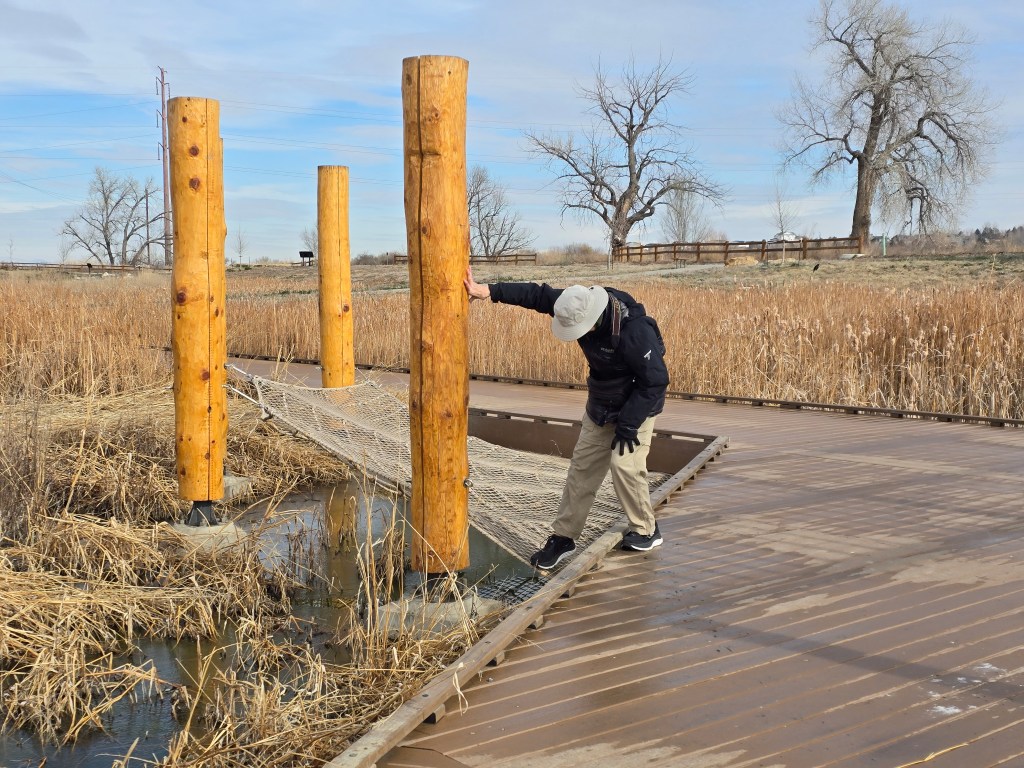
Imaginative play areas and interpretive signs make the Erie Wetlands both fun and educational. Red-tailed hawks soar in the sky. Red-winged blackbirds sing from the cattail marsh. Prairie dogs squeak and throw up their paws as you pass by. And red foxes, raccoons and mink prowl at dusk. It’s a marsh-mellow place.
A few days ago the area was mainly brown, but it’s beginning to green up. We could smell blue mustard, see a distant great-horned owl on a nest, and hear a Virginia rail. Spring is on the way.
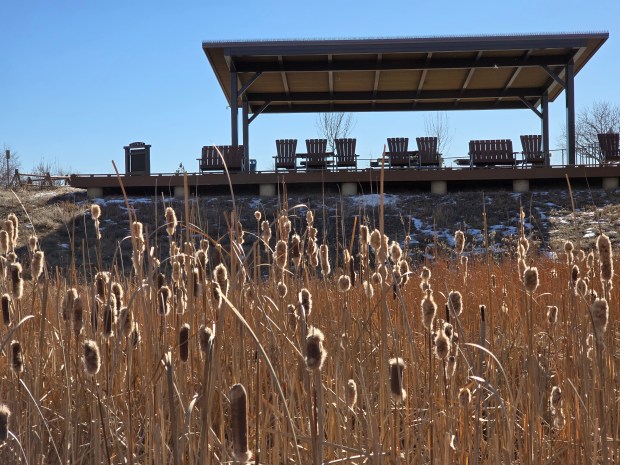 A covered pavilion provides a place for an overview of the Erie Wetlands. (Ruth Carol Cushman)
The town of Erie has transformed a defunct water treatment facility into a 10-acre wetlands park adjacent to Reliance Park and the Recycling Center at 1000 Briggs St. These constructed wetlands not only provide recreation, but they also provide flood mitigation and help filter out pollutants from stormwater drained from city streets. One sign calls them “nature’s kidneys.”
To create the wetlands, about 7,000 tons of biosolids were removed. The area was reseeded and planted with wetland plants, trees and shrubs, and a half-mile, wheelchair-accessible trail was constructed around the lagoons. After two years of work, the wetlands were opened to the public last October.
Comfortable chairs under a pavilion provide a place to sit for an overview of the marsh, and picnic tables provide a place for lunch. The loop trail begins at the first interpretive sign near the pavilion. We like to do it in a counter-clockwise direction with the lagoons on the left and Coal Creek on the right.
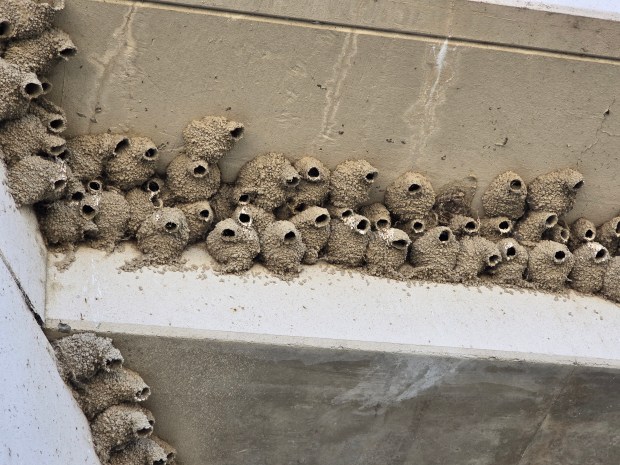 Dozens of cliff swallow nests festoon a bridge near the Erie Wetlands. (Ruth Carol Cushman)
Enroute you’ll pass several large seating areas for classes as well as many rocks that invite you to sit and do some bird watching. About halfway along the trail, a boardwalk crosses the marsh to the west side enabling you to make a very short loop or a figure eight walk. This cross-over trail takes you into the very heart of the marsh. Near the east end of the boardwalk there’s a “climbing web,” a large anchored net that allows children to lie face down just inches from the marsh’s bottom. Even at our age, we were tempted to try it!
Continuing on the main loop, the trail rounds the final lagoon and returns via the west path, passing by the Forebay where storm water from Erie’s streets enters the wetlands. The Forebay collects some trash and looks a bit messy. However, it’s “more than a puddle in a big concrete basin. It’s the workhorse of the wetland” says the sign.
Some plants to watch for are swamp milkweed, rabbitbrush, sedges, blue and sideoats grama, big bluestem and switchgrass. On returning to the parking lot, stop by the Rain Garden for more information on how water is purified by plants, bacteria, and soil.
If you want to extend this very short stroll, cross the bridge over Coal Creek to Reliance Park. Double-back underneath the bridge to Coal Creek Trail and head south. Dozens of cliff swallow nests are attached to the bridge, and oriole nests dangle from the cottonwoods. We plan to return in May when those birds return. A sign with a map of Erie trails says that it’s nine minutes to Coal Creek Park and 12 minutes to downtown Erie from the bridge. Actually, you can follow Coal Creek Trail for 14 miles all the way past Flagg Park and Stearns Lake to Superior. Future plans call for extending the trail north to Weld County.
Ruth Carol and Glenn Cushman are the authors of “Boulder Hiking Trails,” available on Amazon.