
The banner fastened to the fence outside Overbrook Elementary speaks volumes.
“Small School, BIGGER IMPACT!” the sign reads.
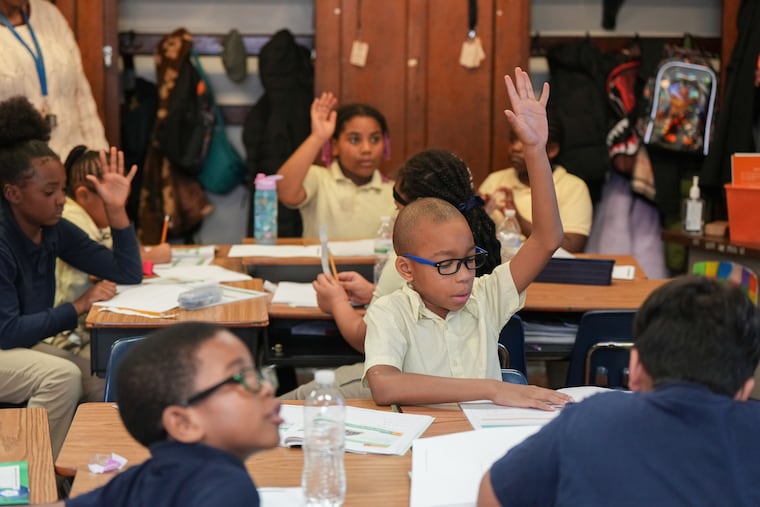
Overbrook Elementary, its supporters say, is a place where families walk their children to school, staff know every child’s name, and volunteers from the neighborhood routinely show up to lend a hand. It educates about 200 kindergarten through eighth graders — one class per grade.
But Philadelphia School District officials have proposed closing it as part of a $2.8 billion facilities plan that would shut 18 schools, co-locate six others, and renovate 159.
If the school board ultimately endorses Superintendent Tony B. Watlington Sr.’s recommendations, Overbrook Elementary would shut permanently in 2027, with its students scattered to four schools: Barry, Bluford, Cassidy, and Heston.
A core group of Overbrook supporters — community members, parents, alumni, staff, and students — have coalesced to fight the district’s plan. They’ve pored over data, created charts and counterproposals. They’ve called meetings, printed T-shirts, and talked up the school. They’re also highlighting a $500,000 private investment that was set to improve the school’s schoolyard and is now in jeopardy due to the proposed closure.
Unlike many other schools on the closure list, most of Overbrook’s small space is in use. But the building, at 62nd and Lebanon in West Philadelphia, was judged by the district to be in poor condition. It was also rated as having poor program alignment — the system’s measure of whether a school can offer adequate modern educational experiences. Overbrook has no auditorium, cafeteria, or gym.
Kathryn McQuade, a veteran district art teacher, came to Overbrook two years ago and was immediately wowed by the “culture of respect” at the school.
“I’ve experienced other buildings,” McQuade said. “I would much rather be at a school that maybe needs a few repairs and physical investments — and let’s be honest, they all need that — than a school that doesn’t have the love and community that Overbrook has.”
Watlington, introducing his facilities plan, said he knew proposed closings would bring pain, but changes are a necessity in a historically underfunded school system that has 70,000 empty seats.
He suggested keeping 200-student schools in small, outdated buildings was no longer possible.
“We must find ways to more efficiently use all of our resources so that we can push higher quality academic and extracurricular programming and activities into all of our schools across all the neighborhoods of Philadelphia,” Watlington said in January, “while at the same time addressing under and over-enrolled schools.”
‘Why do they want to send us to those other schools?’
Overbrook sixth grader Aveyon Scott is acutely aware of what his school is up against.
Aveyon has studied the numbers. He found that attendance, serious incident, and utilization rate numbers are all better at Overbrook than most of the schools students would attend instead. So are math and reading scores, though district officials have said student-based metrics like test scores, attendance, and incidents were not a part of the decision-making process.
“Our school is a good school with good students,” said Aveyon, 12. “Why do they want to send us to those other schools that don’t do as well as we do?”
Debra Joell, Aveyon’s teacher, is now weathering the third attempt to close Overbrook in her 25-plus years working at the school. It survived the first two, but she worries about the outcome of the decision now in the school board’s lap. (No date has been scheduled for a board vote, but it’s expected this spring.)
Joell, who teaches English and social studies to fifth and sixth graders, said she worries about the district creating an “educational desert” and threatening the character of the leafy neighborhood, which she described as “beautiful, family-oriented, excellent, powerful.” The school system has proposed using Overbrook as learning network offices after the school closes.
“No disrespect to any of the other schools or neighborhoods,” Joell said, “but people are trepidatious about crossing neighborhoods, having kids walk a mile to some other place. Our children deserve to grow up here.”
Speaking to the board at a town hall on the closures earlier this month, Joell called the district’s plan for Overbrook “irresponsible, insensitive, traumatic, tragic.”
State Rep. Morgan Cephas (D., Phila.), who represents the area surrounding the school, noted that elected officials helped find nearly $20 million for Overbrook High for significant repairs there, “so we cannot say if it’s infrastructure problem that we can’t find the resources to help.”
A request to help improve Overbrook Elementary’s building as an alternative to closure, Cephas said, “was never made — and as elected officials, we need to have that conversation before you disrupt a community, a set of families.”
Closing Overbrook would also jeopardize a community development project worth half a million dollars, said Cephas — the Trust for Public Land had planned to invest heavily in the school. It’s already spent nearly $100,000 in a project to create a new, student-designed schoolyard at the school.
“We’re literally potentially losing a half a million dollars worth of an investment as a direct result of the decision that you all are talking about,” Cephas said at a February meeting. “I would like to communicate to the community this is absolutely unacceptable.”
Logan Peterson, a project manager in the superintendent’s office, addressed the Trust for Public Land project at a district meeting, saying that he appreciated the nonprofit’s partnership. Because Overbrook will remain a district property, he said, “those investments will continue to be available to the community.”
Elizabeth Class-Maldonado, Trust for Public Land’s Pennsylvania director, said the schoolyard project is on pause at the moment because of the uncertainty.
“We’re still committed to creating a public space that is beneficial for the community,” Class-Maldonado said, “but we haven’t had final discussions if [what had been planned for Overbrook] is going to be another location at the school district, or anything else.”
Center of the community
Rhemar Pouncey has sent children to multiple West Philadelphia schools.
“But I never walked into a Philadelphia public school and not had to worry until my grandson started at Overbrook Elementary,” said Pouncey, whose grandson Nathen is a current first grader. She said she fears what would happen if Nathen, who requires special-education services, were forced to leave the school that’s helped him come so far.
Pouncey said the district “is using the kids and our schools as scapegoats to fix their bad decisions,” she said.
Fahmee Shabazz transferred his son to Overbrook from Heston, and is angry that the district “is making decisions about closing our schools and sending our children elsewhere,” Shabazz said. “Our children should be allowed from kindergarten to eighth grade and graduate as a family from that school.”
Gregory Allen, an Overbrook Elementary alum, educator and the current CEO of the Overbrook West Neighbors Community Development Corporation, questions the wisdom of investing into other schools — including Heston, which is currently rated “severely underutilized” by the district — but not Overbrook Elementary.
“Overbrook Elementary,” Allen said, “is the center of this community.”