
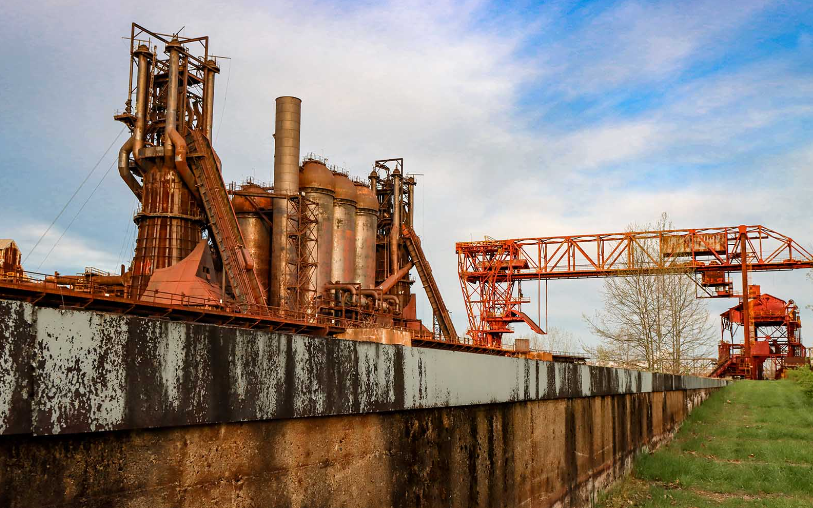
Carrie Blast Furnace is both a mausoleum and monument to Pittsburgh’s industrial history, but for the better part of two decades, the employees of Rivers of Steel — the arts and culture nonprofit charged with the site’s care — have wondered who, exactly, Carrie is.
“There’s a practice among wealthy industrialists … to give their businesses women’s names — or to name particular areas of their business after women in their family — because it’s a way to quite literally name them on the property records to help establish a continuous ownership just in case somebody happens to die,” says Kirsten Paine, Rivers of Steel museum education and historic interpretation manager.
Jones and Laughlin Steel’s Eliza Blast Furnace was named after James Laughlin’s wife. Spang, Chalfant & Co.’s Isabella Furnace in Etna was named after Isabella Herron and Isabella Crowther — an owner’s sister and the lead engineer’s daughter, respectively.
The Carrie Furnace Co. was opened in 1884 by H.C. and W.C. Fownes, but neither had daughters or wives, nor was “Carrie” their mother’s name.
In 2023, Ron Baraff, Rivers of Steel’s director of historic resources and facilities, was researching early references to the Carrie Blast Furnace company on newspapers.com.
Buried in a short article announcing the furnace’s opening from Feb. 29, 1884, was a short sentence: The furnace was named “in honor of Miss Carrie Clarke who lit the fires and performed other baptismal services.”
The team scrambled to put together a brief biography over the next four days. Carrie was the daughter of William Clark — a notorious, union-busting industrialist who was also the Fownes brothers’ uncle.
Since then, Rivers of Steel has gathered more information on Caroline Clark. Today, March 19, 2026, would be Carrie’s 163rd birthday. Paine recounts her life.
“Her story is incredible,” Paine says. “It’s made more incredible because her identity was missing for so long, and because we’ve been able to restore it to the record.”
Who is Carrie?
Carrie’s father, William Clark, is most prominently known as the owner and operator of Lawrenceville’s Solar Iron Works, which primarily made iron hoops for barrels and decorative iron pieces.
“ He had a reputation for being pretty cutthroat as well as being pretty successful,” Paine says.
Caroline was his third child, but first daughter. For an upwardly mobile middle-class family, she was held to lofty expectations: Learn to manage the family and its wealth; preserve its image among Pittsburgh’s elite; and marry for the family’s social advancement.
In 1878, she went to Vassar College — Yale’s sister school. Paine says the move embodies the hopes and expectations the Clarks had for Carrie; they could have sent her to Bryn Mawr College, another traditionally women’s school that is much closer to Pittsburgh, but they opted for the more expensive and preeminent option.
Carrie would have graduated in 1883 or 1884, but was brought back to Pittsburgh in 1881 to become the Clark family’s public face, so to speak. She arranged appearances at social events, attended and managed the family’s public persona and wealth.
By 1884, the Clarks were among Pittsburgh’s industrial elites.
At the same time, local manufacturers from iron to steel production were in pursuit of higher profits for the stronger material. But few, Paine adds, recognized that iron was still integral to steel production.
Carrie Clark’s cousins, H.C. and W.C. Fownes, took a bet on iron, hoping to profit off the city’s biggest corporations. Homestead did not have blast furnaces, which meant that the Pittsburgh Bessemer Steel Co. — which would later be bought by Andrew Carnegie and become Homestead Steel Works — would be buying iron from the open market.
The Fownes’ would be that market.
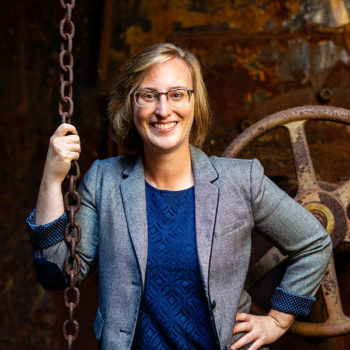 Kirsten Paine. Photo courtesy of Rivers of Steel.
“[The Fownes Brothers] understood the socioeconomic condition of Pittsburgh so completely that they, instead of exploiting the working class people by taking all their money, … took all of the money from the rich people.”
They found a plot of land along the Monongahela River just outside of Rankin and built their blast furnace. Who better to run the iron operation than their uncle, William Clark?
“ [Clark] had been in the business for such a long time, and he had an excellent reputation,” Paine says. “He had all the right friends in all the right places, and he was absolutely the right person to bring in to run the company.”
“ We don’t really know exactly the reasons why, but I think it stands to reason that Carrie is their closest female relative with a stake in the company, in that William Clark was coming to run it.”
But even though a major industrial and historical site bears her name, her less direct attachment to the furnace company’s owners would contribute to her fall into obscurity.
Marriage surrounded by death
About six months after the Carrie Furnace Co. opened — in August of 1884 — William Clark died suddenly. He had a cancerous growth on his hand, Paine says, and an operation left him with a deadly infection.
Two years later, in November 1886, Carrie Clark married Bartlett Arkell. The Arkell family made their money off publishing in a town called Canajoharie — east of Syracuse — and were entering national politics around the time Carrie married in.
It’s unclear how the couple met, but Bartlett Arkell’s sisters also attended Vassar at the same time as Carrie, which accounts for one potential connection, Paine says. Arkell was also a Yale student; occasional events allowed Yale and Vassar students to mingle.
Paine calls it a textbook Gilded Age marriage and incredibly politically advantageous for the Clarks. But Pittsburgh high society didn’t seem to acknowledge it at all.
“There’s no society mention that we can find of this wedding,” she says. “I cannot stress how much this wedding should have been the social event of the season. It should have been splashed around newspapers in the society columns. There should have been press about this marriage — ‘The eldest daughter of a Pittsburgh industrial family marries son of a New York state politician’ — and there’s nothing.
“It’s purely speculation with no historical evidence or any suggestion of evidence to back it up, but I will say that they got married in November of 1886 and almost exactly nine months after, their son was born. It is possible that they got caught and that it was ‘quick, quick, quick’ to prevent scandal.”
 An early image of Carrie furnaces No. 1 and No. 2 from the the Rivers of Steel Archives. Photo courtesy of Rivers of Steel.
Carrie moved to Canajoharie with Arkell and lived relatively under the radar, but two years later, in November 1888, she died. She was 25.
“We do not know how she died,” Paine says. “We have her death certificate — we got it from New York state … but we got our money back because there’s no cause of death listed.”
It wasn’t uncommon for information like that to be overlooked or neglected in the 19th century, Paine adds. The only way to learn her cause of death for certain would be through a family letter or diary.
Her death occurred around the election of President Benjamin Harrison, whom the Arkell family had befriended with hopes of political appointments. Even though the Arkell family appeared publicly throughout the campaign cycle, Clark remained out of the spotlight, leading Paine to believe she was pregnant.
“It wasn’t something that wealthy people tended to let happen — if you’re pregnant, you kind of stay at home, you stay out of the public eye, you don’t want people to see you,” she says.
‘She’s been here this whole time’
Interestingly, Carrie was returned to Pittsburgh. Her funeral was held in Pittsburgh and she was buried in the Clark family mausoleum under the name “Clark” — not Arkell. Her gravestone reads, “Caroline Clark, wife of Bartlett Arkell.”
“That tells me [the Clarks] had real plans for her and that, perhaps, their plans did not go the way they expected,” Paine says. “But she’s buried right next to her father … which also tells me that Carrie was her father’s right-hand girl.”
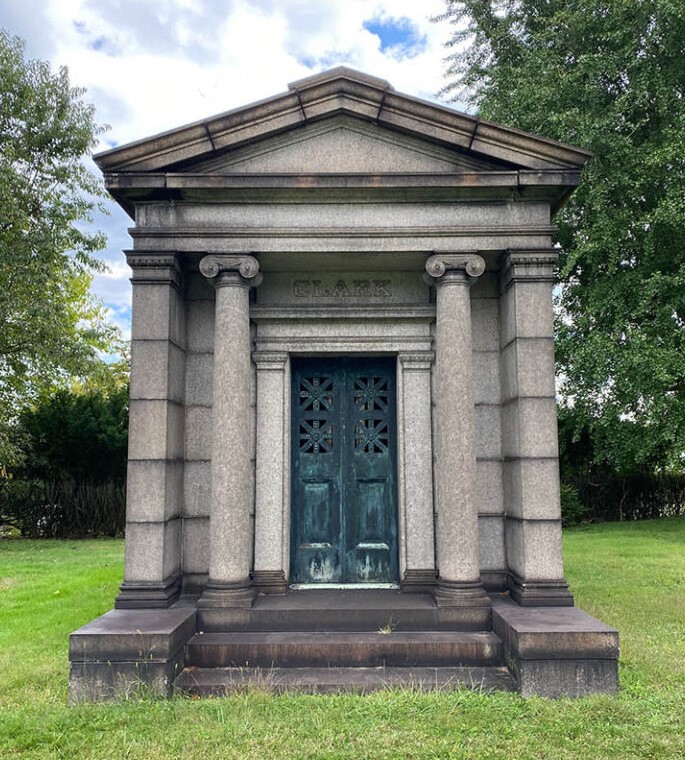 The Clark family mausoleum at the Homewood Cemetery. Photo courtesy of Rivers of Steel.
Ironically, Carrie’s burial as a Clark would further serve to strike her from the historical record, even though the Clark mausoleum is within sight of those for the Kaufmans, Benedums, Heinzs and other Pittsburgh dynasties.
In 1898, the Fownes brothers sold the Carrie Furnace Co. to Andrew Carnegie, severing Carrie Clark’s last familial connection to the eponymous industrial site.
“ They’ve made their money, they’ve proven their point and, quite frankly, they didn’t care about this business anymore,” Paine says.
But the Fownes brothers weren’t quite done profiting off Pittsburgh’s richest citizens.
“They went over to Oakmont and they built the Oakmont Country Club,” she continues. “That’s what they did with the money.”
While Rivers of Steel has essentially mapped out Carrie’s entire life, there’s still one more piece of the puzzle missing: A picture.
“This is a very, very wealthy white woman at the end of the 19th century — there is 100% a photograph of her somewhere,” Paine says. “When you look at Carrie right now, you look at blast furnaces, and blast furnaces are not a human woman.”
Paine says there’s likely a photograph of her in some family record — whether that’s from the Fownes, Arkells or Clarks, she doesn’t know — or within some collection of unlabeled candids at Vassar. So far, Rivers of Steel has had no luck, but that doesn’t mean it’ll never be found.
Finding any information about Carrie Clark has been a practice of fortuitousness, and the fact that her body has been in the Homewood Cemetery — only about 4 miles from the last remaining furnace in Rankin — is proof of that.
“She’s been here this whole time,” Paine says.
“Who knows what else she might have been able to do. Who knows who she might have been. But what we have left is a monument to American industry with her name on it.”