
March 19, 2026 | 5:27 PM
Jaxon White/WITF

I report on how decisions made in Pennsylvania’s state Capitol ripple across communities throughout the commonwealth. My coverage centers on the General Assembly, the Governor’s Office and the broader landscape of Pennsylvania politics.
I’m especially interested in the development and regulation of artificial intelligence, how public officials manage taxpayer dollars and policy ideas aimed at addressing everyday — and sometimes overlooked — challenges.
I grew up just north of Pittsburgh in Beaver County, Pa., and graduated from Bucknell University in 2023. My first reporting gig was at LNP | LancasterOnline as a politics reporter, before I started at WITF in the summer of 2025.

Amanda Berg / Spotlight PA
Pennsylvania State Capitol building in Harrisburg on July 26, 2023.
More people than ever are fighting denials for public records from their counties, school boards and other public agencies in Pennsylvania.
Many appellants are turning to artificial intelligence to help in their efforts.
Liz Wagenseller is the executive director of Pennsylvania’s Office of Open Records, which decides whether to reverse a public records request denied by a government agency. Her agency has seen a “real explosion” of appeals in recent months, Wagenseller said, thanks in part to the spread of AI.
“Around September, we started to see evidence of AI being used in appeals,” Wagenseller said. “If you compare the recent six months to six months a year ago at that same time, there’s been a 64% increase in appeals — an enormous increase.”
AI has become a type of “legal representation” for many appellants, Wagenseller said, but too often the technology is “hallucinating” case law that doesn’t exist or quotes that don’t exist.
Two state senators, Tracy Pennycuick (R-Montgomery) and Rosemary Brown (R-Monroe), have gathered bipartisan support for their proposal to allow agency record officers to deny any requests they believe with “reasonable suspicion” to be written “by a computer program, script, artificial intelligence or generative artificial intelligence.”
Though she said she would want to see lawmakers address “unverified use” of AI, Wagenseller said she wouldn’t want to see AI-use banned entirely from records requests because it has helped many average citizens navigate a complicated process.
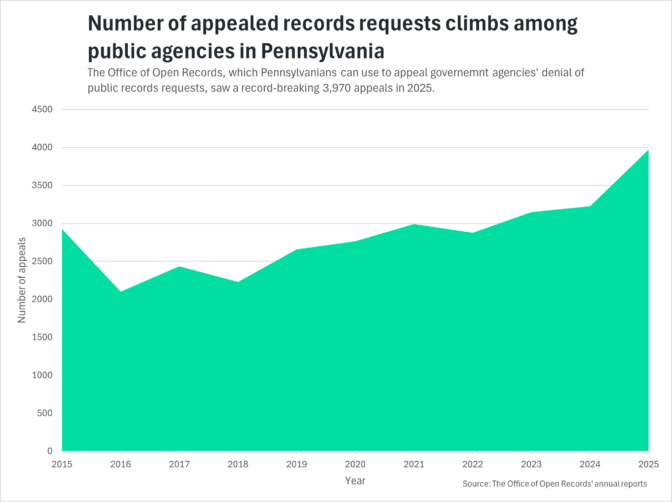
Most of the nearly 4,000 appeals last year were filed by private citizens — not companies or journalists, according to the Office of Open Records’ 2025 annual report.
Some government transparency advocates said the increase in appeals demonstrates a growing knowledge base among the public, but those watchdogs also believe there is much more to be done before reaching true government transparency.
Melissa Melewsky helps journalists with the state’s public records law as the legal counsel at the Pennsylvania Newsmedia Association.
“It’s indicative and encouraging that as more people recognize their right to appeal, that means more people are probably using the law to get to that stage,” Melewsky said.
More than just appeals
Paula Knudsen Burke, an attorney with the Reporters Committee for Freedom of the Press, said there is still a lot we don’t know about the denied requests that were never brought to an appeal.
“It could be untold numbers of people who, for whatever reason, have been denied at the agency level and decide not to appeal,” Knudsen Burke said.
A spokesman for the County Commissioners Association of Pennsylvania said counties collectively receive thousands of requests every year, many of which are completed without the appeal process.
“Many of these requests require staff to locate, review, redact, and compile large volumes of complex data across multiple departments, placing significant demands on time and resources while ensuring sensitive information is properly protected,” the spokesman said, noting some are “overly broad, duplicative, or structured in ways that can delay or disrupt core government functions by overwhelming staff capacity.”
County governments saw the most appeals (705) directed toward them last year, compared to townships (535), school districts (533) or other local government agencies, according to the Office of Open Records.
The county commissioner association is advocating for lawmakers to reform the state’s record law to provide “tools to manage high-volume and bad-faith requests, including clearer standards for overly broad requests, stronger provisions to address vexatious filings, and appropriate cost recovery for particularly burdensome requests.”
Exempt status
Government transparency advocates want to see reforms that make information easier for the public to access.
The OOR found that among the most common exemptions cited by agencies in their denials of requests are for noncriminal and criminal investigative records, and employee notes and draft documents.
Those three exemptions are often vaguely used by agencies, Melewsky says.
“They’re so broad and so broadly applied and interpreted that they really create barriers, significant barriers to accessing even basic information,” Melewsky said.
If Melewsky had her way, lawmakers would allow for some access to records after an investigation closes, like past proposals in the General Assembly to allow access 25 years after it’s complete.
“Many states have some trigger for accessing some investigatory records after the investigation is closed,” Melewsky said. “It’s especially important with regard to non-criminal investigations, especially with regard to public agencies that are in charge of safety.”
Local and state agencies often take a 30-day extension allowed in state law to respond to requests or consider them for legal review.
That rule is often abused by agencies, Knudsen Burke said, to delay responding to requests for documents that should be readily available.
Produced with assistance from the Public Media Journalists Association Editor Corps funded by the Corporation for Public Broadcasting, a private corporation funded by the American people.
Mosaic is WITF’s home for all things arts, culture and lifestyle.
We spotlight and uplift the creators around us, featuring amazing artists, musicians, authors, chefs, dancers, designers, photographers, and more.