
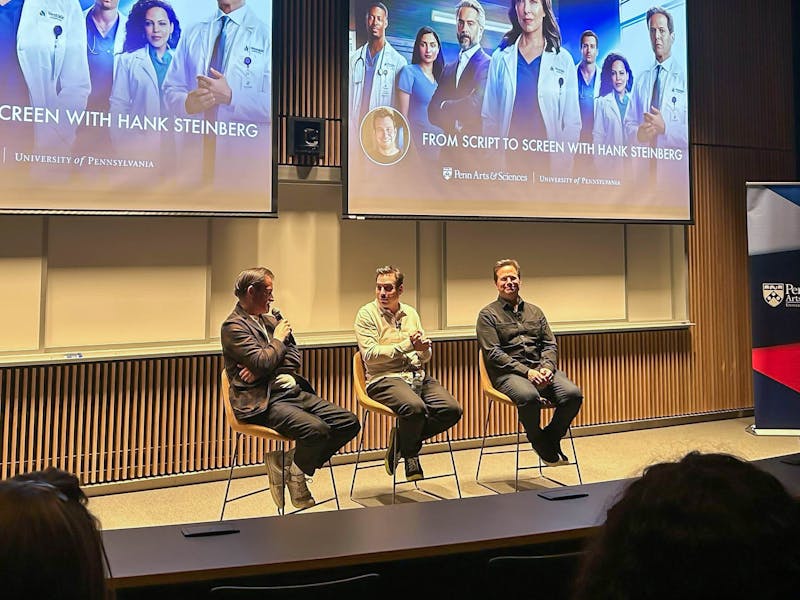
The School of Arts and Sciences hosted a television show screening and discussion with 1991 College graduate Hank Steinberg on Wednesday.
The March 18 event began with a showing of the pilot episode of Steinberg‘s 2025 medical show “Doc,” and included a panel discussion moderated by Cinema and Media Studies lecturer Scott Burkhardt. The display was held at the Perelman Center for Political Science and Economics and included Hollywood advice from Steinberg — who is a writer, producer, and director.
Steinberg discussed the show — an adaptation of Italian series “Doc – Nelle tue mani” — in an interview with The Daily Pennsylvanian.
“There were a few big things that I wanted to change right away,” Steinberg, a former DP staffer, explained.
He described reducing the show’s cast for the American adaptation and focusing on protagonist Amy Larsen’s journey. In the pilot episode, she suffers with eight years of memory erasure following a brain injury.
“We have a much smaller cast, so we can really focus on Amy and the key people around her, and we really keep it focused on her journey, her quest for identity, her memories,” he added. “I thought it’d be much more interesting to see a sensitive, compassionate woman who had a tragedy.”
Steinberg added the Italian version is “quite enjoyable,” but it “only dabbles” in flashback scenes — whereas his version includes flashbacks “every single episode,” which allows the show to operate “on a more psychological plane.”
Actor Scott Wolf, who plays the show’s Dr. Richard Miller, was one of the event’s panelists.
During the event, Wolf expressed that the script was “beautifully conceived and performed” and he had “never read anything that felt so lived in on the page.”
Steinberg and Wolf both emphasized the importance of medical credibility in the show. Wolf explained that actors “have a consultant on set who tells them how to hold your hands and what to do here.”
“We know it’s medically sound because there are people involved that make sure that’s the case,” Steinberg said during the event. “There’s a full time technical medical advisor on set, so anytime we’re doing procedures or even discussing medical cases, he’s there to help out.”
Steinberg told the DP that he developed the “first seeds” of his passion for film while at Penn after taking “a film noir class” that he “really fell in love with.” He graduated as an english major because the Cinema and Media Studies program did not yet exist, but ended up writing a screenplay for his senior thesis.
He also discussed the trajectory of his career during the event, explaining he tried “chasing the marketplace” in Los Angeles after graduation by writing several scripts that ultimately failed to sell.
Steinberg told the DP that he “was going to quit after five years,” but decided to “just write something” that he’s absolutely passionate about. That script ultimately “opened every door” for him.
“It got me my agent, it got me my first two or three jobs, [and] it eventually was optioned by HBO,” he added.
Steinberg and Wolf concluded the event with advice to students interested in a career in film and television.
“My advice is, whatever you’re doing, don’t think about what people want — think about why am I doing it?” Steinberg said.
Wolf acknowledged that the cinema industry is “an incredibly challenging and competitive space,” but told the DP that “if you have enough belief, there’s room for lots of people to tell stories.”