
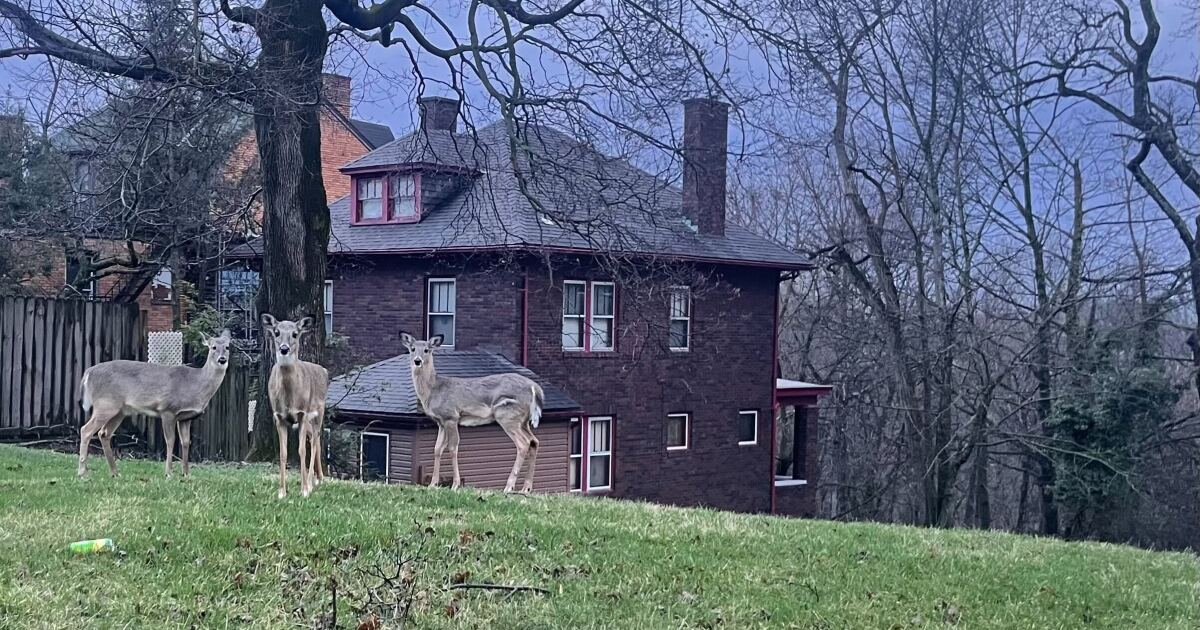
Even in wintertime, hikers don’t have to step off the trail in Frick Park to see telltale signs of deer.
Narrow trees bear the jagged marks of buck rubs, where male deer have dug down into the living layer of the trunk with their antlers. That injury that can kill a fledgling tree, and the understory around the foot of the trees is sparse and meager. Only a few invasive species remain.
“ What our understory currently looks like is pretty bare,” said Pittsburgh park ranger supervisor Erica Allwes on a recent walk through the park. Many of the plants that should be there are probably somewhere in a deer’s stomach, leaving Allwes to point to a few scattered spots where foreign plants like Japanese stiltgrass push up through the dirt.
“ We’re really only seeing the invasive species, or the very deer resistant species,” she said.
The city of Pittsburgh hopes to mitigate such impacts through its deer-management program. The initiative invites archers into some of the city’s parks to hunt deer, with a goal of keeping the population more stable. Marksmen contracted by the U.S. Department of Agriculture also help in selected parks, taking out weaker deer in a process called “targeted harvesting.” The program is now finishing up its third year, with this year’s round of targeted harvesting set to finish by the end of this month.
Deer are native to the region, but they lack real predators in the city, aside from cars and the occasional coyote. And if the population gets too large, Allwes says, there’s a risk of diseases beginning to proliferate. The hunting program aims to manage the population back to more reasonable levels. In Frick Park alone this past season, archers removed 41 deer. Since the start of the program in 2023, a total of 237 deer have been killed through archery and targeted harvesting in the park.
That, said Professor Jeremy Weber of the University of Pittsburgh’s Graduate School of Public and International Affairs, is “a massive amount of deer for what is just a one-square-mile area. It tells you just how extensive the population was before the start of this program.”
Weber has studied Pittsburgh’s program, and the numbers he cites are not the only signs of progress.
After a peak of 583 deer carcasses were picked up by the city after car accidents or other causes of death in 2024, the city picked up 550 carcasses last year. Archers took a total of 142 deer this year, which is 57 less than last year — even though more archers participated in the program this time around, and more parks were open to hunting.
But it can be hard to determine exactly why such fluctuations occur. And the 2025 total is still 200 more deer carcasses than the city picked up in 2016 — a reflection of how the deer population has skyrocketed in the past decade.
And not every corner of the city has seen the same impacts. In the North Side’s Riverview Park, deer continue to present challenges. Archers took only one deer from that park this year – a far cry from the nearly 100 removed by archery and targeted harvesting there last year.
Kate Giammarise
/
90.5 WESA
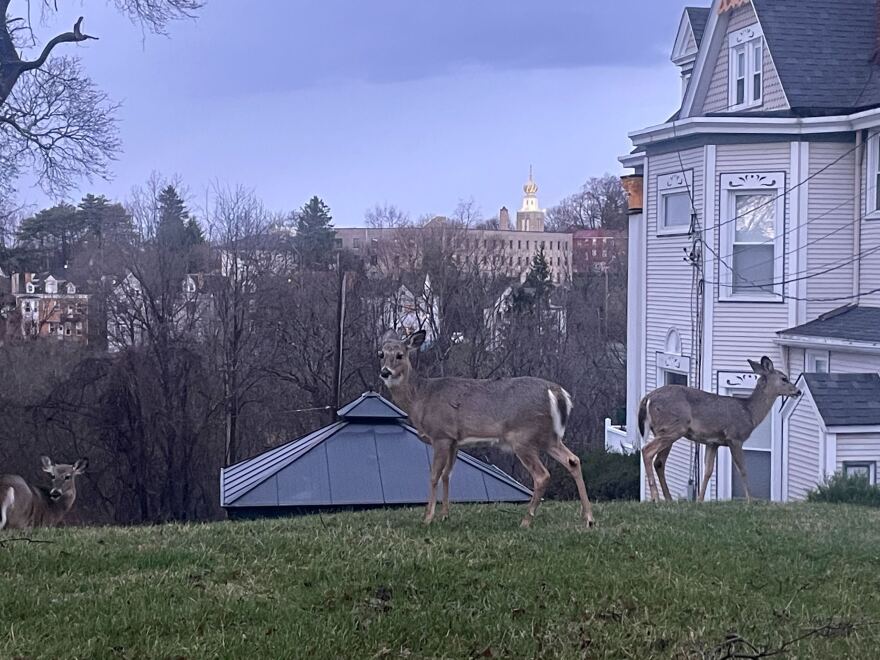
Deer graze in a yard in Pittsburgh’s North Side on March 11, 2026. Riverview Park is across the street.
Mark Masterson, chair of the Friends of Riverview Park, says the lower total isn’t because the deer problem has been solved. Even with the program ongoing, his organization estimates there are between 250 and 450 deer living on the park grounds–eating plants, spreading ticks, running into the road, and even exacerbating landslides through overbrowsing.
“My sense is now we’re seeing deer back in the park similar to what it was two years ago,” he said. “Hiking and walking around in the park and riding through it on my bike, I’m seeing more deer coming back.”
Masterson says previous targeted harvesting in Riverview did have an impact. He hopes to see targeted harvesting return to the park in future years.
“We still need help in Riverview, and hopefully the city continues this program, because I think it makes a difference for all of the parks in the city,” he said. “It’s not something that’s gonna fix itself. It’s gonna get worse if it’s not managed.”
Other Western Pennsylvania municipalities, some of whom have been running their own programs for decades, counsel patience.
Fox Chapel, a wooded suburb just northeast of the city, has been running a deer-management program since 1993, and Officer Don Stoner has been in charge of it for the last 20 years. He says the borough coordinates between landowners and archers who want to hunt deer on their property.
“ The community is unique that we do have a lot of private spaces that people own that can hold the deer – wooded areas, stuff like that on private property,” Stoner said. The borough’s police department also gets a permit from the state game commission to remove additional deer – the local equivalent to Pittsburgh’s targeted harvesting.
Before the program started, Fox Chapel had over 125 reported deer-vehicle accidents annually. Now, the borough sees fewer than 20 per year. Stoner says the early years of a deer management program tend to produce the most marked results.
“ I think you’re gonna see better numbers the first year or two,” he said, noting that he’s heard the Fox Chapel program originally started showing results within the first five years of its existence. “ Once you get to the proper balance, yeah, you’ll start seeing that it’s a maintenance thing.”
Variations from one year to the next can also have an effect on hunting success, Stoner noted.
“ Certain seasons, acorns do better than other seasons,” he said by way of example. “You may have had a park that had a lot of oak trees, so there are a lot of acorns that year [which] gave the hunters a better opportunity,” he said. “Maybe the following year, there weren’t as many acorns on the ground, but the different food sources outside the park drew them outside.”
City Councilor Barb Warwick represents both Schenley Park and Frick Park — two places where deer are often spotted. Schenley is one of three parks that will see targeted harvesting this spring. According to Allwes, the city alternates its targeted harvesting locations to give new areas extra attention.
Warwick says she expects it will take a while to really impact the deer population because the city only started relatively recently.
“ Pittsburgh was way, way behind the curve on this. This is something that we should have been doing long ago, long before our deer population got as bad as it is,” she said. “So it is gonna take us a few years at least to kind of catch up and manage the problem. At this point, we’re really just trying to keep it from exploding even more out of control.”
Weber, of the University of Pittsburgh, says that even when programs remove deer from an area, more deer from the surrounding region will sometimes move in.
“ As you have removals in Frick, for example, deer are going to migrate in and alleviate pressure from other places,” he said. “So it’s kind of dispersing the benefits more broadly. … Frick Park isn’t capturing all the benefits. Some of that is spillover into the surrounding communities that now have slightly less intense deer populations.”
According to Weber, these kinds of programs tend to last for a long period of time.
“This is an issue where you don’t just solve it,” he said. “Anytime you have a large green space where there’s no predators, you’re going to have overpopulation.”
Allwes agrees there’s still a long way to go before the numbers stabilize.
“Our management plan might be a little bit more aggressive than some areas, but these are the first couple years of a deer management program [and] hopefully after that we can just sustain it through archery.
“Deer will continue to populate and reproduce,” she added. “We want to just make sure we stay ahead of it.”