
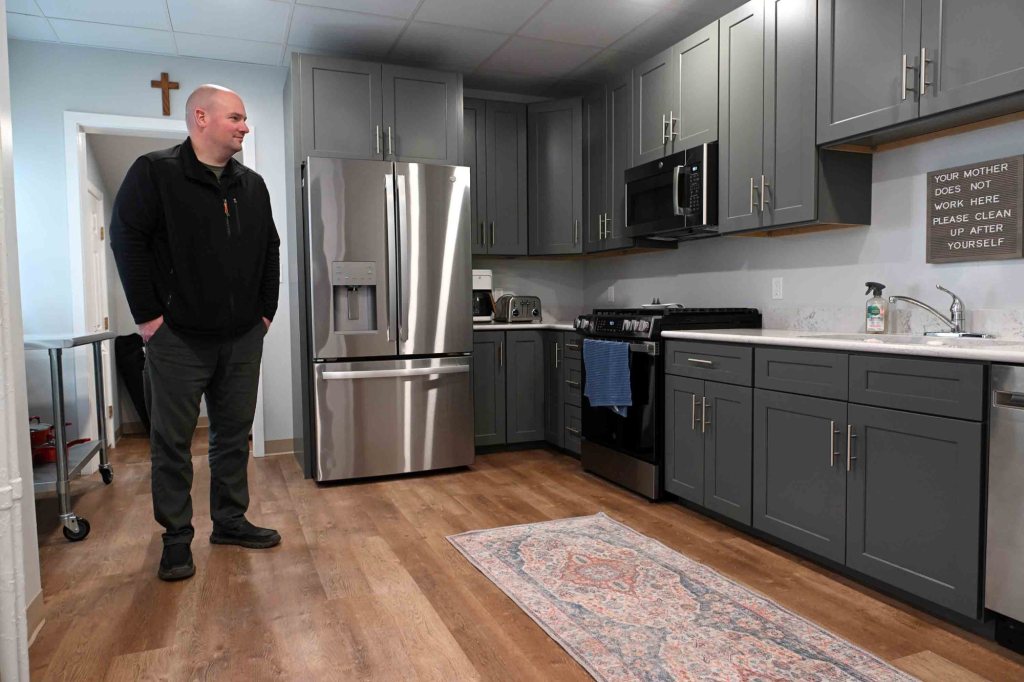
For Navy veteran William “Chris” Price, his move into Hope Rescue Mission’s Hope House is the next step in a long journey through recovery.
“From the background that I came from, through recovery into transition, and now moving forward in life, it’s the next perfect step,” he said.
The facility, 131-133 S. Ninth St., reopened in February after a six-month, $800,000 renovation that transformed two aging row homes into a transitional residence for men graduating from the mission’s main campus at 645 N. Sixth St.
Price, 64, previously lived at Hope House but temporarily moved back to the mission dormitory for about six months while the mirror-image homes on the city’s south side were combined into one cohesive space.
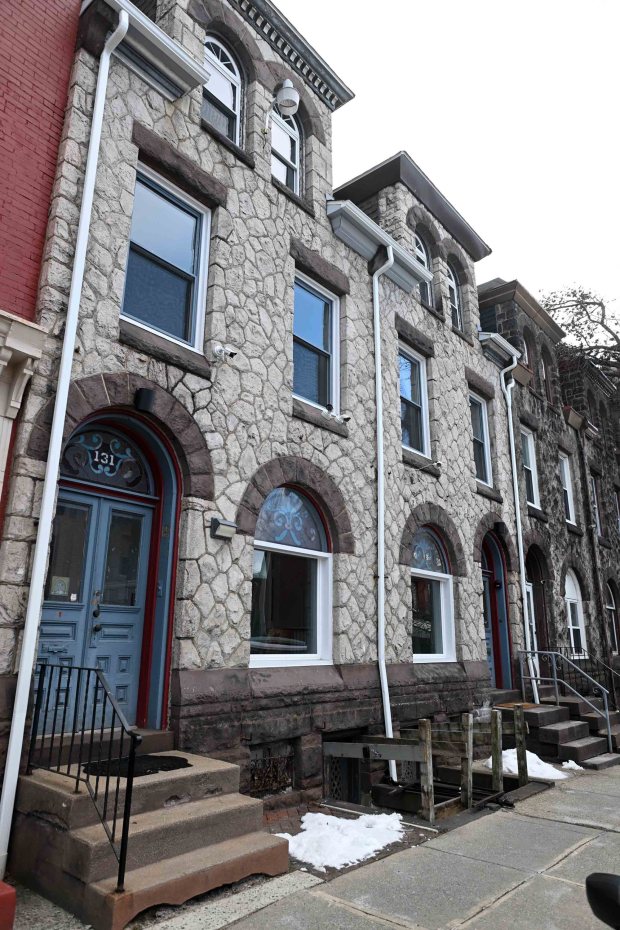 Hope Rescue Mission’s Hope House, 131-133 S. Ninth St., reopened in February after a six-month, $800,000 renovation that transformed two aging row homes into a transitional residence for men graduating from the mission’s main campus at 645 N. Sixth St. (BILL UHRICH/READING EAGLE)
“We just got finished renovating,” said Rob Turchi, CEO of the more than 130-year-old faith-based nonprofit that provides emergency shelter, meals and long-term support for people experiencing homelessness.
Turchi said funding for the project came largely through a grant from Customers Bank, along with private donations.
Kaiser Martin Group of Muhlenberg Township served as general contractor for the renovation, which included new roofs and windows, upgraded heating, electrical and plumbing systems, and a fully ADA-accessible bedroom and bathroom addition.
The finished facility boasts 13 private bedrooms, four bathrooms, two living rooms, a kitchen, dining area, laundry room and rec room. An outdoor patio, grill space and garden are in the works.
Volunteers from local churches, businesses and Reading High School along with area nursing students added the final homey touches inside, helping to paint, clean and furnish the building for occupancy.
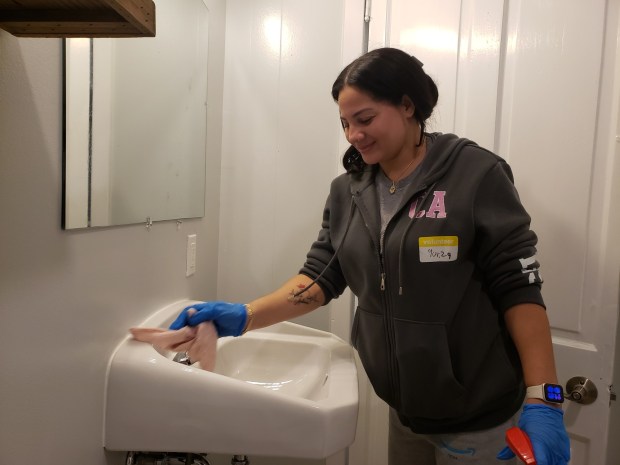 Yuliza Contreras of Legend Truck Body and Premier Fleet Services, Leesport, cleans a bathroom at Hope House in time to welcome 13 residents to the refurbished group home on South Ninth Street. (MICHELLE LYNCH/READING EAGLE)
Like Price, the men who will live at Hope House are not newcomers to the mission’s program.
“They are 13 men who have proven themselves to be in sustained recovery, to be really very stable individuals in our main campus programs,” Turchi said.
The mission’s main campus is designed as a place of restoration and refocus, he said, but not a permanent home. Hope House offers the final stage of transitional housing for men who have demonstrated at least six to 12 months of stability and sobriety.
“They need somewhere affordable to go to,” Turchi said. “So this is all about affordability, but also extending a sense of community.”
Residents will pay a program fee of about $400 a month, covering utilities and continued access to case management, addiction recovery and mental health services.
They will be required to maintain sobriety, keep their rooms clean and participate in the structure that has supported their recovery, Turchi said.
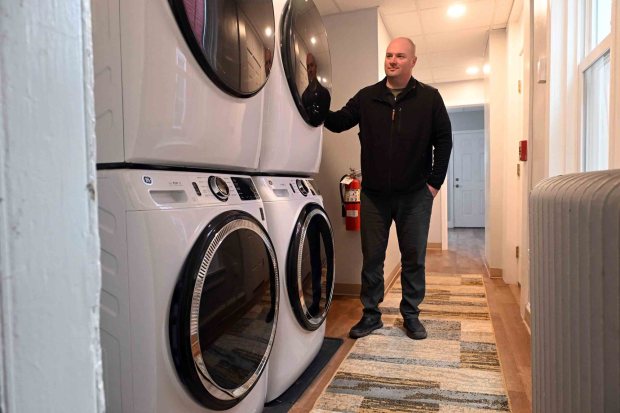 Hope Rescue Mission CEO Robert Turchi looks over the laundry at the mission’s community housing at 131-133 S. Ninth St. (BILL UHRICH/READING EAGLE)
For Price that structure matters.
“It’s a very structured program by design,” he said, “because it’s helping us, the residents there, work ourselves to the place where we are financially independent.”
A Navy veteran who served from 1983 to 1991 in the aviation branch, Price said he came to Pennsylvania in 1999 “as a person at the end of a rope.”
“At that point in my life, I was addicted to drugs and had pretty much burned most of the bridges in my life,” he said.
Despite many career and personal successes, Price struggled with addiction for much of his adult life.
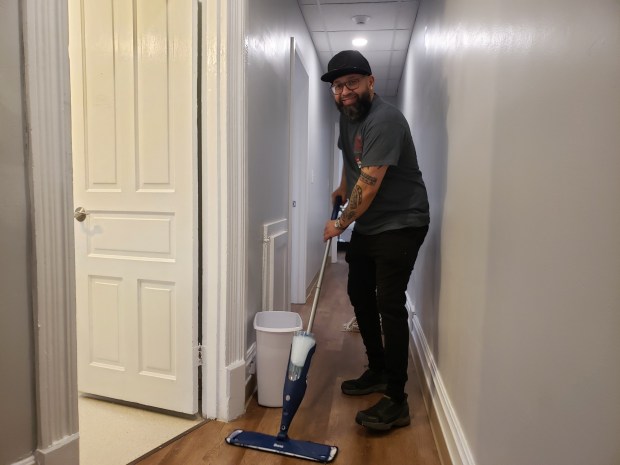 Manuel Sosa of Legend Truck Body and Premier Fleet Services, Leesport, cleans floors at Hope House in time to welcome 13 residents to the refurbished group home on South Ninth Street. (MICHELLE LYNCH/READING EAGLE)
“Recovery is not a once and done thing. Recovery is a lifelong process,” he said. “Recovery is like climbing up a down escalator. It is a constant effort. If you take a rest and pause, you go backwards.”
Over the years, Price said he experienced periods of sobriety followed by relapse.
“I’ve had periods of sobriety followed by falling back after I got complacent, comfortable and lax,” he said. “So now it is an everyday practice to find gratitude, to find support, to find strength, to continue restoration and continue to move forward.”
Price, who is working and planning for eventual financial independence, credits Hope Rescue Mission’s programs with helping him and other clients on their journeys.
He also finds strength in his Christian faith.
“The spiritual part of me knows that I am being renewed daily by the relationship that I have with the Lord,” he said, “and so that gives me promise for hope and for a future.”
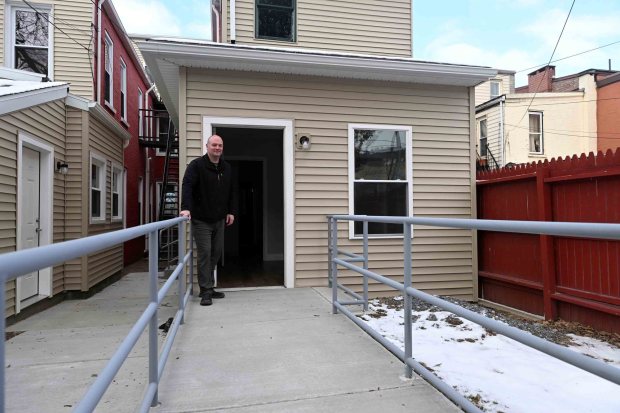 Hope Rescue Mission CEO Robert Turchi stands on the ramp leading to an ADA-compliant bedroom at the mission’s community housing at 131-133 S. Ninth St. (BILL UHRICH/READING EAGLE)
He offered simple advice to others who may find themselves where he once stood.
“Take every opportunity that’s provided, apply yourself diligently, look for ways to be part of the solution and find something to be thankful for every day,” he said.
For men like him, Price said, Hope House represents more than a roof overhead. It is a bridge from crisis to stability, from dependence to independence, from isolation to community.
“It’s absolutely fitting that Hope Rescue Mission and Hope House have the word ‘hope’ as the beginning of their title,” he said. “It’s a place of hope.”