
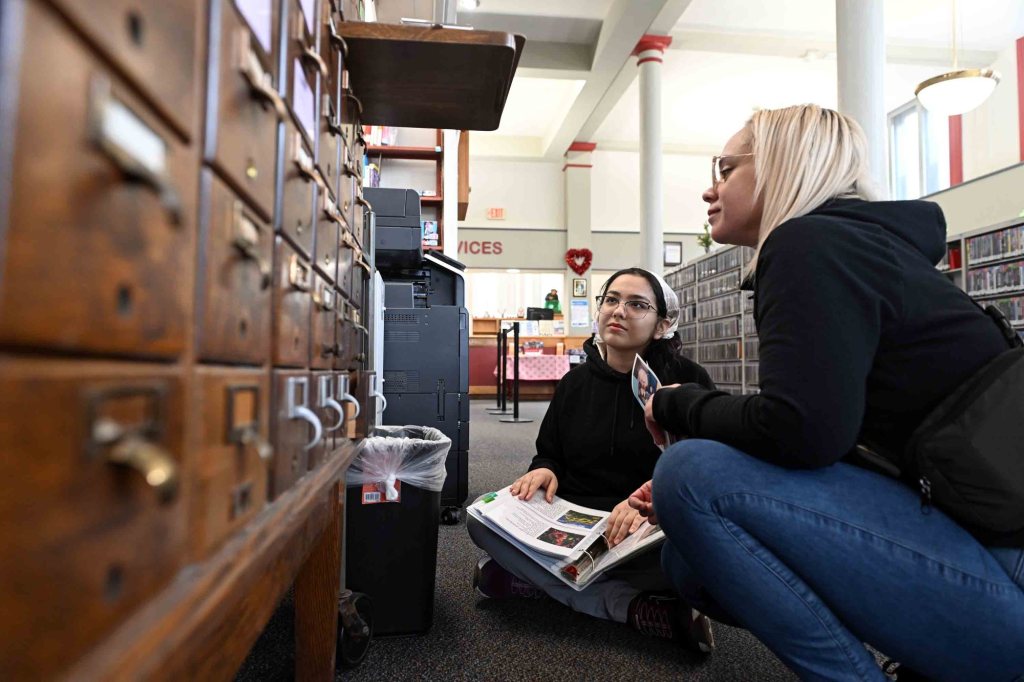
The scene recently in the main branch of the Reading Public Library could have been taken from an old yearbook from the 1960s or ’70s.
Young people sit on the floor clutching notebooks near a ponderous wooden card catalog, gleaning seeds of knowledge from its contents.
Only the updated version is that the card catalog doesn’t contain entries for finding books in the library but actual seeds for planting in city gardens.
Yamileishka Rodriguez and Yahaira Ortiz are the gardeners who visited, hoping to sow and reap a crop of flowers and vegetables from the new Seed Library.
“I love growing stuff, but usually it’s hard to find seeds, and it’s so expensive,” Rodriguez said while paging through a notebook with photographs of the plants that the seeds will yield. “And then when we see this, it’s like, ‘Wow.’ And it’s all categorized, so I can see the pictures and then see what I can try to grow.”
For Ortiz, it’s keeping the family gardening traditions alive.
“My mom and grandmom always had plants,” she said.
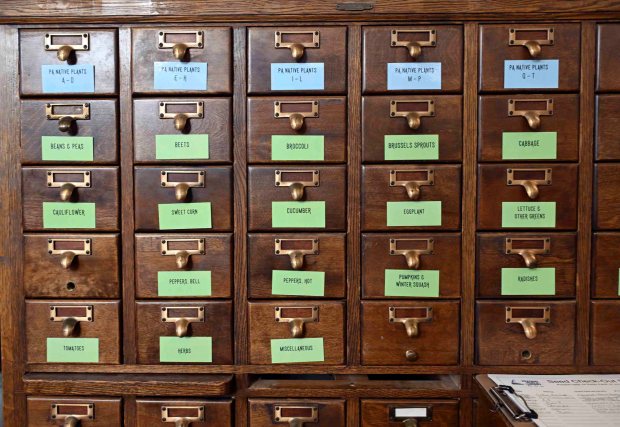 An old card catalog has been repurposed for the Seed Library at the Reading Public Library. (BILL UHRICH/READING EAGLE)
The Seed Library is a project spearheaded by Jennifer Bressler, assistant library director and Penn State Master Gardener .
“We had been thinking about doing a seed library for a while,” she said.
Other county libraries have been offering seeds, she said, and the Sinking Spring library has an indigenous seed library.
The libraries have been working in cooperation with Berks Nature, which had its annual Seed Swap in February.
“There’s a seed-saving workshop,” Bressler said, “and during those, we learn how to collect seeds and store them, save them, and then germinate them and plant them for the following season.”
Other master gardeners save their seeds and donate them, plus others are donated by area businesses, she said.
“It’s gaining in popularity,” Bressler said, “and is really taking off.”
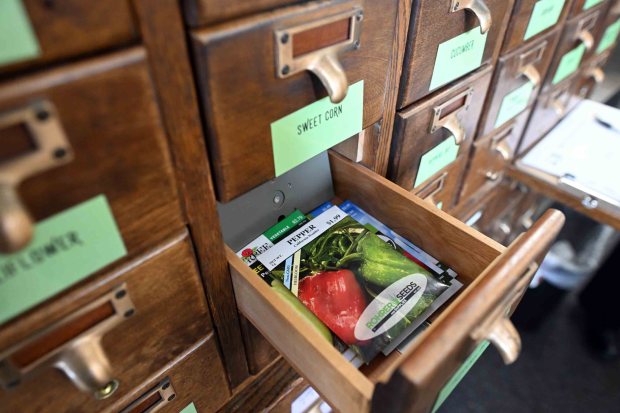 The Seed Library at the Reading Public is stocked by master gardeners who have saved their seeds and donated them, plus others are donated by area businesses. (BILL UHRICH/READING EAGLE)
Melissa Adams, library director, sees plenty of benefits in the Seed Library program.
“It’s really important because in the city of Reading, we often have a lack of being able to cultivate our own growing crops, and there’s also a sort of a food desert scenario in many different communities and this is a way to be able to help fill that gap,” she said. “And so we’re hoping that people can come and ‘check out’ the seeds, and take them home and be able to make use of them for their home gardens.”
The Seed Library also plays into a nostalgic feeling for the older libraries.
“We, of course, had this lovely card catalog that we wanted to repurpose, and we were so glad to be able to do it in this way,” Adams said.
Rodriguez and Ortiz made their selections from the catalog after researching the seeds available.
Rodriguez would like to grow more vegetables this year rather than flowers.
“I’m trying to do vegetables, too, now, because that’d be so cool to actually grow something that you can eat,” she said.
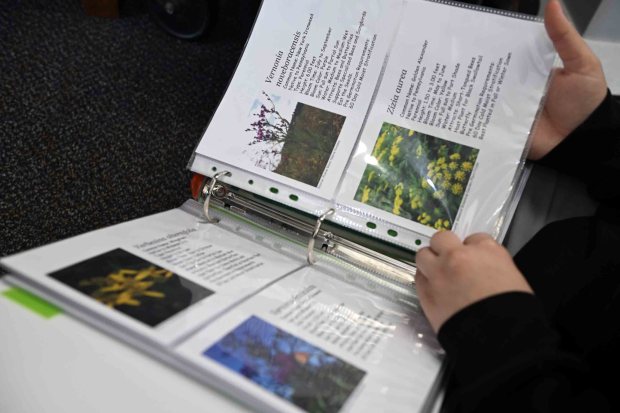 Yamileishka Rodriguez browses through the selection of seeds available at the Reading Public Library’s Seed Library. (BILL UHRICH/READING EAGLE)