

Erie officials are considering selling or leasing the town’s mineral rights to energy company Civitas Resources, a decision that could determine oil and gas development beneath large parts of the community, as talks continue largely behind closed doors. Municipal mineral rights refer to the town’s ownership of minerals beneath the surface that can be leased or sold to energy companies for drilling.
Over the past several months, the council has met in executive session at least 10 times to discuss matters related to negotiations and the potential sale of property, with little public disclosure about the scope, timeline or terms of a possible agreement with oil and gas operator Civitas Resources. Public agendas describe these sessions using broad statutory language — such as “negotiations” or the “purchase, acquisition, lease, transfer or sale” of property — without identifying specific projects or mineral rights. The lack of detailed public information has raised concerns among residents, who say they were unaware that discussions were taking place until recently.
The issue at hand is whether Erie should sell or lease its mineral rights, which are tied to the approved Draco Pad and could involve drilling beneath large portions of the town, and how that decision might affect public health, development, and property values.
That distinction could be significant. If Erie retains its mineral rights and declines to lease them, it may be able to influence the configuration of drilling operations. If it sells those rights, that leverage could be reduced or eliminated.
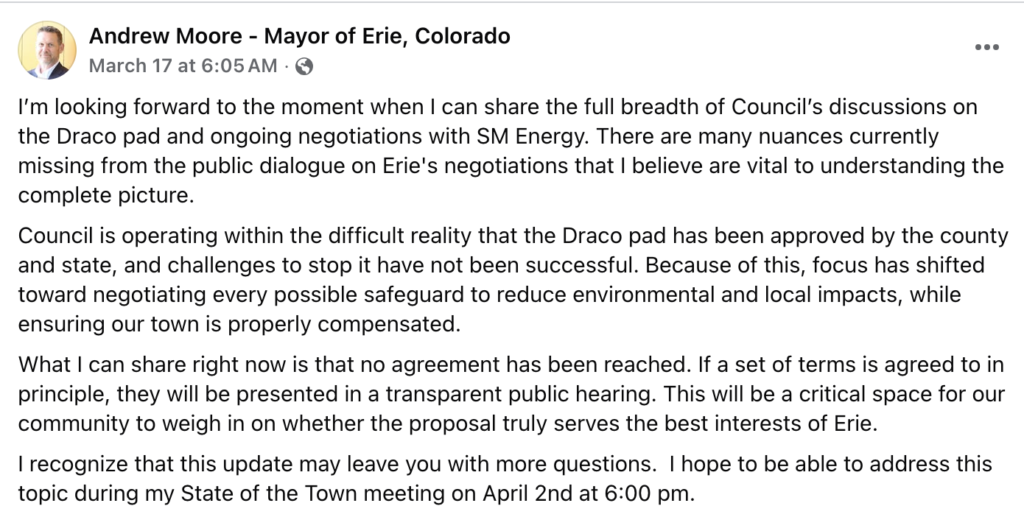
The response received from Mayor Moore was the same as his March 17 Facebook post.
The issue first surfaced publicly in December 2025, when the Town Council voted 4-3 to move forward with hiring Alameda Mineral Advisors to negotiate a potential agreement involving the town’s mineral assets. The firm is led by Matthew Owens, a former chief operating officer of Civitas Resources. Under the agreement, Alameda is tasked with representing the town in negotiations and helping structure a potential sale or lease of its mineral rights.
According to town documents, the agreement allows for up to $4.5 million in compensation tied to the negotiation process and any resulting transaction, including a commission based on a percentage of the deal’s value.
While the council has not publicly confirmed the full structure of a potential deal, in a December 16th council meeting Mayor Moore mentioned that Civitas Resources expressed interest in acquiring the town’s mineral rights. Civitas is the parent company of Extraction Oil & Gas, which owns the approved Draco Pad project, a fracking development that has drawn sustained opposition from some community members.
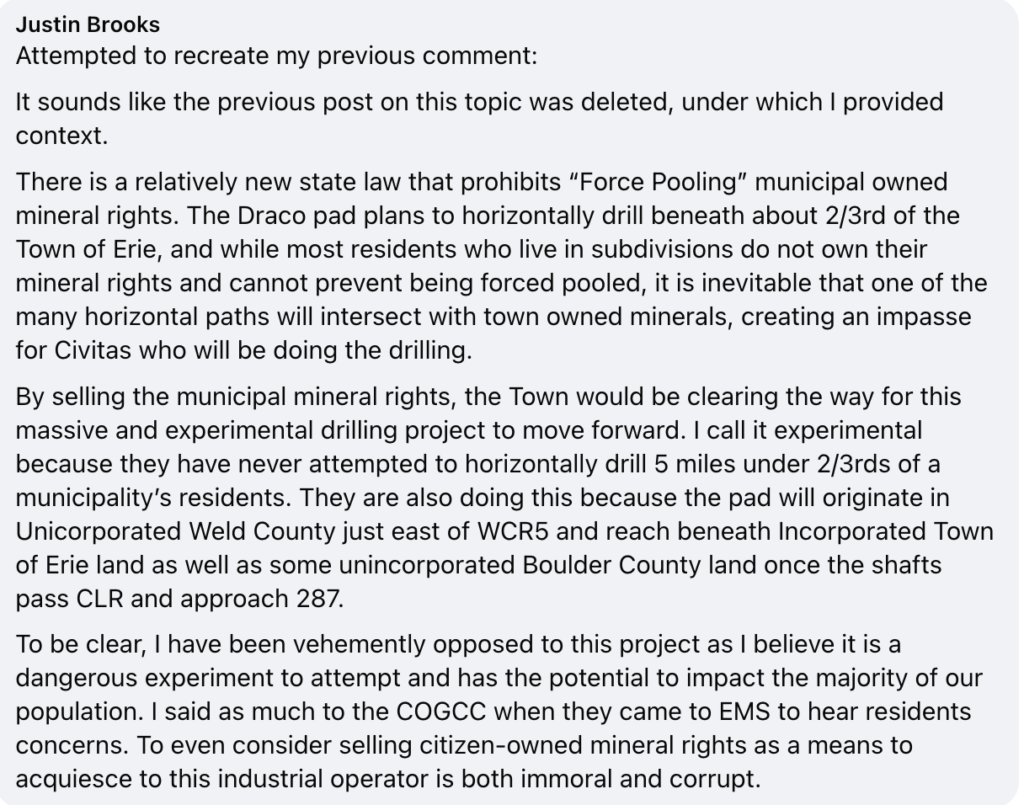
Former Erie Mayor Justin Brooks wrote in a Facebook post that selling the town’s mineral rights would be “clearing the way for this massive and experimental drilling project to move forward.”
The involvement of Owens has become a focal point for criticism, particularly given his prior role with Civitas and the perceived lack of transparency.
Many residents, like Jennifer Bertman, have raised concerns that a consultant who stands to benefit financially from a successful deal may not be positioned to provide impartial guidance. “To hire a former Civitas employee as a consultant who stands to make millions if the sale goes through is a conflict of interest,” Bertman wrote in an email to the Town Council.
Civitas Resources declined to comment.
Town code requires public officials to disclose and recuse themselves from decisions where conflicts of interest exist, though it is unclear how that standard applies to contracted consultants.
Owens has declined to comment.
As Erie mineral discussions struggle to find footing in a public forum, some argue that the lack of transparency is due to the format of conversations.
Councilmember Dan Hoback said the structure of executive sessions can limit meaningful public input. “Contract negotiations always take place in executive session, so public engagement often comes only once a contract or other agreement is largely in place,” Hoback said.
Under Colorado law, public bodies may enter an executive session to discuss negotiations, legal matters, and personnel issues. While no formal votes can be taken in those sessions, discussions can shape decisions that are later approved in public.
Some residents feel this “closed-door” dynamic has effectively frozen them out of the conversation regarding mineral rights. With no public hearings scheduled and only a brief window for comment at the upcoming March 24 meeting and a town hall scheduled for April 2nd, many feel the town’s feedback loop is broken.
Councilmember Emily Baer has publicly urged community members to become involved. “Council serves to represent the people,” Baer said. “Democracy is not a spectator sport.”
Still, many residents say participation is difficult due to the lack of public information on what is being considered. Without dedicated public meetings or detailed disclosures, some residents argue that by the time a vote reaches the floor, the real decisions have already been made in private.
The questions facing Erie are unfolding within a broader shift in Colorado oil and gas law.
A 2019 law, Senate Bill 19-181, shifted the state’s regulatory framework to prioritize public health, safety, and welfare while giving local governments more authority over siting and land use.
More recently, Senate Bill 24-185 introduced new limits on the forced pooling of municipal mineral interests. The law requires state regulators to deny certain pooling applications involving local government-owned minerals unless operators revise their plans.
However, the law remains largely untested in practice, and it does not offer a guaranteed path to stopping drilling entirely.
“It requires the operator to amend the application to avoid municipal unleased interests — not deny the whole thing outright,” said Heather Sabo, an Erie resident who has closely followed oil and gas permitting.
County Line Rd & Arapahoe Rd, Erie Colorado
That shift gives Erie greater authority over where and how drilling occurs within town limits, but it does not eliminate development altogether, making decisions about whether to retain or sell municipal mineral rights a key factor in how much leverage the town ultimately has.
Beyond legal and financial questions, many residents point to potential health impacts associated with oil and gas development near residential areas.
Baer cited research and personal experience in describing those concerns, including her son’s illness following nearby drilling activity. “There are more than 1,700 peer-reviewed health studies that point to the negative health impacts that can and have been recorded, living near oil and gas development,” she said.
Public health findings on oil and gas impacts vary, though multiple studies have identified associations between proximity to drilling and certain health risks. The role those findings play in shaping local policy decisions is often debated.
Erie does not currently have a dedicated public health department, and residents have called for more localized study of potential impacts.
A central question remains unanswered: why would Erie choose to sell its mineral rights at this moment?
Possible motivations could include financial considerations or efforts to influence how future oil and gas development in Erie takes place. However, the town has not publicly outlined its reasoning.
Without that explanation, some residents say the process feels driven more by private negotiation than public deliberation.
Residents have organized online and through community networks, calling for the release of nonconfidential documents, dedicated public meetings and greater transparency about the potential deal.
For now, the outcome of the mineral rights discussions — and their implications for Erie’s future — remain uncertain. What is clear, residents say, is that decisions of this scale carry consequences beyond any single contract.
When decisions of this scale are made largely out of public view, residents say, trust in the process itself becomes part of what is at stake.