
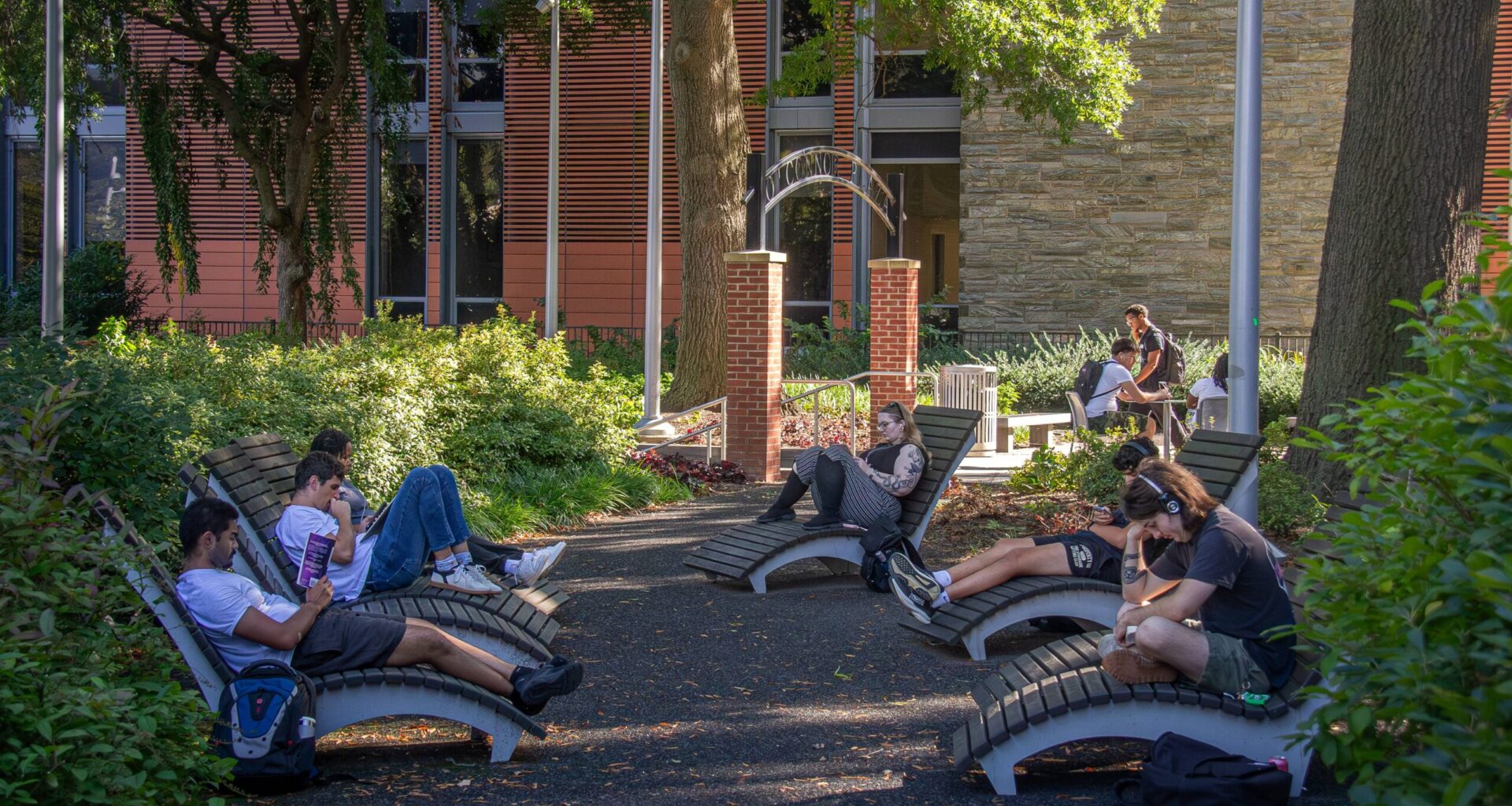
Students sit on the benches at Founders Garden. | JUSTIN ALEX / THE TEMPLE NEWS

As the United States approaches its 250th birthday this July, the nation’s birthplace has become the center of celebrations. But the fanfare is set in an era marked by intense political division and rising sentiment against President Donald Trump’s actions in his first year, reflected in protests across Philadelphia.
Rising food costs, concerns about increased Immigration and Customs Enforcement activity and strikes against Venezuela and Iran have loomed over the city.
“There’s no such thing as the middle class anymore,” said J.D. James, a 49-year-old North Philadelphia resident. “The Republicans really don’t care about anybody lower than them. Whoever has money, that’s what they care about.”
James has lived in North Philadelphia for more than 40 years and said that he’s never felt patriotic. When the federal government attempted to remove slavery exhibits at the President’s House in January, his frustrations mounted.
James takes care of his mother full-time, including buying her groceries. This year, he had to stretch thin or shop at lower-quality grocery stores. In addition to rising grocery costs, he has seen gas prices increase.
“I feel like we should not be at war right now,” James said. “I’ve put the cost of three people’s cars in my tank this week.”
Gas prices have risen on average by a dollar following U.S strikes against Iran in February, according to the Energy Information Administration. A Forbes economist predicts that “essentially everything” will become more expensive because of rising gas prices. Diesel is crucial to the shipping, construction and agriculture industries, and may face higher operating costs that trickle down to consumers.
Philadelphia expects to see a historic summer in anticipation of an estimated economic boost of as many as $2.5 billion tourism boom driven by the FIFA World Cup and the MLB All-Star Game, alongside events scheduled to celebrate the nation’s 250th anniversary.
Patriotic celebrations have begun throughout the city, including Wawa Welcome America’s 16-day Festival leading up to July 4, block parties and the anticipated largest Independence Day parade ever.
Cristian Javier, a 27-year-old who has lived in North Philly for his entire life, doesn’t feel like participating in the celebrations. He feels that immigrants in Philadelphia are not being adequately protected.
The Trump administration’s increased presence of ICE nationwide makes it difficult for him to feel any pride.
“For anyone who is Hispanic, there’s a fear in them,” Javier said. “I fear sometimes that because of how I look, because of my prominent facial features, that I will be racially profiled and stopped, even though I am a U.S citizen,”
Although some are wary of calling themselves a patriot, others are more optimistic about the upcoming celebrations in Philly.
Darnell Riggins, a security guard in North Central, is feeling hopeful in anticipation that the Independence Day celebrations will put Philadelphia “on the map.”
The moment could shed light on Philadelphia’s rich and vibrant history, a city of many firsts, which he said makes him feel more patriotic.
“I feel like our city is actually on the rise. It’s about to be one of those go-to cities,” Riggins said. “[The city has] done a lot that’s bringing more awareness to us. So, I am going to say I am proud to be here for once.”