
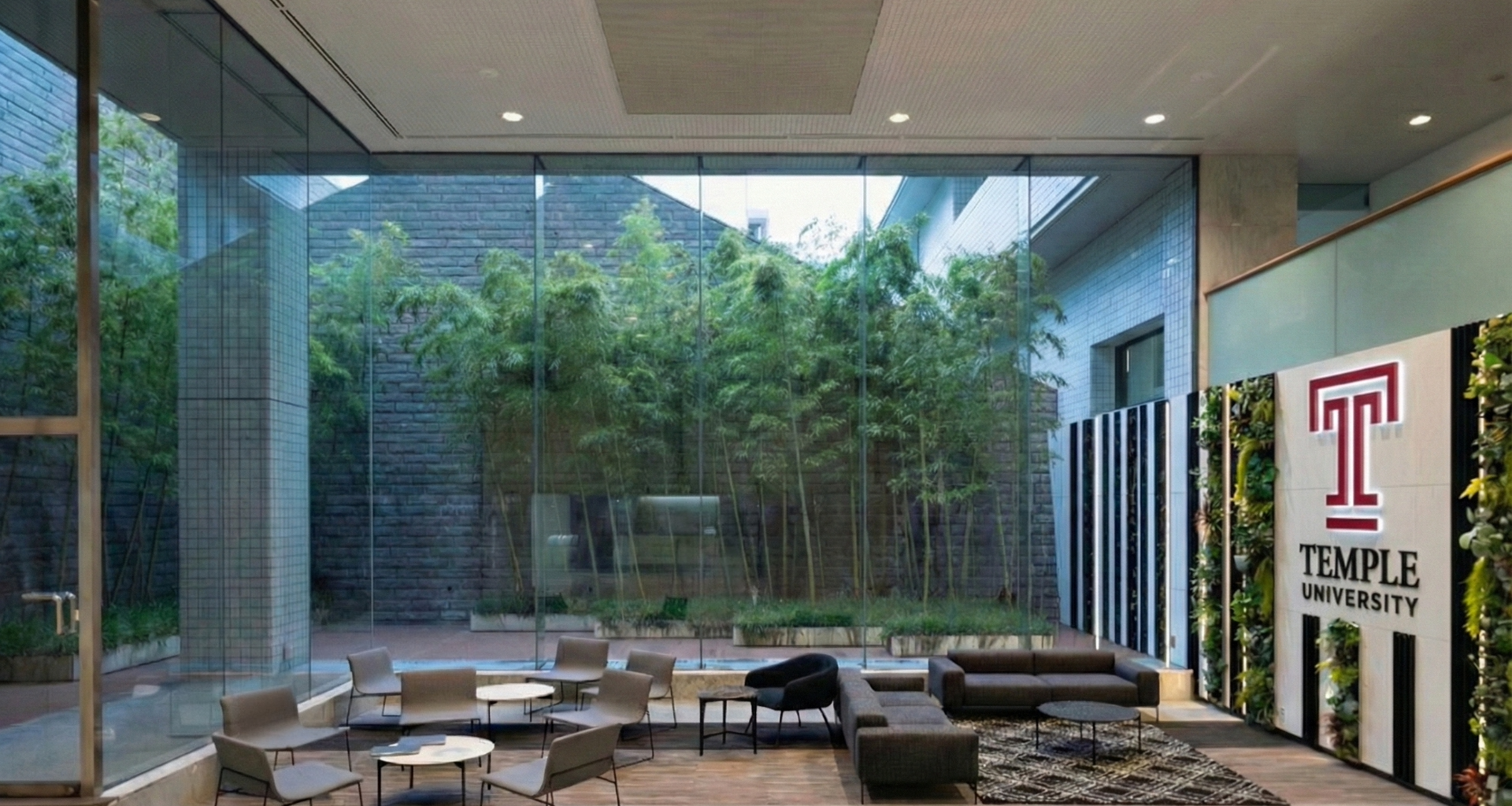
The inside of the new Hillside Center on Temple University’s Japan campus. | COURTESY / THE TEMPLE NEWS

Temple Japan is opening the Hillside Center, an eight-story facility that contains academic and recreational spaces, in Fall 2026.
The Hillside Center is in Mizonokuchi, Kawasaki, a Tokyo suburb.
“This building opens up opportunities for study, research, extracurriculars, clubs, you name it,” said TUJ Dean Matthew Wilson.
The 75,000-square-foot center has 23 classrooms, a 300-seat auditorium, a dance studio, music rooms, a library and several recreation facilities.
Wilson expects 800 to 1,000 students to take courses at Hillside when it opens, but the building can accommodate around 2,000.
TUJ has 3,650 students this Spring between its Tokyo and Kyoto campuses. Wilson predicts TUJ’s total enrollment could reach 4,000 students in 2026-27.
It takes less than thirty minutes for students living in the Yoga, Mushashi Kosugi and Nogawadai residence halls to commute to the Hillside Center by train. Taking the train to Hillside from these campuses is expected to save students money because it is a direct route without any transfers, Wilson said.
Sophie Noller, a junior computer science major, lives in the Mushashi Kosugi dorm, which is about 20 minutes closer to Hillside than the city campus. She thinks a shorter commute would improve her Japan experience.
“Commuting really takes a lot out of you,” Noller said. “So it definitely takes away your energy to kind of stay on campus and go to events.”
Many students live in the Mizonokuchi area outside of the dorms because of its affordability compared to the city campus, Wilson said.
The new location will also increase the number of courses TUJ offers, said Yasuko Taoka, TUJ associate dean for Academic Affairs.
“First Year Writing, Japanese, Intro to Japanese, those courses are always ones that are full,” Taoka said. “So, this allows us to offer more sections of it.”
Hillside almost doubles the existing classroom capacity in Tokyo, which could allow TUJ to offer more majors.
The classrooms are equipped with microphones, monitors and cameras for students to join class virtually, giving students in Kyoto and Setagaya-ku easier access to Hillside courses.
The learning center will offer a dedicated space for tutoring and programming for academic support.
In addition to general education courses, Hillside will offer first-year focused classes for students in the First-Year Experience and bridge programs. The First-Year Experience program combines first-year courses with support services for new students, and the bridge program offers classes for academically proficient students in need of English language support.
This focus allows the administration to be more strategic with their student support services, Taoka said.
“Knowing that most of the students who are going to be at that location are going to be new allows us then to target the communications,” Taoka said.
Hillside’s auditorium makes it easier to facilitate events like movie nights, plays and concerts. The fitness center, music practice rooms and rooftop garden also offer new opportunities that aren’t available at the city campus. TUJ is looking into new academic programs to utilize the building’s added space, Wilson said.
The Hillside Center also offers a comparatively suburban experience to the dense Setagaya-ku location. The building was constructed in 1983 and previously functioned as a training facility for the camera company Canon.
The purchase of Hillside in February was the first time Temple purchased an academic building in its 104-year history of overseas expansion.
Buying the property outright, rather than leasing, allows Temple to retrofit the facility to its needs without outside approval.
Temple is dividing some of Hillside’s rooms to accommodate smaller class sizes, making it similar to the city campus, which averages 24 students per class.
TUJ’s undergraduate enrollment has almost tripled in the last five years. TUJ is opening a 184-bed dormitory in Setagaya-ku in Fall 2026 to accommodate its recent growth.
This spring, 350 students enrolled at TUJ’s Kyoto campus, which opened January 2025.
“Ten years out, I think Temple will be an even more major player in the education market,” Wilson said. “If our popularity and growth continues, I could see us in a much larger, consolidated campus in Tokyo, with even more opportunities for our students.”