


izzetugutmen
Over the past two decades, newspaper publications decreased from 7,325 to 4,490 across the country while circulation dropped from over 50 million to around 15 million. Additionally, the number of journalists and people working at newspapers has decreased from over 365,000 to about 90,000. Unvetted, subjective news reports presented in short-form fashion are increasingly, and alarmingly, becoming our main source of information.
In Erie, Pennsylvania on the eve of the 1860 presidential election, Abraham Lincoln was the favored candidate locally. This was reflected in the coverage within the widely circulated Erie Gazette and Erie City Dispatch newspapers. There was a third well-circulated paper though, the Erie Observer, which represented local opposition, an opposition that was not merely wary of a Lincoln presidency, but outright hostile towards the idea.
Erie Observer editor Benjamin Franklin Sloan referred to Lincoln as “a respectable man of moderate abilities,” but he also alleged Lincoln was a “nothing and nobody” whose “importance comes from what he represents and not what he is.” Sloan had little patience for the abolitionist rhetoric he felt Lincoln represented. He believed it radical, instead of sympathetic to, as he put it, “the rights and property and safety of our Southern brethren.” Voting for Lincoln, he argued, was a vote for “the aggressive spirit of anti-slavery fanaticism” and against the Constitution and the Union. Voting against Lincoln then was the only “barrier to sectionalism and fanaticism.”
After Lincoln’s clear win a few days later – including by a significant margin in Erie County – Sloan was melancholy. The presidency, he editorialized, had been corrupted “for the purpose of pillage and plunder” in lieu of “a servant to look after the interests of the people.” Lincoln was destined to bring the United States “to the very brink of ruin.” Had the “wise and patriotic” founders of the United States foresaw this election, continued Sloan, they would have built “better safeguards.” Good men were disgusted by what politics had become.
“We warned the people previous to the election of the result which has followed, because we inform our readers now, as duty bound, of the exact state of the country, such mole-eyed papers as the [Erie] Gazette sneer at the dangers that surround us and stigmatize our articles,” Sloan added. He’d rather “bear the taunts and sneers of … the ultra anti-slavery humanitarians” than “wither and die under the reproaches of a betrayed, divided, and infuriated people.”
While it is easy to pick apart Sloan’s points, he was correct in where this was headed: civil war. As fears of the Union dissolving escalated, Sloan appeared almost gleeful over his previous predictions of “secession and revolution” in the South. He commended South Carolina, Georgia, and Alabama for their “honorable sincerity and conscientious resolve” since Lincoln’s election.
These sentiments were widespread throughout southern states, but Sloan’s frequently sensationalist editorials are a fascinating glimpse into anti-abolitionist perspectives in the North. The Observer, along with the Gazette and Dispatch, were unapologetically partisan in their stances extending far beyond the divisive national issues of the time into politically mundane local issues like the mayoral race or proposed ordinances.
News being partisan and sensationalist are not new allegations. In fact, for most of the first century or so of the United States, such partisanship was the standard and expectation. The early decades following the American Revolution are even referred to as the party press era. People read newspapers owned and curated by those whose views most aligned with their own. This confirmation bias, as described by Northeastern University, is “the tendency to process information by looking for, or interpreting, information that is consistent with one’s existing beliefs.” If one lived in Erie in 1860 and consumed their news only from the Erie Observer or the Erie Gazette, their understanding of national politics would be extremely different, not just from their editorials but from their story selection and framing of issues.
Both then and today, the media landscape can and often does frustrate people. The Observer and Gazette took swipes at each other weekly. One can imagine Erie neighbors siding with one paper over another, echoing the viewpoints of each, criticizing the other paper that they wouldn’t dare spend their hard-earned pennies on.
From the modern perspective, to leaf through old Observer or Gazette newspapers is to see first drafts of history (a phrase popularized by Washington Post publisher Philip L. Graham in the 1960s). Reading the direct words of those experiencing those years firsthand and analyzing their diverse and evolving perspectives provides indispensable historiographical insight.
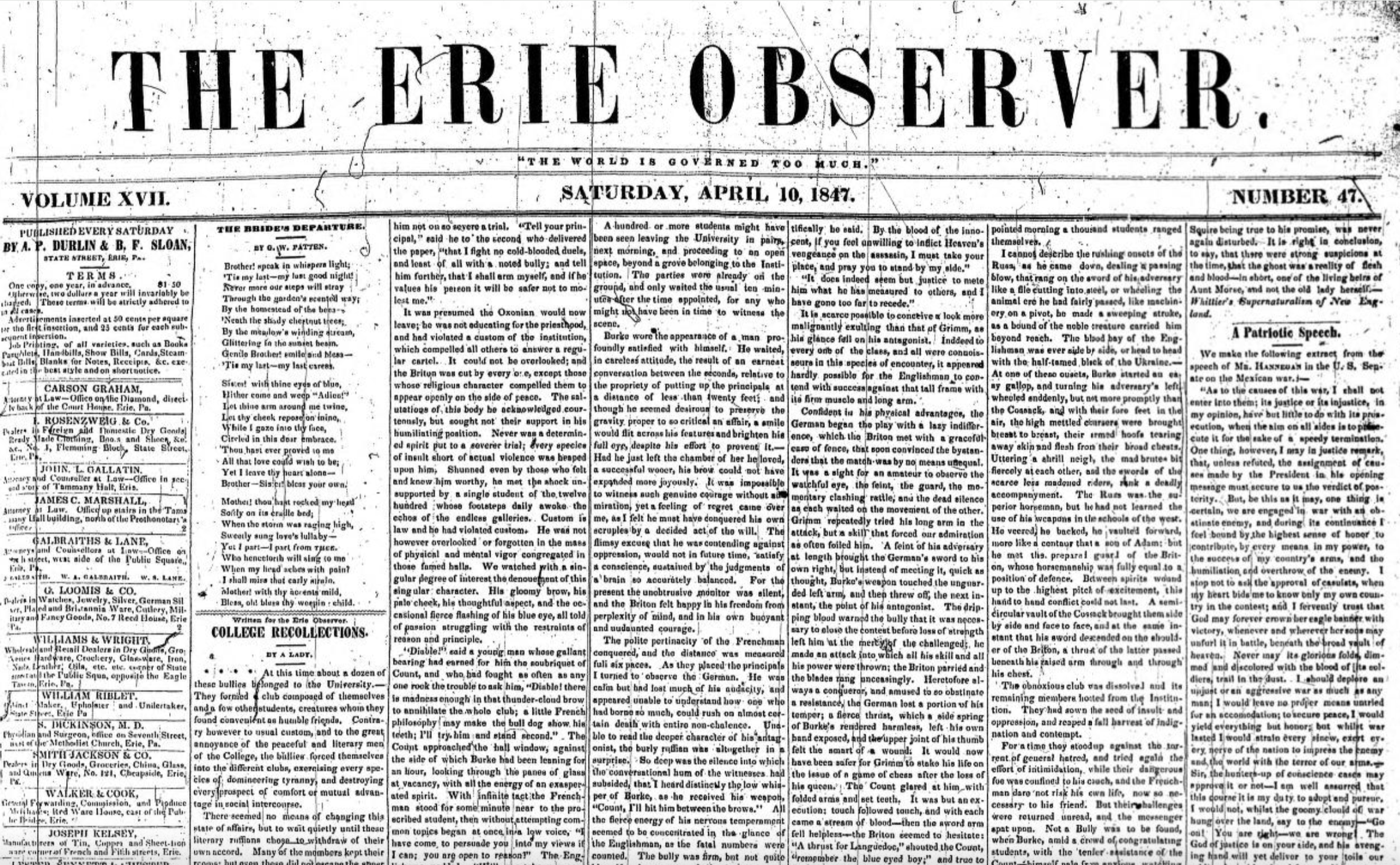
The Erie Observer was one of three newspapers in circulation in Erie’s early days – one that ran as an opposition paper relying on partisan and sensationalist views back in the 1860s, prior to the concept of unbiased journalism, which was established in the 1920s.
(The Newspaper Archive)
As decades passed, the vigilance of muckraking journalists such as Ida B. Wells, Ida Tarbell, Upton Sinclair, and Nellie Bly demonstrated the power and influence of journalism. Words could change hearts and minds – and, in some cases, even laws. At the same time, they were competing with the powerful “yellow journalism” of the era: deliberately sensationalized, clearly unethical, often downright inaccurate (but probably more entertaining) stories that were the turn-of-the-century equivalent to internet grifter clickbait.
In the early 1900s, journalism changed and improved drastically with the professionalization of the field. In 1908, the University of Missouri established a school of journalism, followed by Columbia University in 1912. News, its purpose objective and verifiable and designed to inform, and opinion, subjective takes meant to persuade and inspire conversation, were separated and made independent of one another in the newsroom. Unlike previous eras, opinion pieces would follow strict ethical standards that included comprehensive fact-checking, avoiding misleading claims, and disclosing any conflicts of interest.
For news, standards of objectivity were developed. The Society of Professional Journalists (founded in 1909) and the American Society of Newspaper Editors (founded in 1922) established codes of ethics emphasizing accuracy and fairness. As described by the Society of Professional Journalists, for journalism to be ethical, it should be “accurate and fair” while journalists should be honest and courageous in gathering, reporting and interpreting information.” Their code of ethics includes seeking truth, minimizing harm, acting independently, and being accountable and transparent. In Erie, Hazel Eberhart, better known by her pseudonym Barbara Hawley, was the city’s first professionally educated journalist. She graduated from Kansas State University in 1925 before writing for the Erie Daily Times and then the Erie Dispatch-Herald.
To some extent, the shift towards objectivity was a business strategy. Appealing to broader audiences meant selling more papers which increased advertising revenue. The shift from smaller-scale partisan newspapers to a more standardized and professional model helped legitimize the field.
In the modern day, it can sometimes feel like objective and ethical journalism is an artifact of a bygone era. That, of course, is not accurate. There are tens of thousands of journalists, reporters, analysts, and editors out there putting in the work, doing what they were professionally trained to do, covering their beats with expertise and rigor and objectivity. They keep us informed on everything from national news to local council meetings to crimes, sports, education, finance, health, science, arts and culture, food, technology, the environment, and every topic in between.
These professionals now often get overshadowed by those who aren’t worried about objectivity, fairness, and transparency – and perhaps the bigger problem is that people cannot always tell the difference. Besides apathy, one might say that the lack of media literacy is the most significant growing issue.
According to Pew Research Center, 62 percent of those age 65 or older “follow the news all or most of the time,” compared to 45 percent between 50 and 64, 26 percent between 30 and 49, and 15 percent between ages 18 and 29. As Tim Franklin, chairman of local news at Northwestern’s Medill School of Journalism, worries, “[Most frightening] is the idea that generations are growing up without the habit of following news, particularly for their own communities.”
Even if they don’t seek it out though, as research analyst Naomi Forman-Katz says, “[T]he news still finds them.” And, she adds, “Democracy depends on people being informed.” Newsrooms have spent decades now trying to adapt to the digital age and attract the younger demographics, including in recent years producing podcasts and vertical videos.
Examine their polling on how many get their news from social media and the results are almost the inverse of the Pew poll: 76 percent in the youngest age category compared to 28 percent in the oldest. It likely doesn’t need to be explained, but there are numerous problems with relying on social media for news, foremost being algorithms deciding what you do and don’t see. For instance, algorithms reduce the reach of any posts with external links. Notice how news organizations are now putting links down in the comments? In addition, many self-proclaimed news accounts lack standards and editorial oversight. Then there is the entire financial infrastructure of social media platforms like Facebook and TikTok which incentivizes clickbait, shock, and sensationalism.
It’s also becoming increasingly difficult for many to know how to consume news responsibly. The lines between objective reporters and opinion-sharing talking-heads, particularly on television, have blurred. I still use an RSS feed (like Feedly) to ensure that I chronologically see all headlines from websites that I follow. From there, I can decide myself which articles to read or not read. Media bias charts by organizations like Ad Fontes Media and All Sides are flawed, but are helpful tools too. The News Literacy Project has created resources to help teach about different types of bias which includes the well-known partisan bias, but other types of bias including demographic, corporate, neutrality, and “big story” along with five forms that include framing, story selection, absence of fairness and balance, tone, and sourcing. Still, these require consumers of news to actively pay attention to what and how they are engaging with information.
Perhaps the biggest problem though: there are fewer and fewer newsrooms to publish. Countless small town newspapers have shuttered all across the United States in recent decades. Many of those still in existence are barely holding on. Just recently in nearby Venango County, the Derrick Publishing Co. announced their closure, shutting down three papers: Oil City’s The Derrick, Franklin’s News-Herald, and The Clarion News. In Pittsburgh, the city faced the one-two gut punch of the city’s alt-weekly Pittsburgh City Paper being shut down by Block Communications in January, followed by their announcement a few days later that they’d cease operations of the historic Pittsburgh Post-Gazette in May. This came following a Supreme Court ruling against ownership in favor of the Newspaper Guild of Pittsburgh.
According to the Associated Press last year, over the past two decades, newspaper publications decreased from 7,325 to 4,490 across the country. Circulation has dropped from over 50 million to around 15 million. Another grim statistic: during this same time, people working at newspapers has decreased from over 365,000 to about 90,000. An eye-opening 2025 joint project from Muck Rack and Rebuild Local News found a 75 percent decrease in local journalists since 2002. Another way to put it: there used to be about 40 journalists per 100,000 people. Now, it’s less than nine.
Examining the Staff Directory of GoErie.com from 2016, the same year the locally-owned Erie Times-News was sold to GateHouse Media (which later merged with Gannett, which recently rebranded as USA Today Co.), there were 18 full-time reporters, nine editors, five photojournalists, and 15 “special section” writers for Showcase, Her Times, Lake Erie Lifestyle, and Rock Erie. Needless to say, those numbers have dwindled since. Similarly, when one realizes how few left there are to cover beats for The Meadville Tribune, it’s actually impressive how they accomplish so much with so few.
The fewer professionals there are to cover local issues, with their years of building trust and relationships and networks of information, the more that people will be in the dark about local issues – or they will simply turn elsewhere for their information, replacing fact-checked articles with posts on local Facebook groups where moderation of the comment sections range from the Wild West to authoritarian.
Generally speaking, there’s value in community groups and the provided exposure to this diversity of thought, but many devolve into unflinching tribalism, mindless memes, and short-form videos thrust into the world by financially-motivated grifters who’ve been chipping away at our attention spans for years. As longtime 60 Minutes reporter Scott Pelley said in a speech over a decade ago, we now live in “a world where everyone is a publisher [and] no one is an editor.” For anybody who has an editor, you know they aren’t just helpful, but indispensable.
We need these first drafts of history, news and opinions, in Erie, but also for Girard, for Edinboro, for Wesleyville and all of the other small boroughs and townships with their own meetings and happenings and scandals and, heck, even those feel-good stories. This isn’t only for future historians, but for an informed citizenry presently. As explained by esteemed broadcast journalist Walter Cronkite in 2002, democracy requires a healthy free press, which he believed was threatened by a powerful oligarchy, and he believed shouldn’t “be limited to only those who have the bank accounts to pay for the battle and win it.”
This keeps the free exchange of ideas, free from government interference, alive and well. As newsrooms close and news deserts grow, tsunamis of unvetted information from sources that don’t necessarily value objectivity or even truth, threaten to be our only sources for understanding what is going on around us. Now, truly more than ever, we need quality, rigorous, ethical journalism to be the cornerstone of our information infrastructure.
We need our editors and reporters at the Erie Times-News and the Meadville Tribune. We need our smaller market papers like Erie County’s remaining Corry Journal, Erie Gay News, North East News-Journal, Titusville News-Journal, and Union City Today. We need all of our university and high school newspapers, providing experience and inspiration to the next generation. We need our alt-papers like, yes, the Erie Reader (which has our own Alana Sabol keeping us informed on our city and county council meetings) as well as nearby Cleveland Scene and Buffalo Rising. In fact, we could even use more. As the founders of the country understood, journalism on every level from national to local to hyper local is essential to a thriving, surviving United States of America.
Jonathan Burdick runs the public history project Rust & Dirt. He can be reached at jburdick@eriereader.com