

The long fight for constitutional gender equality took center stage at Rutgers Law School–Camden when the Women’s Law Caucus, the Rutgers Law School Alumnae Network, and the Minority Student Program co-hosted a program examining the past, present, and future of the Equal Rights Amendment (ERA) in honor of Women’s History Month.

Moderator Molly Gonzales, with panelists Ting Ting Cheng, Kate Kelly, and Roberta W. Francis
The program featured a panel of legal scholars and advocates at the forefront of gender equality, including Ting Ting Cheng, director of the Marcy Syms Equality Initiative at New York University School of Law; Kate Kelly, a civil rights attorney and constitutional equality advocate; and Roberta W. Francis, an ERA education consultant with the Alice Paul Institute. The event was moderated by Molly Gonzales, advancement and civic engagement manager at the Alice Paul Center for Gender Justice.
Together, the panel traced the amendment’s origins in the work of suffragist Alice Paul while connecting them to today’s legal debates and grassroots advocacy, highlighting how generations of activists have carried forward the movement for gender equality under the law.
“It’s important for women to think of themselves as ‘constitution makers’ when advocating for equality and the protection of women’s rights,” said Kelly. “When you look at the Amendments to the Constitution, most were not originally envisioned as expansively as they have become, but they have grown over time to complement the democratic project that is our country.”
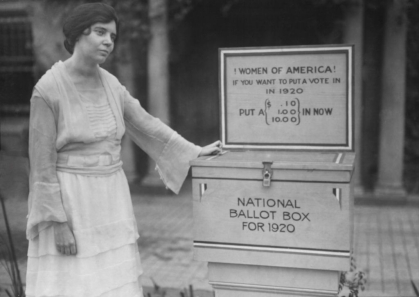
Alice Paul, an advocate for women’s suffrage and the original author of the Equal Rights Amendment. Photo courtesy of the Alice Paul Center for Gender Justice.
The ERA was first drafted by Alice Paul in 1923 to ensure constitutional protection against sex‑based discrimination, stating that “equality of rights under the law shall not be denied or abridged … on account of sex.” Though introduced in Congress repeatedly over the following decades, it was only approved by both the House and Senate in 1972 and sent to the states for ratification.
The amendment included an initial deadline for state ratification, set for 1979 and later extended to 1982. By the end of that period, it had been ratified by only 35 of the 38 states required for adoption.
Renewed efforts in recent years led Nevada, Illinois, and Virginia to approve the ERA, bringing the total number of states that have voted to ratify it to the required three‑quarters, or 38. While this milestone meets the constitutional threshold, legal and political questions about the expired time limit and formal certification have kept the amendment from being officially published as part of the Constitution.
Cheng emphasized the importance of state-level action in advancing gender equality. She noted that while the federal ERA remains unratified, many states have enacted their own equality provisions, some of which go further than federal protections. She explained that state constitutions can offer broader rights without additional legislation and that these rights are more directly accountable to the people, with state judges often being more responsive than federal judges. These state-level provisions are an essential complement to the federal effort, providing both practical protections and a framework for ongoing advocacy toward a national ERA.
“Even though the federal ERA hasn’t been fully ratified, the work at the state level, with equality provisions enacted in more than half of the states, has been vital,” said Cheng. “These state efforts not only protect rights locally but also keep the momentum alive for a national amendment.”
Reflecting on the generational energy that has fueled the fight for equal rights for more than a century, Francis emphasized that each era has brought periods of intense activism followed by quieter moments, stressing the importance of not losing hope. Advocates should continue to build upon the solid legal foundation created over time.
“There are very few arguments against the ERA that can’t be answered with credible sources,” said Francis. “Even though it hasn’t been formally published as part of the Constitution, the evidence shows it has been ratified—and the facts are on our side.”