
RANSOM TWP. — Officials are revising zoning to address data centers as the township deals with lawsuits from a property owner that planned to build a data center campus.
The township Planning Commission met Monday evening to review an ordinance defining and regulating data centers.
The ordinance would require them to be built in the M-1 and M-2 Manufacturing districts, buildings to be no higher than 35 feet, with a maximum lot size of 50 acres, have setbacks of at least 200 feet from all property lines, noise generated not to exceed 60 decibels at the boundary of the property and provide an environmental and community impact analysis
The commission reviewed each section of the proposed ordinance, making suggestions on revising the definitions of a data center, and data center accessory use, using public water if available, setbacks, noise levels, safety, power use, lighting, fencing height, required assessments and buffering. Solicitor Jillian Kochis said she would add severability and decommissioning sections to the ordinance.
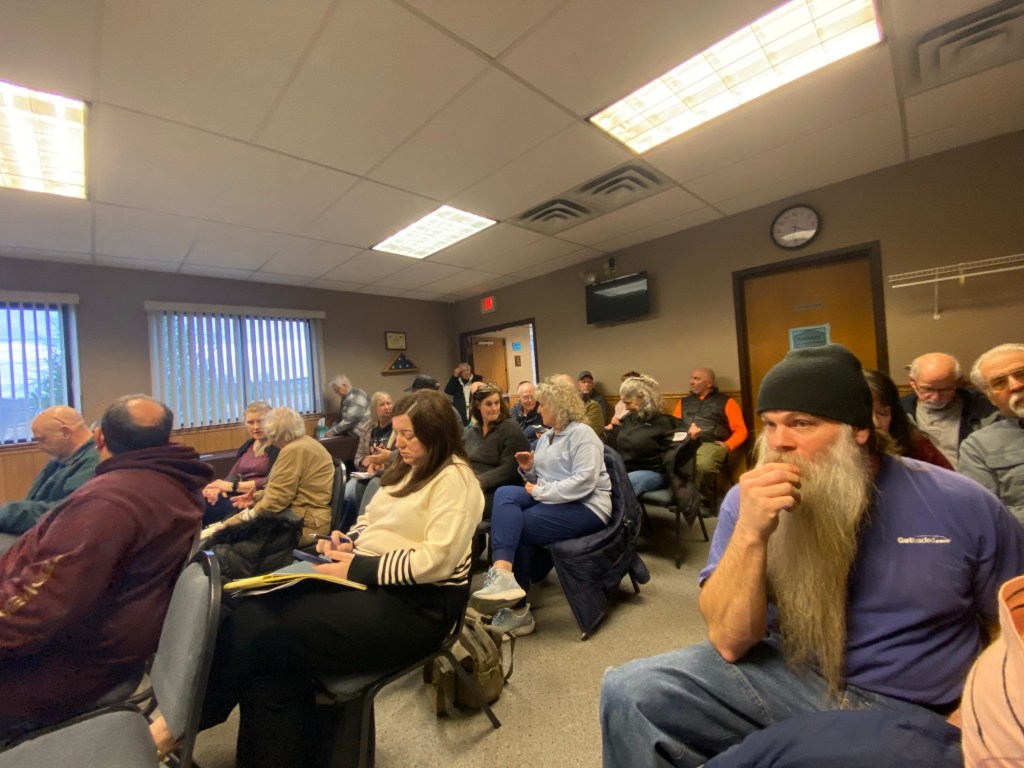
Some of the more than 30 people in attendance provided suggestions to the ordinance.
Commission Chairman James Murphy said the new ordinance would protect residents and the environment, emphasizing the state mandates municipalities have to allow data centers.
“We’re trying to be proactive by putting something in place to try and circumvent any problems down the path,” he said.
Kochis said her understanding is that if there isn’t a specific use in the zoning, it is considered denied.
Murphy explained to the crowd the township supervisors asked the commission for recommendations on a data center ordinance and they will have the final say on it.
The discussion took place amid ongoing legal challenges related to the township’s rejection in January of a zoning ordinance that would have permitted data centers.
Scranton Materials LLC filed a curative amendment, which challenged the validity of the township’s zoning ordinance, in November that would have allowed the construction of six data centers, each with a 156,648-square-foot footprint at 819 Newton Road. At a Jan. 20 hearing, township’s Board of Supervisors voted 2-1 to dismiss the proposed changes due to lack of testimony and evidence from Scranton Materials. Laura McGarry, who appeared on behalf of her mother, Susan Magnotta, a resident of Scranton’s Keyser Valley section, requested the motion.
The developer appealed the decision and filed a lawsuit seeking a declaratory judgment against the supervisors last month.
Attorney Michael Mey argues in the appeal the township supervisors acted improperly and went against the advice of their solicitor when they dismissed Scranton Materials LLC’s application for a zoning change that would have allowed the data center campus. The appeal asks the court to reverse the township supervisors’ decision and allow data centers on Scranton Materials’ property.
The lawsuit, which Mey also filed, asks the court to declare the township’s zoning ordinance exclusionary to data centers, and as relief, to allow the development of data centers on 251 acres of Scranton Materials’ property.
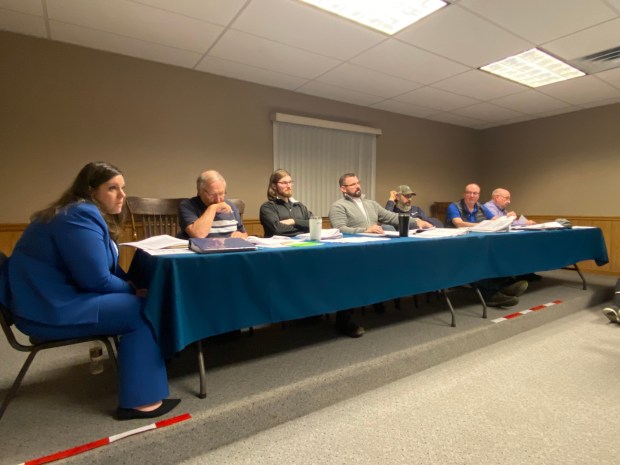 Members of the Ransom Twp. Planning Commission hear from members of the public at a special meeting Monday, March 23, 2026. They discussed a proposed ordinance defining and regulating data centers in the township during the meeting. (Christine Lee/Staff Photo)
Municipalities in Pennsylvania must allow for every type of lawful land use somewhere within their borders, and failing to do so exposes local governments to legal challenges for exclusionary zoning.
To remedy exclusionary zoning, property owners can submit a curative amendment where they propose their own zoning standards to allow for what they believe is unlawfully excluded land use.
In Scranton Materials’ case, the quarry’s attorney argues that Ransom Twp.’s 2018 zoning ordinance is exclusionary because it does not define or classify any data center uses, and township supervisors refused to comply with the Pennsylvania Municipalities Planning Code, or MPC, according to the lawsuit.
The MPC provides the legal framework for municipal zoning.
Both legal challenges are ongoing.
The ordinance discussed Monday states that data centers are allowed in the township’s manufacturing zones. The curative amendment proposed by Scranton Materials would have created a data center overlay district in the township that encompassed Scranton Materials’ property. The ordinance also requires buildings be 35 feet, rather than 120 feet in the curative amendment, and setbacks of 200 feet, compared to 50 feet in the curative amendment. The proposed ordinance also does not require a water feasibility study if the data center relies on nonpublic water sources.
Murphy said at the meeting the commission picked apart Scranton Materials’ overlay ordinance, which covered its property.
The commission did not vote on the proposed ordinance during the meeting. A date it will be voted on has not been determined.
Ordinance requirements
The proposed ordinance would require data center developers to:
• Have all principal and accessory structures be arranged, designed and constructed to be harmonious and compatible with the site and surrounding properties, with campuses containing more than one building encouraged to provide a variety in building size, massing, siting and appearance.
• Be permitted by conditional use in the township’s M-1 and M-2 Manufacturing districts, with data centers not allowed in residential districts and conservation areas.
• All principal buildings, accessory structures and utility substations set back at least 200 feet from all property lines.
• Be connected to public water and sewer if available.
• Buildings be no higher than 35 feet, with a maximum lot size of 50 acres.
• Noise generated not exceed 60 decibels at the boundary of the property.
• Lighting from the data center shall be directed downward and can’t be projected toward neighboring properties.
• Fences shall not exceed 6 feet.
• Substations must include year-round opaque landscaping or a screen wall a minimum of 10 feet high. Data center developers are encouraged to bury power lines; on-site power lines of 34.5 kilovolts and below must be buried.
• Provide 24-hour emergency contact signage at the entrance.
• Provide a 150-foot landscaped buffer.
• Provide an environmental and community impact analysis prior to the hearing and perform an Environmental Impact Assessment, environmental surveys addressing wildlife and migratory bird activity, and a stormwater and watershed impact study. Facilities withdrawing more than 50,000 gallons of water are also required to submit a hydrogeologic impact study demonstrating no adverse impact to nearby wells, groundwater resources or surface waters.
• Submit annual compliance reports documenting its environmental performance, and an independent environmental and operational compliance review every five years after operations begin, and an independent Hazard and Emergency Response Capability Assessment.
• A decommissioning plan with the application.
• Provide notice of its intent to discontinue if the developer plans to do so.
• Ensure adequate radio coverage for first responders and an emergency response assessment.