
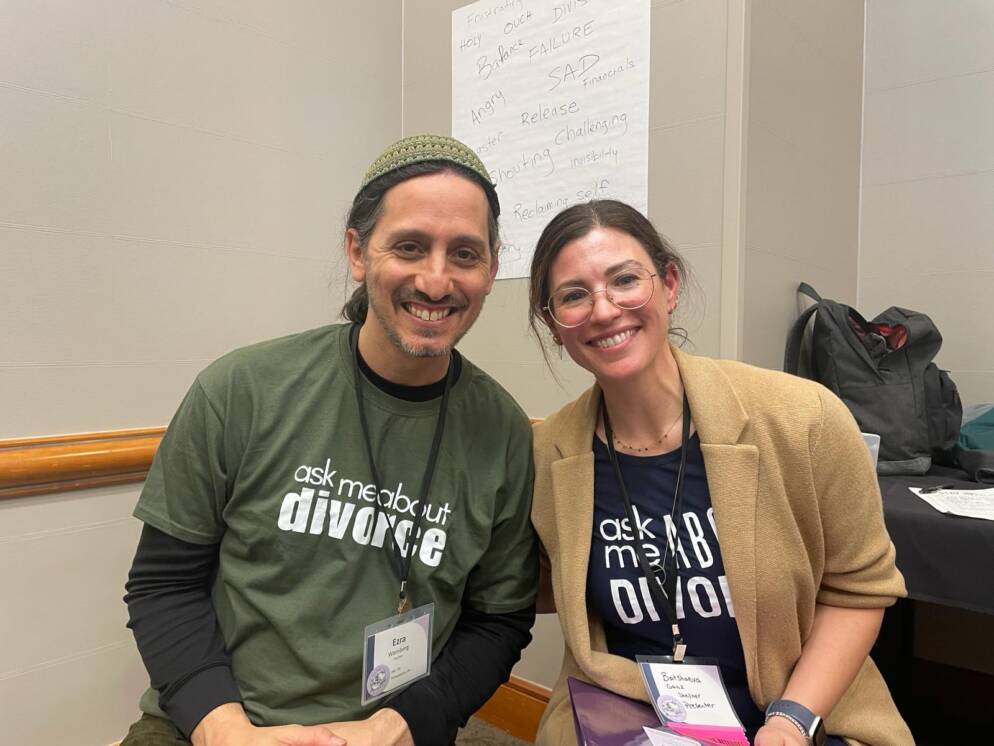
 Reb Ezra Weinberg, left, with Batsheva Ganz, his partner in running the Areivut organization offering divorce resources. (Courtesy of Reb Ezra Weinberg)
The Jewish ketubah signing includes financial protections for the woman in case the marriage breaks apart. While the focus on the woman was perhaps written for a different time, its wisdom is clear: Jewish communities understand the reality of divorce.
Yet while divorce is deeply understood and protected against in Jewish wisdom and contracts, it is less understood and protected against in practice, according to Reb Ezra Weinberg, a Philadelphia rabbi.
That’s why Weinberg is now focusing his rabbinical work on helping Jews who are going through divorces.
The rabbi leads two organizations, Jews Get Divorce and Areivut, that aim to bridge this gap between Jewish wisdom and practice. Jews Get Divorce offers resources for community members going through separations. Areivut provides resources for clergy and other community leaders who may be called upon as a “divorce first responder,” as Weinberg put it.
“We need to do more here,” he said.
The issue is personal to him.
Born in Scranton, Weinberg’s parents split up before he turned 2. His mother moved to Philadelphia to enroll in the Reconstructionist Rabbinical College, while his father stayed in Scranton.
Weinberg had to live separate lives with each parent. At the time of his bar mitzvah, he actually had two on back-to-back weekends.
“It was a high-conflict divorce,” he recalled.
Even as a kid, Weinberg noticed that his parents didn’t have much help in dealing with their situation. A voice kept ringing in the back of the future rabbi’s head.
“There has to be a better way to do this,” he recalled.
That was in the late 1970s. In 2019, Weinberg went through his own divorce. He assumed that help would be more forthcoming.
It wasn’t. The only support he got was advice on how to get a get, or the formal Jewish divorce document.
“The Jewish community had no response,” Weinberg recalled. “The joke is, it would have been easier if my spouse had died.”
As time went on, Weinberg the adult recognized that the problem was bigger than his own experience. He had a growing sense that “this must have happened to a lot of people.”
The day after his separation, Weinberg traveled from New York City, where he had been living at the time, for his niece’s bat mitzvah in Philadelphia. He was bracing for family members to ask about his wife.
At one point, the rabbi led a part of the service called Hallel, about praising God in special moments on the calendar. He thought, “How am I supposed to do this by myself?”
He asked the audience if anyone wanted to come up and say the prayer with him. By the time he said it, he had a crowd around him.
“If you ask people to show up, they’ll show up,” Weinberg said.
Two years later, Weinberg attended a friend’s wedding weekend and made a toast. He told the audience that it was his two-year “divorce-aversary.” He thought it was a bad idea, but he did it anyway.
After the speech, people started approaching him to tell him their divorce stories.
“People started coming up to me and saying, ‘Wow, we never heard the word ‘divorce’ in a synagogue,’” Weinberg recalled.
Around the same time, the rabbi got accepted into the Atra-Center for Rabbinic Innovation’s Fellowship for Rabbinic Entrepreneurs.
“I pitched this,” he said. “The Jewish world had to learn to show up better. We need resources. I spent a year learning how to organize, identify a need and develop resources.”
Since he started doing this work, Weinberg has identified three myths that perpetuate in the Jewish community: “Divorce is solely a personal problem. We believe it’s also a community issue. Divorce brings out the worst in people. It doesn’t have to. And the third: Divorce has to be a war. Actually, there are a lot of ways to de-escalate,” he said.
Jews Get Divorce and Areivut try to address these myths.
The rabbi estimated that his classes and groups through Jews Get Divorce have reached a few hundred people so far. Areivut has now completed training sessions in Pittsburgh and Chicago, with the more recent Chicago event spanning six synagogues and reaching “probably 1,000 people.”
“More and more people are getting referred to us,” he said of Areivut specifically.