
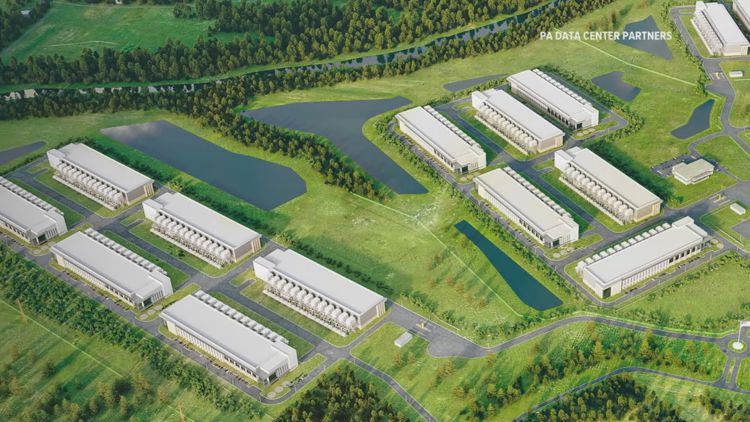
The Pennsylvania State House on Tuesday voted to approve a bill regulating AI data centers, setting up a debate between Democrats and Republicans on how to best confront the rapid growth of the facilities being proposed across the Commonwealth.
House Bill 1834 passed the chamber in a 104-95 vote, with two Republicans joining all 102 Democrats in support. The measure now heads to the state Senate for consideration.
The bill, authored by state Rep. Robert Matzie (D-Beaver), would give enforcement powers to the Pennsylvania Public Utility Commission to carry out a new regulatory framework.
It also requires data centers to use increasing amounts of clean, in-state energy, starting at 10% in 2027 and rising to as much as 32% by 2035.
Matzie says the legislation is aimed at addressing the growing strain data centers could place on the state’s electric grid, as well as protecting consumers from rising costs.
“Some of the protections specific to the piece of legislation include not charging grandma more than charging the data centers,” Matzie said. “This would incentivize them to bring their own power in. If you bring your own power in, then a lot of what’s in this bill would not apply to them.”
The bill also requires data centers to contribute to energy affordability programs, including the Low-Income Home Energy Assistance Program (LIHEAP), depending on their power usage.
Additionally, it directs regulators to ensure that the costs of serving large-scale facilities are not passed on to residential customers and small businesses.
Supporters say the measure is a first step toward managing what is expected to be a significant increase in electricity demand across the PJM Interconnection region, driven in part by AI-related infrastructure.
The legislation comes in response to calls from Josh Shapiro for stronger consumer protections as multiple data center projects are proposed statewide, including in Lancaster County, Middlesex Township in Cumberland County and at the current Dauphin Highlands Golf Course site.
Republicans, however, raised concerns that the bill could discourage investment.
State Rep. Martin Causer (R-McKean) argued the measure risks pushing developers to other states.
“Data centers are an opportunity for the Commonwealth and one that we don’t want to miss out on,” Causer said. “If we squander that opportunity, they’re going to go to another state, build their data center and then they’ll still be part of the PJM system.”
Causer criticized the renewable energy mandate, noting the current price of those forms of energy.
“We’re mandating in the bill where the energy has to come from, and these are very expensive sources of energy,” Causer said. “On top of that, we’re also mandating that they have to accept intermittent power. What business would do that?”
Causer added that lawmakers should instead focus on working with developers.
“Data centers are coming regardless,” he said. “I think we have an opportunity to take advantage of this opportunity by bringing the data centers to Pennsylvania but working with them to require them to bring their own energy so that we can overall strengthen the grid for everyone.”
Matzie, meanwhile, said the bill represents a critical opportunity to put safeguards in place before the industry expands further.
“You can go back home and say, ‘Hey, I had an opportunity for consumer protections and affordability for grandma, and at the same time also increase a program that helps low-income folks,’ [instead of] going home and voting no against this,” Matzie said. “If this bill fails or doesn’t go to the Senate and doesn’t become law, there’s nothing on the books. So really, this is our opportunity to go home and say we did something.”