
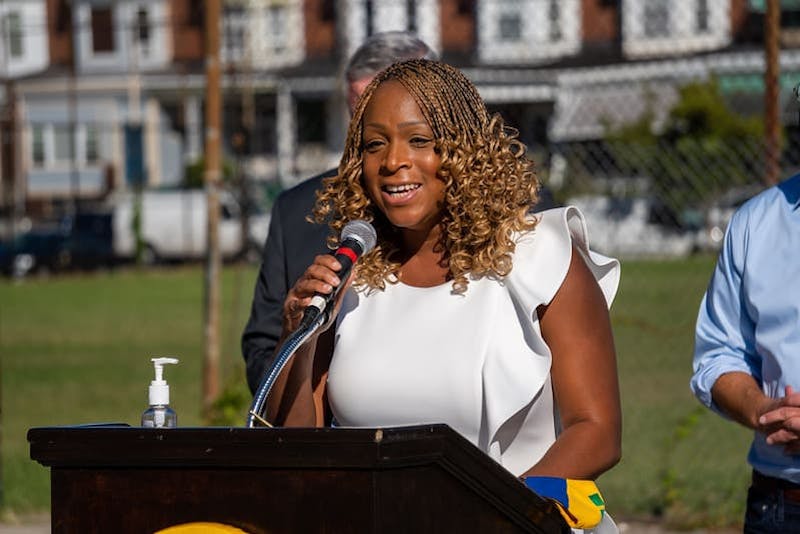
Philadelphia City Councilmember Jamie Gauthier held a press conference at Paul Robeson High School on Monday to protest the School District of Philadelphia’s plan to shut down Robeson and several other schools throughout the city.
Gauthier — whose district encompasses Penn and University City — was joined by parents of children currently attending schools slated for closure under the proposal. Speakers at the March 23 event offered alternative proposals to revitalize the schools rather than shut them down.
The District’s “Facilities Master Plan,” unveiled in January, threatens to close three schools in Gauthier’s district of West and Southwest Philadelphia — Blankenburg Elementary, Robeson High, and Parkway West High schools — along with 15 other schools across the city. Last month, the plan was revised to close two fewer schools, but all three West Philadelphia schools would still be shut down under the proposal.
A request for comment was left with Gauthier’s spokesperson.
“Paul Robeson is a high-performing magnet school,” Gauthier said during the conference. “They have a 96% graduation rate and they send students to places like Harvard.”
She added that despite School District of Philadelphia superintendent Tony Watlington previously describing Robeson as a “model school,” it is still slated for closure.
At the event, Robeson Home and School Association President Samantha Bromfield spoke about the school’s small class sizes and close teacher-to-student ratios, which she says allow “students with IEPs to thrive in a great environment.”
Robeson currently offers a program that exposes students to possible careers in Human Services. Parkway West has a similar Career and Technical Education program, which Gauthier said helps address “Philadelphia’s crippling teacher shortage.”
Robeson alumnus Tyrese Prince emphasized the value of these programs at the schools during the conference, adding that Robeson “doesn’t just prepare students academically, but it prepares them for life — exposure to careers in Human Services, mentorship programs, and college readiness initiatives.”
The speakers at the conference urged the city to consider making improvements to Robeson rather than closing it down.
“Instead of shutting down Paul Robeson High School, we should be uplifting it, investing in it, expanding the very programs that make it special,” Prince said.
At the event, Gauthier announced an alternative proposal to avoid closing Robeson and instead design a new building for the high school. The plan also would establish a new “educational hub” to “keep Blankenburg Elementary and Parkway West in our communities.”
She said the new hub — which would co-locate Parkway West and Blankenburg into a currently under-used building — builds on “these schools’ existing strengths of career readiness, autism and special education support, and strong local partnerships, all while achieving the facility plan stated goal of reducing student transitions.”
“The district was unable or unwilling to build a plan that serves our kids, and so we did it ourselves,” she added.
Speakers also noted Robeson’s proximity to Penn and University City, which Bromfield described as “a great location that is highly gentrified.”
Penn’s Netter Center for Community Partnerships currently partners with Robeson for their University-Assisted Community Schools program, which allows Penn community members to assist at local schools. The Netter Center also hosts an Academic Based Community Service course where Penn students perform community service-related tasks at Robeson.
A request for comment was left with a University spokesperson.
“Closing Paul Robeson — the last high school in University City’s heart — sends a message to Black and brown kids that they don’t belong in neighborhoods of opportunity,” Gauthier said.
Several of the schools affected by the city-wide proposal currently have partnerships with Penn. Along with Robeson, Lankenau Environmental Science Magnet High School in Northwest Philadelphia has partnerships with the Water Center at Penn and the School of Social Policy & Practice.
“The experience of interacting with a school with the reputation of Penn for any student, for any student, is absolutely invaluable in a way that just visiting the campus isn’t,” Lankenau teacher Meredith Joseph previously told The Daily Pennsylvanian. “It really allows our students to see themselves in those spaces.”