
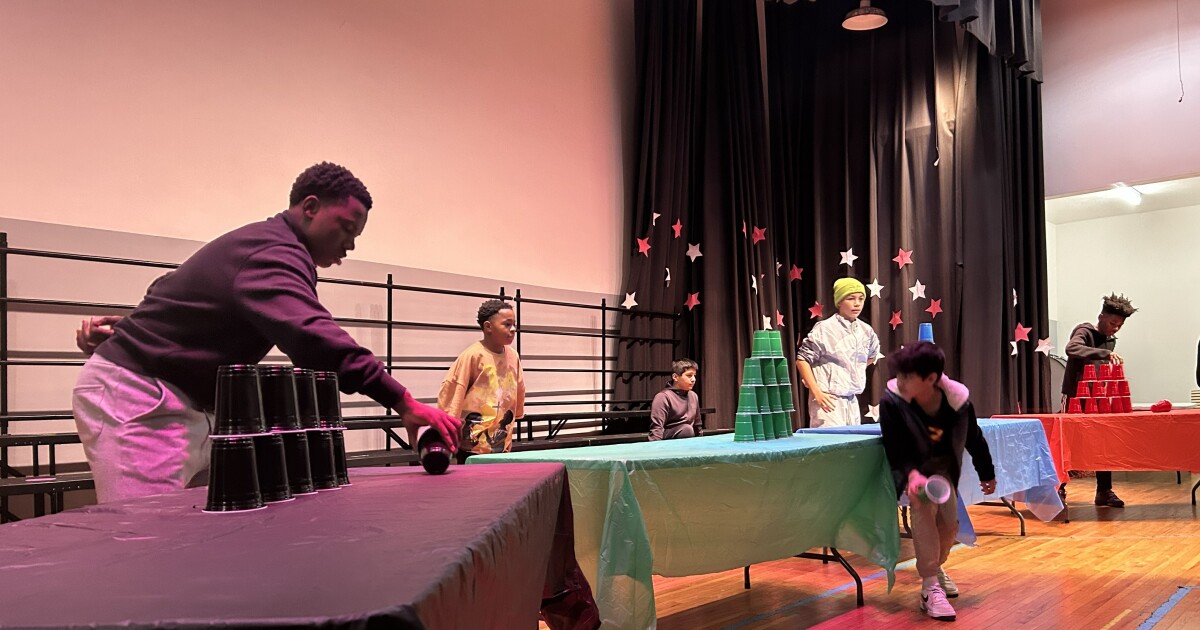
It’s a half-day at Pittsburgh Sterrett 6-8, and the House of Esperanza is getting ready for a house meeting.
Esperzana is one of four new houses the Point Breeze middle school introduced this year. Educators at Sterrett are taking a page out of the Harry Potter series, in which Hogwarts students are sorted into four houses.
But instead of Gryffindor and Hufflepuff, Sterrett’s teachers created houses based on values they want students to embody:
Esperanza, meaning hope in Spanish, is the house of perseverance Stallion is the house of power, with black stallions symbolizing freedom and empowermentMamba is the house of endurance, inspired by basketball legend Kobe Bryant’s signature “mamba mentality” And Tikanni, Inuit for wolf, is the house of community, emphasizing the strength of a bonded wolf pack
Educators say it’s all part of an effort to build a sense of community and belonging inside the school — one that’s resulted in improved attendance, discipline rates and classroom engagement.
“Even though we became a little more competitive, it also shows our leadership and how we can — instead of getting angry from not winning — support the other houses,” said Annalee Frye, one of Esperanza’s house leaders.
Sterrett is one of nine Pittsburgh Public Schools piloting the house model this school year, and district administrators say they plan to expand the program to 13 more PPS middle schools this fall.
At Sterrett, students across grades meet regularly with their collective houses for team-building activities, lessons on conflict resolution, and schoolwide competitions.
Frye, an eighth grader, said that’s led to some positive changes: her peers are more patient with one another and less disruptive in class, she said.
“And as phoenixes do, we rise,” Frye said, referencing Esperanza’s team mascot, the phoenix. “So if there’s a problem, we will maybe get low, but then we’ll rise.”
Attendance and behavior gains
In February, attendance at Sterrett was up 3 percentage points compared to the same time last year. Suspensions were down 32%.
Melissa Pearlman, assistant superintendent of instructional leadership, credited the feelings of belonging and mutual accountability that the house model fosters.
“Now they’re coming in knowing that it’s not just about them, but it’s about everybody else that relies on them,” Pearlman said. “Their teachers, the people in the cafeteria, all of their peers.”
Teachers from each of the nine schools piloting the program traveled to the Ron Clark Academy in Atlanta, Ga., this past summer to see its house system in action.
The nonprofit middle school offers multi-day workshops that teach principals, administrators, and educators how to implement a house system that incentivizes positive student behavior and improves school culture.
Science teacher Briana Weatherspoon visited the Atlanta school in 2024 and 2025. She worked with the school principal and a team of teachers to develop a version of the house model adapted for Sterrett.
Teachers came up with their own symbols, colors and mottos to represent each house, Weatherspoon said.
“We really wanted the teachers to buy into it. We wanted the kids to buy into it,” she explained. “Usually you buy into something that you have to put work into, something that you have to build, something that you feel is your own.”
Jillian Forstadt
/
90.5 WESA
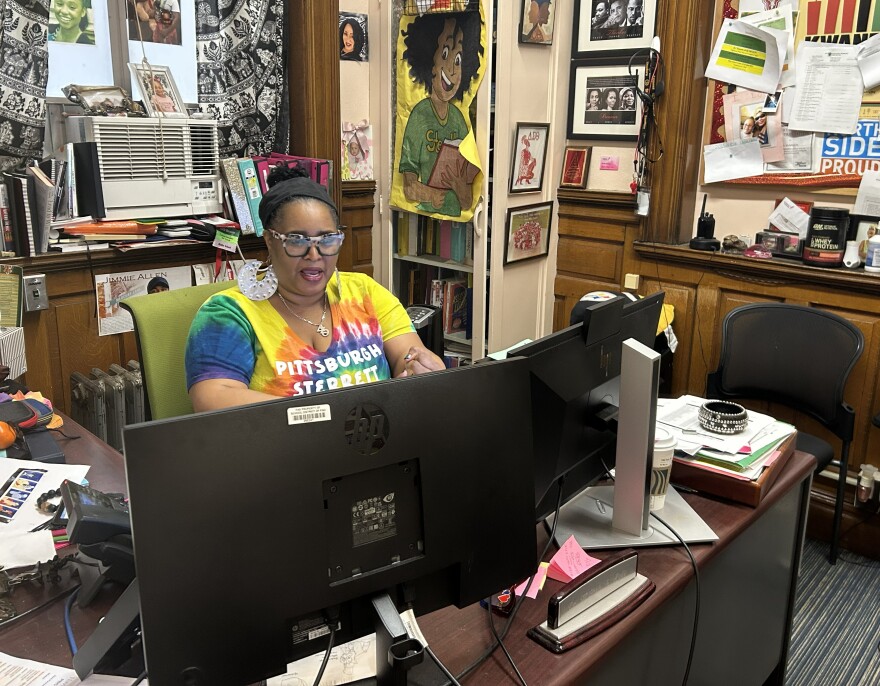
Pittsburgh Sterrett 6-8 principal MiChele Holly gives students a motivational pep talk as part of the morning announcements on Feb. 6, 2026.
At the start of this school year, staff held a celebratory sorting ceremony for students in the school’s gym. Teachers, cafeteria employees and the school’s security guard were also sorted into houses.
The principal, MiChele Holly, has remained a neutral party. She wears a rainbow shirt with all of the house colors during competitions.
“The goal is for any student to come walk into any house and feel a connection with at least one person,” Weatherspoon said. “You’re my math teacher, or you’re just on the team, or I saw you at lunch… at least an entry point for every student in every house.”
Research shows that strong relationships between students and teachers can boost student reading and math scores, as well as class participation.
It’s part of the reason schools across Southwestern Pennsylvania are adopting the house model as they work to fight learning declines and persistently high rates of chronic absenteeism in the region and nationwide.
“The house system gives teachers a very concrete structure to build those relationships around and to ensure that they’re doing those positive things that will lead to those positive outcomes,” said Jackie Foor with the Consortium for Public Education.
Over the past two years, Foor’s nonprofit has brought together more than 200 Western Pennsylvania educators implementing the house system. Teachers in the cohort trade best practices and work through common challenges, such as securing staff buy-in and gathering low-cost resources for activities.
They’re also working to envision a “regional house system” with a common framework across schools. Foor said this could prove helpful for transient students, such as students experiencing homelessness, as they transition between schools.
Holly also sees the house system as a way to prepare students for major changes, such as the leap to high school, or from one building to another as a result of school closures.
Under the district’s hotly-debated Future-Ready Plan, all combined K-8 and 6-12 schools would be restructured to serve either K-5, 6-8 or 9-12 students. Sterrett would absorb some middle school students attending nearby Westinghouse 6-12, slated to become a traditional high school.
“We wanted this to be our year where we got this together, before our school doubled in size,” Holly explained.
District administrators are still waiting for an affirmative vote from the Board of Education to enact their plan, and any school closures would not take place until after the end of the 2026-2027 school year.
But assistant superintendent Pearlman said the district is committed to improving the culture across PPS middle schools regardless of building configuration.
“And so that’s why we made the commitment that every middle school will begin the house process, whether they’re in the early stages of learning or in full implementation, like here at Sterrett, next school year,” she said.
Tapping new leaders
Duquesne City School District is now in its second year with the house system in place for seventh and eighth graders. According to the district, disciplinary incidents dropped by 74% in the first year of the program.
Jillian Forstadt
/
90.5 WESA
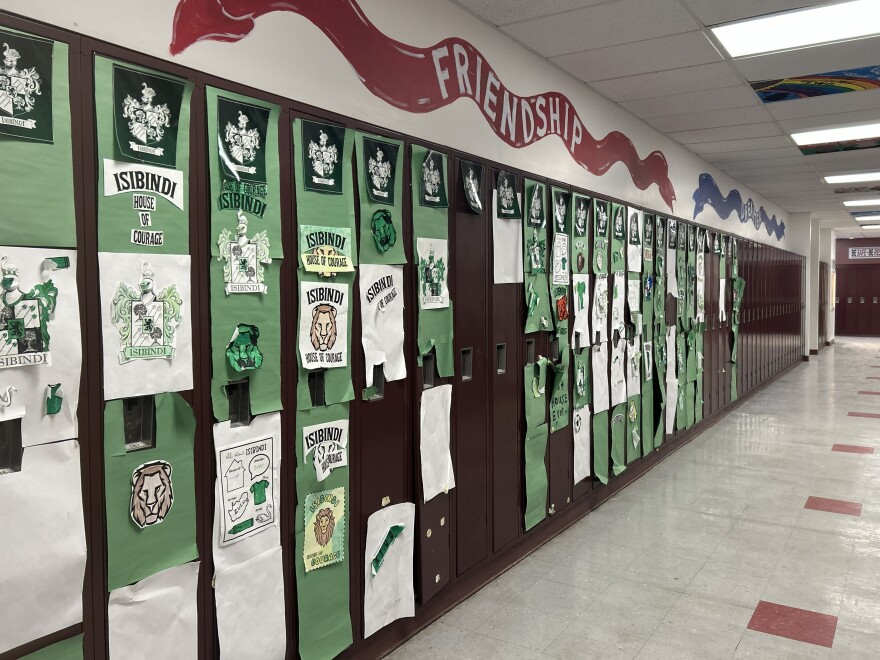
At Duquesne City School District, middle schoolers are sorted between Altruismo (the house of giving), Amistad (the house of friendship), Isibindi (the house of courage), and Rêveur (the house of dreamers).
The district, which received funding from Huntington Bank and Remake Learning to implement the model, now plans to expand the program to include fifth and sixth-grade classes.
“The whole idea of a positive behavior intervention system is to get them to jump through the hoops that we want to jump through, and it’s kind of masked as a game, as a competition,” said social studies teacher Lucas Wilson.
One way schools are getting students to buy into the new house system is by selecting peer leaders for each team — and not necessarily the students known to raise their hands for every role.
“I really didn’t want to be a house leader at first because everybody else did,” said Sterrett seventh grader Maurice Murray.
“But then I just accepted being a house leader because I might as well,” he said. “I mean, they called me a good kid and stuff, so I was like, ‘Okay, I’ll do it.’”
Murray is now one of the house leaders for Tikanni, the house of community. While he said he was at first nervous to speak in front of his peers, he got used to it as he began speaking up more and more.
Jillian Forstadt
/
90.5 WESA
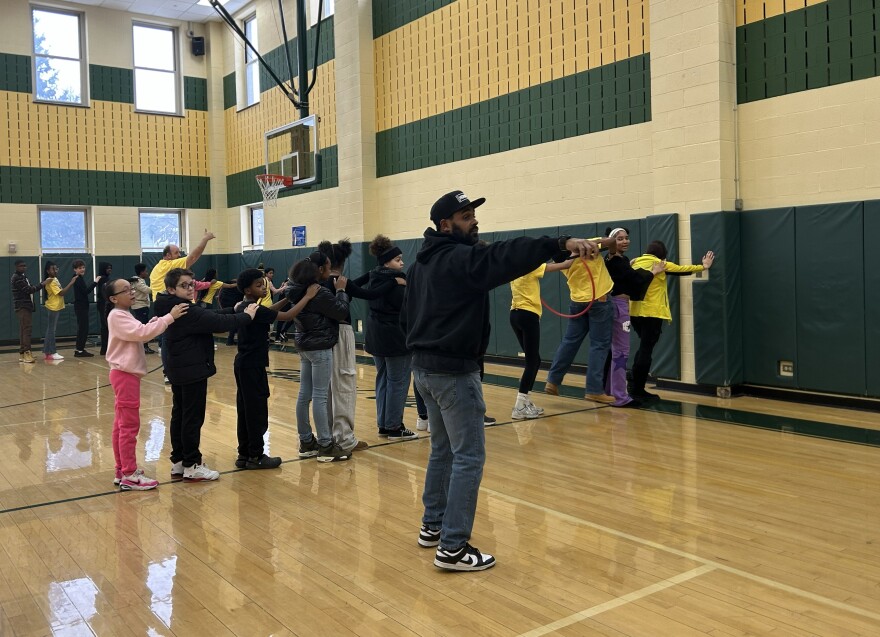
PPS students in the House of Mamba participate in team-building activities in the school’s gymnasium on Feb. 6, 2026.
And Murray agrees that the house system has made his classes better. He also said he feels more connected to the teachers and students sorted into Tikanni.
While the house system has bonded students and adults, Holly said conflict can still arise. The difference, she explained, is that students now have safe adults within their house to confide in.
Conflict management and emotional regulation lessons are also integrated into house meetings.
“Remember, this is middle school,” Holly laughed. “If you were changing houses because of a conflict, you’d be changing houses every day.”