
EOS_0392 Large
Building a better scanner
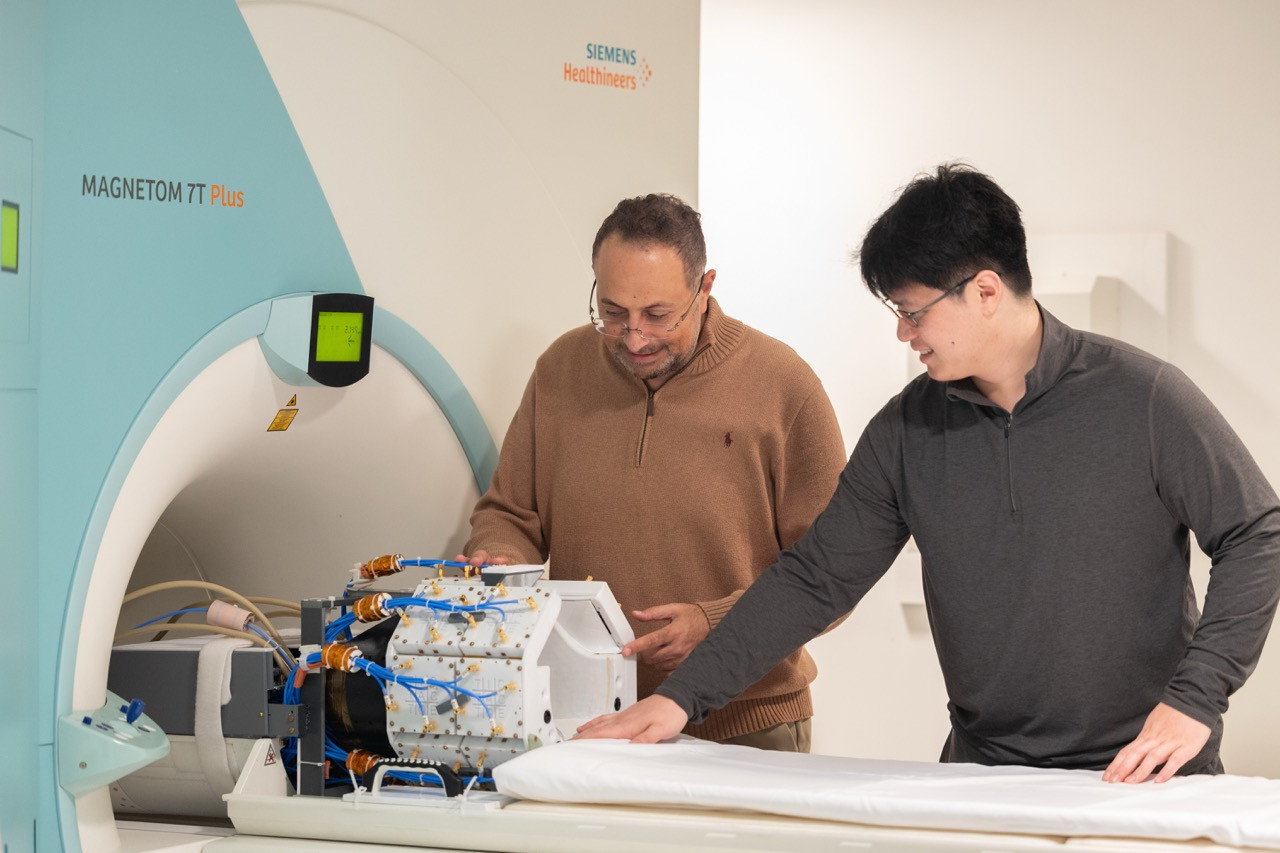
Magnetic resonance imaging (MRI) uses strong magnetic fields to create detailed images of the body’s tissues and organs. The magnetic flux density—measured in the unit Tesla (T) —helps determine the level of anatomical detail visible in the scan. While most MRI scanners operate at 1.5T or 3T, Ibrahim has developed specialized radiofrequency coils that allow Pitt’s 7T system to fully leverage this ultra-high magnetic field and deliver exceptional quality images.
“This publication shows that 7T provides more reliable and sensitive morphometric measurements when compared to 3T,” Ibrahim said. “For research questions involving subtle structural differences or longitudinal change in the brain, high performance 7T MRI is definitely the way to go.”
The large-scale, first of its kind study analyzed brain morphometry in 350 healthy adults between the ages of 29 and 68, each of whom completed imaging sessions at both 3T and 7T. The research team evaluated cortical and subcortical volumes, cerebral white matter, and mean cortical thickness. Across all measures, 7T demonstrated stronger correlations with age and revealed a greater number of brain regions, exhibiting more statistically significant age associations compared to 3T.
“Because 7T produces higher-contrast, lower-noise data, researchers need substantially fewer participants to detect meaningful effects with our 7T technology.” Ibrahim said. “Studies that would require 350 participants at 3T could achieve statistical significance with approximately 100 participants at 7T.”
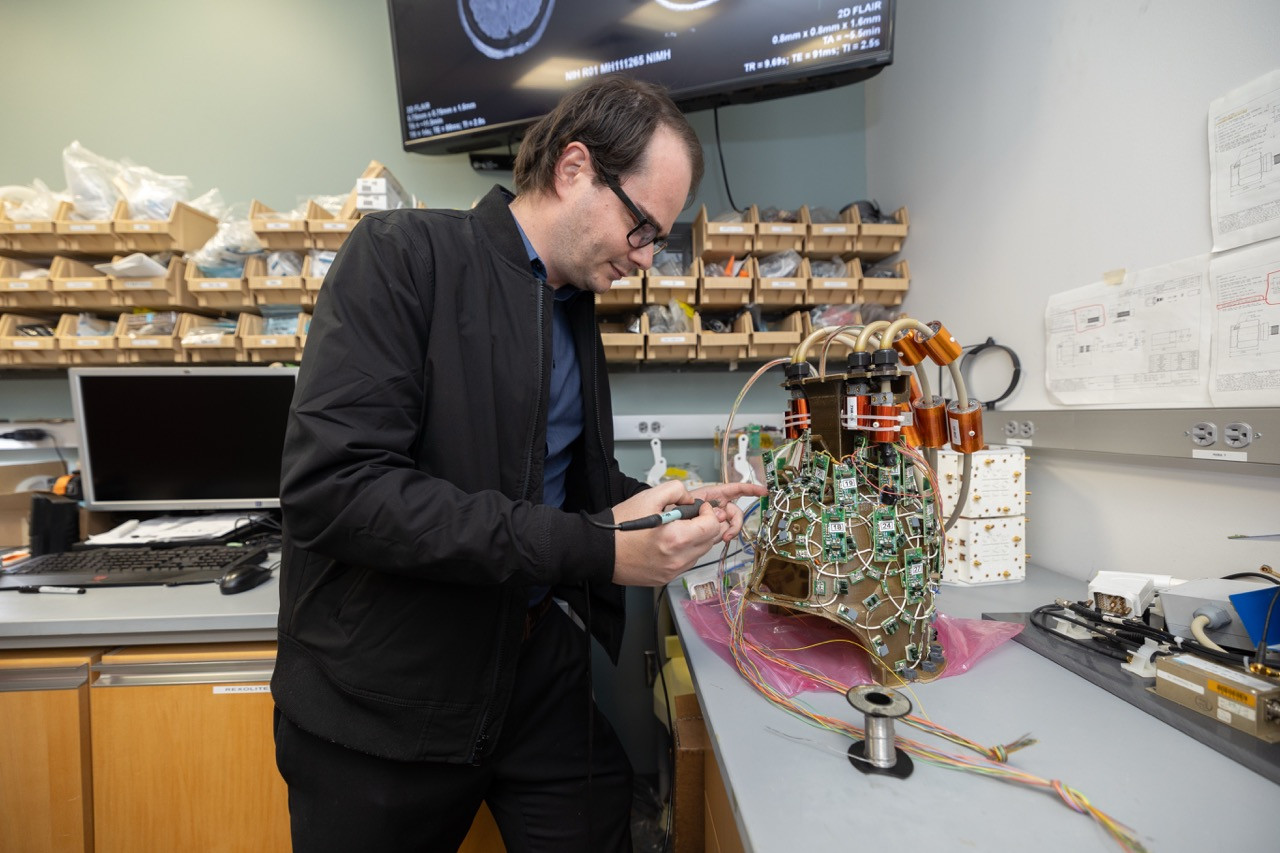
While 7T scanners exist at other institutions, their adoption for large-scale human studies has been limited since the magnetic strength can cause distortions and inhomogeneity in the images. Ibrahim and the 7 Tesla Bioengineering Research Program (7TBRP) have been troubleshooting these limitations for over the last 20 years by developing a custom radiofrequency coil system, Tic-Tac-Toe, which enables the 7T scanner to work smoothly and create the sharpest images possible.
“There are significant challenges when scanning at 7T. The interactions between the electromagnetic waves and tissue can lead to regions in the brain where there’s simply no MRI signal to detect.” Ibrahim said. “But our anti-claustrophobia Tac G2 coil system is, to my knowledge, the only one in the world that has successfully and comprehensively solved this problem. We don’t have those voids in our 7T images, and there are no barriers to running all types of MRI studies at 7T.”
Following the successful development of the first generation coil system, Tac G1, which was used on about 2,000 in-vivo human scans, the Tac G2 coil system implemented in 2022 has been used on more than 2,500 in-vivo human scans, exceeding the Tac G1’s usage in less than half of the time. This development has since enabled over 40 NIH-funded studies across aging, psychiatry, neurology, and cognitive neuroscience.
‘;