
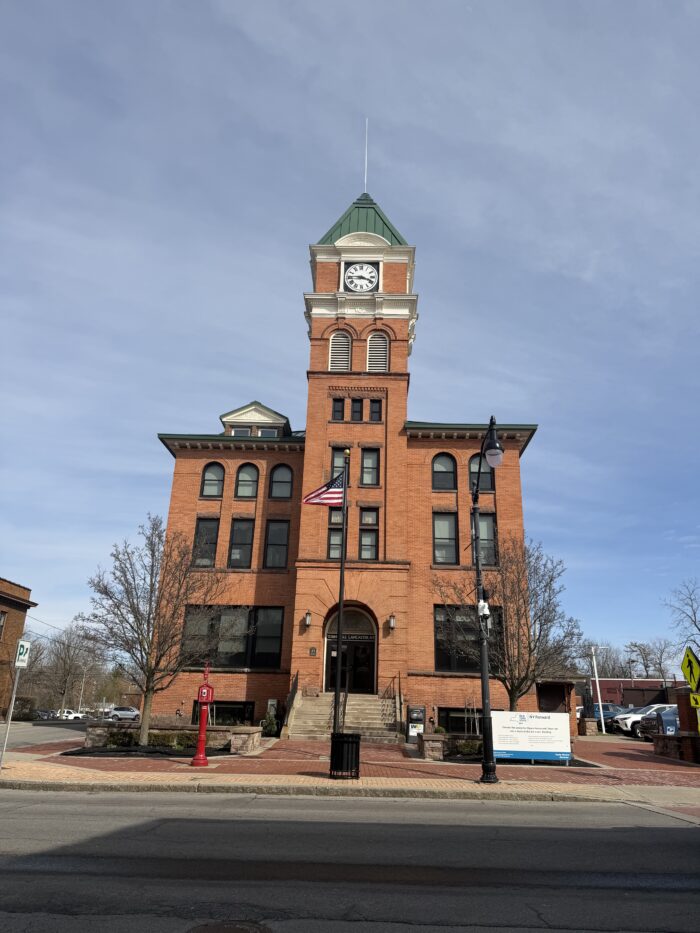
In addition to Buffalo, five major municipalities in Erie County have received money to address opioid addition, which has killed hundreds in their communities. Between them, they’ve spent less than half of the funds. Some of what they have spent misses the mark.
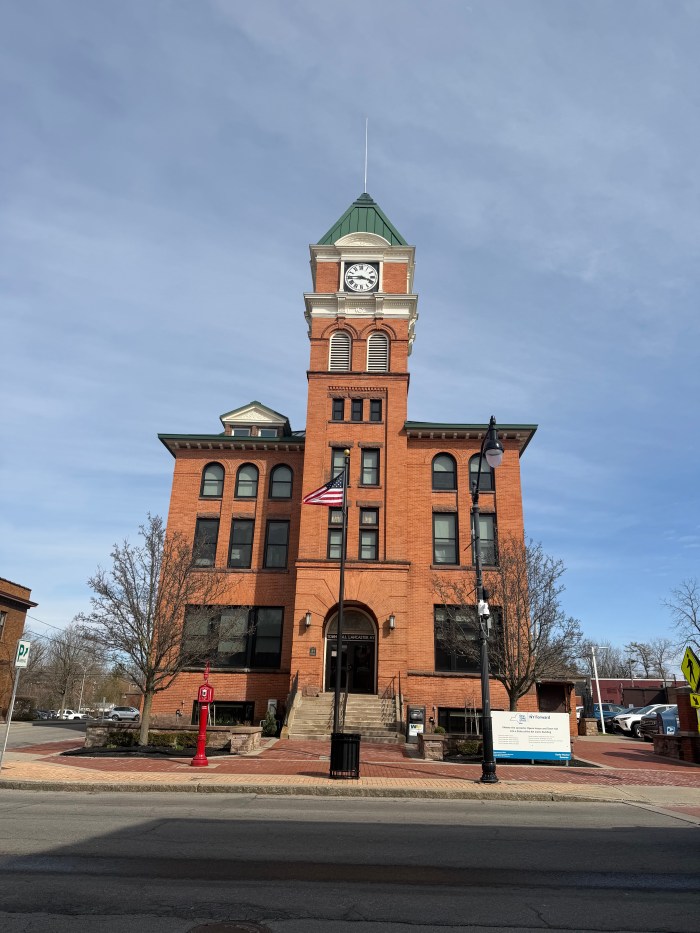
Lancaster Town Hall. Photo: Adam Smith-Perez.
Five of Erie County’s largest municipalities have spent less than half of the $417,990 they’ve been allotted by a state agency in the past three years to fight opioid addiction. In that time, at least 386 people died of overdoses in those communities.
The towns of Lancaster and Tonawanda haven’t spent any of the money they’ve received. The Town of Amherst has used only a portion of its funds. Cheektowaga town officials provided an incomplete accounting of the town’s spending.
The City of Lackawanna has spent most of its money — derived from settlements to lawsuits against opioid manufacturers — but on equipment that has little or nothing to do with combatting opioid addiction.
Dr. Kelly Ramsey, an addiction specialist and former chief medical officer for the state Office of Addiction Services and Supports, says it’s time to reassess who controls the funds and how they’re being used by public officials and law enforcement.
“[Settlement funds] are getting grabbed by everyone for everything. And so it doesn’t really end up with the people who know what to do with that money appropriately.”
The five municipalities, plus the City of Buffalo and Erie County, each receive state funding to fight the opioid epidemic. Investigative Post in December reported that Buffalo is sitting on most of the $6 million it has received.
In Lackawanna, officials acknowledged they spent nearly all their funding on defibrillators for the city’s fire department — which a medical expert told Investigative Post are of little to no use in reversing an opioid overdose.
In Amherst and Cheektowaga, officials spent their state money to pay for their towns’ drug courts — including an administrator’s salary, trips to addiction conferences and transportation for participants in drug court programs, which some addiction experts say offer mixed success in combating opioid misuse and overdoses.
Meanwhile, Lancaster and Tonawanda officials told Investigative Post that they have not spent any of their settlement funding at all — more than $100,000 in total.
Tonawanda Town Supervisor Joe Emminger didn’t offer much of an explanation as to why the town has failed to spend any funds on opioid treatment programs.
“We just haven’t,” Emminger said.
He said the five-member town board will decide how to spend the town’s $61,000 allocation in the coming months. The board’s decision will be informed largely by the expertise of the town’s law enforcement and emergency medical services departments.
“I want to make sure we’re spending it in the right place,” Emminger said. “In all likelihood, we’ll spend it on training with our first responders.”
Our coverage of opioid settlement funds
The funds sent to the municipalities come from settlements won by the state attorney general — and attorney generals nationwide — in litigation against drug manufacturers and distributors for their role in the epidemic. Purdue Pharma and the Sackler family are among the most well-known targets of the lawsuits, accused of overmarketing Oxycontin, leading to an uptick in opioid addiction nationwide.
The opioid settlement funds are earmarked by law “for treatment, recovery and prevention efforts” in communities that have suffered the effects of the opioid epidemic.
According to the state Office of Addiction Services and Supports — which distributes opioid settlement funds — Lancaster has received at least $40,000 since 2023.
“Nothing has been spent,” Diane Terranova, Lancaster’s town clerk, told Investigative Post by email.
A Lancaster official told Investigative Post that they were considering using funds for opioid overdose reversal training and drug lockboxes at senior centers, ostensibly as a prevention measure for misuse.
“The way they describe how you can use the funds is very difficult to understand,” said John Trojanowsky, Lancaster’s youth bureau director.
Cheektowaga and Amherst spent on courts
According to records and interviews with town officials, Amherst and Cheektowaga have used settlement funds for their drug treatment courts, founded in 1996 and 1997, respectively.
Cheektowaga’s drug treatment court operates as a post-plea program, whereby an individual with a history of substance use, who has been arrested and charged with a criminal offense, may qualify for diversion to drug treatment instead of jail time. If they graduate from the program, the DA offers “a lesser charge, usually a violation,” according to Megan Green, the town’s drug court coordinator.
The state’s Office of Addiction Services and Supports has earmarked $246,000 in settlement funds for Amherst since 2023 through the current fiscal year. At least $68,311 has been spent on drug court expenses, according to records obtained by Investigative Post.
Jennifer Adams, interim comptroller for the town of Amherst, told Investigative Post that Amherst currently has $187,000 of settlement funding sitting unspent in a trust. She said the town expects to receive another $24,000, promised for this current fiscal year, within the next month.
So far, the town has used its opioid-fighting money to buy bus passes for drug court participants, staff training, toxicology tests and to pay to send town officials to national drug court conferences.
Investigative Post is awaiting a response to a March 5 Freedom of Information Law request for all settlement fund expenditures in Cheektowaga since 2023. The town has been allotted $61,000 since 2023, according to state records.
Brian Nowak, the Cheektowaga town supervisor, told Investigative Post that the opioid settlement funding largely covers a salary for a drug court coordinator. Nowak said the town’s general fund has to “subsidize opioid settlement funds,” specifically the general fund tax levy, to fully pay for the coordinator salary.
Christine Khaikin is a senior health policy attorney at Legal Action Center in New York City, and has worked for years advocating on a policy level to better direct how opioid settlement money is spent.
Khaikin says that state law requires that opioid settlement funds expand “treatment, recovery and prevention” efforts, rather than fill in budget holes, previously supplied by other sources of state or federal dollars.
Paying for a staff position at a drug court that has existed for decades is “a very classic example that we’ve seen in a lot of places,” Khaikin told Investigative Post.
Khaikin added that drug treatment courts results are “mixed,” and that opioid settlement spending on courts indicates a “punitive,” law-enforcement-oriented approach favored by many counties and municipalities statewide.
“A big issue can be that people in the treatment court are required to attend treatment, and then there’s a lack of community treatment available, or they don’t have the coverage that will pay for the treatment that they’ve been required to obtain,” Khaikin said.
“We haven’t prioritized community providers. We’ve just focused on funding in the law enforcement context.”
Green, Cheektowaga’s drug court coordinator, told Investigative Post that drug treatment court participants in Cheektowaga have to complete a treatment program somewhere — inpatient, outpatient, long-term residential — in order to graduate from the program.
Participants also have to attend “two self-help meetings” a week and are subject to random toxicology screenings three times a week — the costs of which are also covered by opioid settlement funds.
Green said that for every 1oo people who graduate from Cheektowaga’s yearlong drug court program, “usually only one or two get rearrested.”
Neither Cheektowaga nor Amherst’s drug treatment recent court success and failure rates were publicly available online. Amherst’s drug treatment court staff did not respond to requests for interviews or an emailed set of questions.
Defibrillators for opioids in Lackawanna
In March 2024, the city of Lackawanna used opioid settlement funds to purchase $33,420 worth of automated external defibrillators, or AEDs — equipment that addiction experts say does little to address opioid overdoses.
Ramsey, the addiction specialist, said defibrillators are more likely to be used in cases involving cardiac arrest or certain stimulant overdoses.
“It’s not the primary intervention for opioid overdose,” she said.
The exception, according to Ramsey, is a drug user with underlying cardiac issues.
“But that’s not the typical physiology or pathology that occurs in an opioid overdose.”
Public health officials in other states agree.
Subscribe to our free weekly newsletters
For example, California’s guidelines for opioid settlement spending have strongly discouraged spending funds on defibrillators.
Antonella Peterson, a research assistant for the Opioid Policy Institute who studies public health at Yale University, worked for years as a volunteer emergency medical technician in West Virginia and subsequently in military medicine. She said the money for equipment like defibrillators should come from a municipality’s general fund, not settlement dollars.
“I can say with confidence that this is a kind of vibes-based spending. It feels good to use this money for our emergency services,” Peterson told Investigative Post.
But that’s not what it’s meant for, she said.
“This [money] is to address the hurt that our communities have experienced in connection to the opioid epidemic.”
Chuck Clark, spokesperson for the City of Lackawanna, insisted that defibrillators were a legitimate use of opioid settlement dollars.
“Based on the external EMT training provided to city firefighters, Automated External Defibrillators (AEDs) are considered a first line of defense for treating and reviving opioid patients; therefore, purchasing them with opioid settlement funds is appropriate,” he wrote in an email response to Investigative Post’s inquiry.
Clark said Lackawanna has received $44,356 in opioid settlement dollars and has a balance remaining of $8,484.
Ramsey, the addiction specialist, said opioid settlement dollars are appropriate for some medical equipment purchases. Since opioid overdoses happen as a result of breathing failure, she said, two evidence-based ways funds could be spent are oxygen tanks and pulse oximeters — the small device you get on your finger at the doctor’s office to check oxygen levels in the blood.
The City of Buffalo has a poor record of spending — or not spending — settlement funds.
According to city records, Buffalo law enforcement has spent more than $575,000 of its opioid settlement funds on vehicles and related equipment, including speakers for a fireboat.
In addition, the city offered Save the Michaels, one of Buffalo’s most well-known addiction services nonprofits, $500,000 in opioid settlement funds in April 2024. The funding was earmarked to renovate a building and pay for staff salaries at a transitional housing facility on the East Side. The project remains unfinished. Since February, Erie County and the Office of Addiction Services and Supports have canceled their contracts and funding for the nonprofit — resulting in two of its facilities closing and the possibility of a third in danger of shuttering, too.
The state attorney general’s office confirmed last week that it is currently reviewing Save the Michaels.
Adam Smith-Perez, who covers urban affairs for Investigative Post, is a Report For America corps member.
posted 19 minutes ago – March 26, 2026