
Concerns from local residents and some Erie leaders are mounting over a potential deal to lease or sell the town’s mineral rights at the site of the Draco Pad, as key discussions about the matter continue behind closed doors.
The issue stems from Civitas Resources — which recently merged with SM Energy Company — expressing interest in mineral rights owned by the town near the planned Draco well pad.
“The town was approached (by) several actors in the oil and gas field exploring potential lease of its mineral rights,” David Frank, Erie’s environmental services director, said at a December meeting of the Town Council.
To better understand the value, the council at that meeting voted 4-3 to hire Alameda Mineral Advisors to evaluate the town’s mineral assets and solicit bids from companies.
The company would only be paid if a deal is completed, receiving 7.5% of the total value, capped at $4.5 million, according to the agreement approved by the council.
Councilmembers Emily Baer, Anil Pesaramelli and Dan Hoback voted against the agreement. Mayor Andrew Moore, Mayor Pro Tem Brandon Bell and Councilmembers Brian O’Connor and John Mortellaro voted in favor.
Since then, residents have voiced frustration over the matter, which has been discussed in private talks of the council and town staff.
“I’m very concerned that decisions regarding … Erie’s minerals have been made in executive sessions and not in public sessions,” one resident told the council during a meeting this month.
“It’s going to have a negative impact on anybody that lives in Erie’s house, just depending on proximity, whether you’re up against certain assets, whether you’re getting fracked under, whether you own a well,” another resident said.
Alameda Mineral Advisors was formed in 2024 by Matthew Owens, whose LinkedIn shows him as the former chief operating officer of Civitas, the company tied to the Draco Pad site.
An email sent this week, addressed to the Erie Town Council, said: “And this deal is being brokered by an individual who used to work for this company. And we are paying this person millions of dollars??”
The email adds: “I’d also ask that you consider a more open approach with the public—this is not your land to broker, it is ours.”
Owens could not be reached by the Daily Camera for this story.
Mineral rights tied to the Draco project
Mineral rights give their owner the legal ability to access and extract underground resources such as oil and gas — or to lease or sell that access, according to a Cornell Law School webpage.
Erie’s mineral rights that could be leased are within the drilling area tied to the Draco Pad, a project the Colorado Energy and Carbon Management Commission in March 2025 approved in a 4-1 vote despite concern from the nearby community. According to Civitas’ website, the Draco project has “pad construction” scheduled for this year, which will include “construction of sound walls to minimize disturbance to the surrounding area.”
The project calls for 26 wells in unincorporated Weld County near Erie, and would drill more than 7,000 feet down and then extend horizontally for roughly five miles, according to the town, reaching beneath parts of Erie and Boulder County.
Town officials previously said they were disappointed in the state’s decision but would continue working to protect residents.
Divided council
Baer called the potential leasing of the town’s mineral rights a “slippery slope.”
“This seems like a departure from our stance as a town, where suddenly we’re entertaining lease offers,” Baer said in December. “My principles are not up for purchase.”
Bell pushed back on that comment, framing the effort as due diligence.
“I’m a little put off by that remark,” Bell said. “My integrity is worth more than a business deal. This is not a business deal. This is fiduciary responsibility, which we owe the residents.”
Moore said the goal is to understand what options the town has.
“If you assume that Draco is going to get drilled, then I want to get something out of it for the town,” he said.
‘An opportunity to see if Draco can be stopped’
Recent state legislation puts the town in “uncharted territory,” Frank said. The town has leased its mineral rights before but hasn’t done so “in a long time.”
“In the past, the choice was to negotiate a lease or a sale or be force-pooled. And so it was always in your interest to find a deal,” Frank added in December.
Force pooling is a process by which any interested person, “typically an oil and gas operator,” according to a definition from the state, may apply to the Colorado Energy and Carbon Management Commission for an order to pool oil and gas resources located within a particularly identified drilling unit.
But a 2024 state law limits the ability of oil and gas operators to “force pool” mineral owners — including local governments — into drilling units without consent.
That means if Erie refuses to lease or sell its mineral rights, those resources generally cannot be included in a drilling unit within town boundaries.
Frank said invoking that protection could force a redesign of the drilling plan near the Draco Pad.
“If we refuse all lease offers, presumably ECMC would be compelled to request an alternate spacing unit that does not include those parcels,” he said.
“I see this as an opportunity to see if Draco can be stopped. If there is even 1% chance, I want to go with that and see because we have heard from our town loud and clear,” Pesaramelli said in December.
‘Veil of secrecy’
Beyond the policy debate, residents and council members opposed to a mineral rights deal say there is another issue at hand: transparency.
The town has yet to publicly share the valuation of its mineral rights, despite earlier expectations it would be available in January, Hoback said this week.
“Is council going down the path of creating a contract without any transparency?” he asked.
In a social media post this month, Moore wrote: “What I can share right now is that no agreement has been reached. If a set of terms is agreed to in principle, they will be presented in a transparent public hearing. This will be a critical space for our community to weigh in on whether the proposal truly serves the best interests of Erie.”
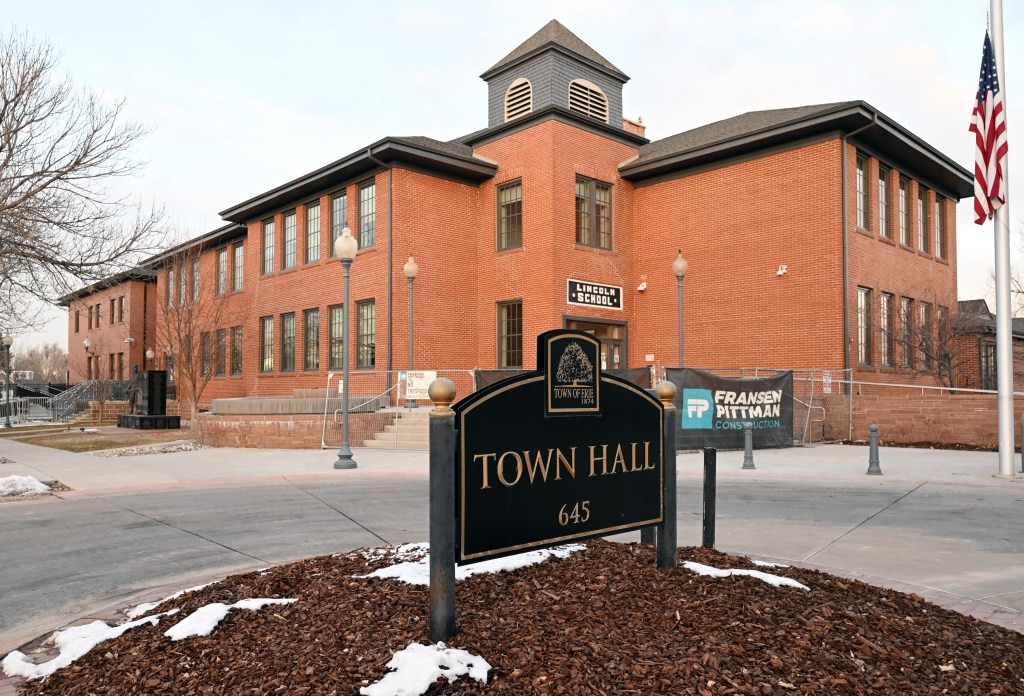
Moore added that he will be able to address further questions from the community during a “State of the Town” scheduled for 6-8 p.m. April 2 at Erie Town Hall.
But Hoback said he is “not convinced that a state of the town meeting is sufficient,” adding: “I am calling upon the council and the mayor who sets our agendas to have a council session that allows for an open discussion on this topic. … I’m prepared to continue trying to use whatever legal rules we have at our disposal to slow down and pierce the veil of secrecy.”