
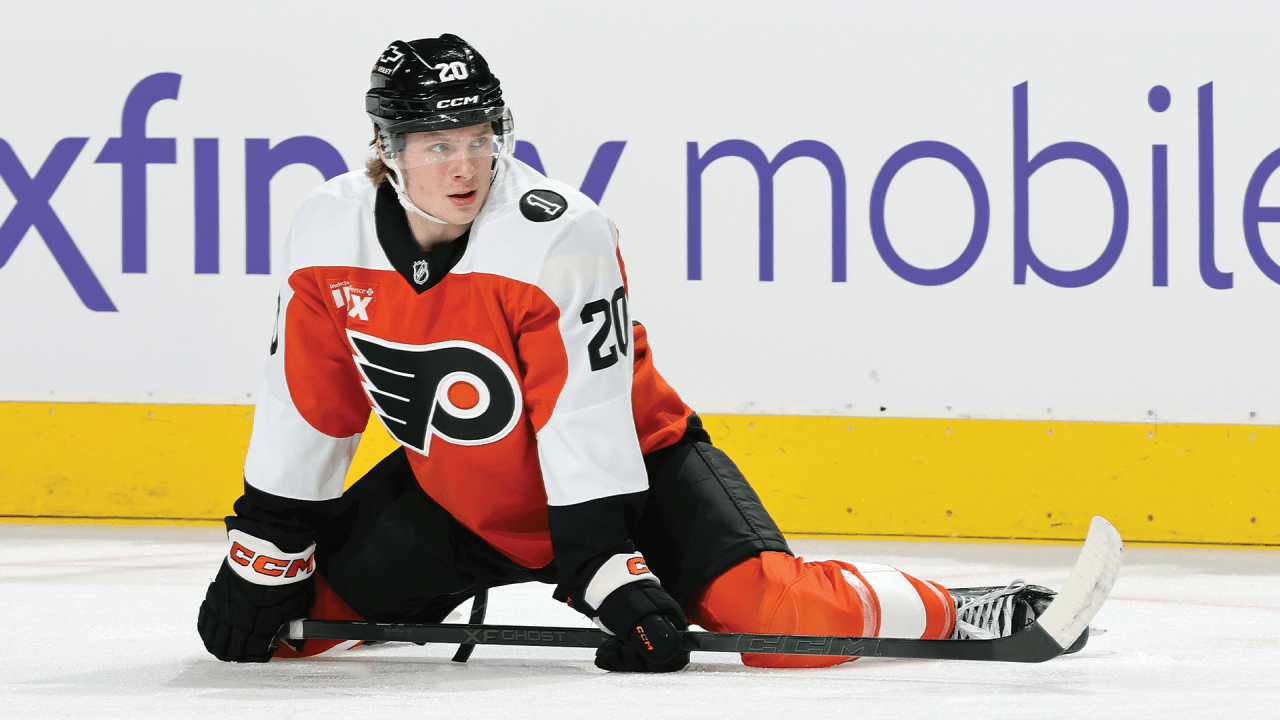
The Philadelphia Flyers have a tall order at hand this weekend: a road/home back-to-back set against the Detroit Red Wings and Dallas Stars. Realistically, the Flyers need to win both games to stay alive in the Eastern Conference playoff chase. It won’t be easy. Philly needs a regulation win in Detroit on Saturday to pull even in points with the Red Wings. Detroit would still be ahead in the standings by tiebreaker. Dallas, meanwhile, has the second-best record in the entire NHL this season.
For Flyers head coach Rick Toccchet and his players, however, the chance to potentially play meaningful hockey games into April represents a valuable opportunity. One of the main keys to navigating must-win games, according to Tocchet, is to keep with the same daily routines players follow all season.
“Just because the moment is so big, don’t change things. Like all of the sudden, you go, ‘I don’t want to talk to anybody. I’m just gonna go to bed early,” Tocchet said before Thursday’s game against the Chicago Blackhawks.
Tocchet speaks from plenty of personal experience. He recalls that, on the night before the Flyers played Game Seven of the 1987 Stanley Cup Final against the Edmonton Oilers, he altered his regular routine. He didn’t socialize with teammates. Instead, he ordered room service at the team’s Edmonton hotel and then he went to bed exceptionally early to make sure he got extra rest.
Unfortunately, Game Seven didn’t go the player’s way. Tocchet, who built his career with a physically aggressive style — and compiled 21 points through the first 26 playoff games — played an overly cautious match in the deciding game. He was a non-factor (one shot on goal, zero points,no memorable hits), Two games earlier in Edmonton, Tocchet played his customary game. He ended up scoring two goals and assisting on a Pelle Eklund power play goal to spearhead a 4-3 comeback victory.
In hindsight, Tocchet wished he’d approached Game Seven no differently than he did every other game of the Flyers’ playoff run. The next time he found himself one win away from the Stanley Cup (as a member of the 1991-92 Pittsburgh Penguins), Tocchet did not psyche himself out. He stuck with his normal routine and did not overthink every play on the ice. In the first period, Tocchet assisted on a Kevin Stevens tally. Later, he scored a go-ahead goal on the first shift of the second period. Pittsburgh won the game, 6-5, and captured the Stanley Cup.
Thirty-four years later, as the Flyers’ head coach, Tocchet said he’s related to his players things he learned about preparing for the season’s biggest games: Don’t change anything you normally do.
Tocchet said, “It’s no different, like, if you’re on a breakout and [a teammate] gets open. There’s five minutes left. Get the puck to him. But sometimes the moment’s so big, you’re thinking, ‘I don’t want to puck the puck over the middle. I’ll just rim it off the glass.’ You’ve got to have the confidence to make that play. Just because the moment is there, don’t defer. If there’s a chance to make a play, make a play.”
Most NHL players have big game experience at lower levels of the sport. Tocchet has emphasized to players such as Trevor Zegras and Matvei Michkov that seizing the moment in a vital NHL game doesn’t take a different mentality than doing it, for example, in international junior play. It’s about trusting one’s instincts.
Along the same lines, Tocchet has talked to Flyers rookie forwards Denver Barkey and Alex Bump about seizing the moment at the NHL level. Don’t defer to older, more experienced teammates. If there’s a shot, take it. If there’s an opportunity to make a play with the puck, act instinctually.
Coincidentally or not, both Barkey and Bump had strong games — including a goal and an assist for Bump and a goal for Barkey — in the 5-1 win over Chicago. They went to the net and played aggressively and got rewarded for it.
“I haven’t been getting as many shots lately So it’s about getting to open areas and getting the puck off,” Bump said.
On Thursday night, the Flyers showed a willingness not only to battle for time and space but to shoot the puck rather than passing up opportunities. It produced 42 shots on net and five that lit the lamp. Now the challenge is to replicate the process in Detroit and against Dallas.
“We played a good game and we’re feeling good about ourselves. But tomorrow is another day,” Tocchet said.
Regardless of what happens over the final 11 games of the season, the Flyers need their players — youngsters and veterans alike — to take the lessons they’ve learned from Thursday’s win and the 7-2-1 stretch that leads into this weekend. The lessons don’t change from season to season. It’s experience of actually going through a stretch drive (and eventually the playoffs) that build winning teams in the long haul.