

As the federal government tries to erase history, Philadelphia has a chance to preserve it in bigger, bolder ways than it ever has before by honoring Judge, the woman who escaped slavery under President George Washington.
Get a compelling long read and must-have lifestyle tips in your inbox every Sunday morning — great with coffee!

We need an Ona Judge Day. / Illustration by Natalie Hope McDonald
Listen to the audio edition here:
When, on January 22nd, National Park Service workers unceremoniously crowbarred the slavery-memorial panels off the walls of the President’s House at 6th and Market streets, the outrage in Philly came fast and furious. The NPS was, of course, acting on the order of President Donald Trump, who claimed that the exhibits at the outdoor historic site were “part of a concerted and widespread effort to rewrite our Nation’s history, replacing objective facts with a distorted narrative driven by ideology rather than truth.”
Also, of course — this being Philadelphia — we called bullshit.
Aside from the sheer offense at being bossed and usurped (we don’t much like that), there was also shocked anger over what felt like a real loss: Those panels, displayed prominently at a widely visited national historic site, shared a true story whose objective facts were being obliterated.
The objective facts are this: When President George Washington resided in Philly, he held nine human beings captive: Hercules, Moll, Austin, Christopher Sheels, Giles, Paris, Richmond, Joe, and a woman named Ona Judge — the only one of the group who managed to escape. Her story was told prominently at the site.
From before sunup to well past sundown, Judge and her fellow slaves prepped meals; scrubbed floors; cared for kids; emptied stinking chamber pots; mucked out stalls; husbanded the horses; chauffeured the carriages; sewed up the satins, silks, and velvets worn by their entitled owners; and Lord knows what else. Their nightly reward? Sleeping in a dank, cramped basement, then rising early to start the backbreaking work all over again. Right here in our Northern, non-slave-owning city. The cradle of liberty.
These facts were brought to light for all to see in 2002, when excavation at the site of the President’s House revealed shocking evidence that these enslaved men and women had lived there. A dignified exhibit was eventually erected to honor their memory, its 34 panels depicting their lives with elegant, wrenching simplicity. Removing the exhibit felt akin to burying Washington’s slaves deep beneath the President’s House all over again. The city itself sued the NPS, claiming that the feds had no authority to mess with the exhibit without Philly’s approval.
Happily, U.S. District Judge Cynthia M. Rufe was also having none of it; on February 16th (which was Presidents’ Day, because God loves irony), she called bullshit too.
In a thrillingly pissed-off decision, Rufe — a 2002 George W. Bush appointee — ordered the Trump administration to “restore the President’s House Site to its physical status as of January 21, 2026.” The preliminary injunction holds while the city’s suit moves through the court.
“An agency, whether the Department of the Interior, NPS or any other agency,” she wrote, “cannot arbitrarily decide what is true, based on its own whims or the whims of the new leadership, regardless of the evidence before it.”
Preach!
I sure hope the court’s final decision will ensure that the memorial stays in place for good. But you know what? If we’re to spare the stories of Washington’s slaves from the “whims” of America’s current or future leaders, restoring the panels isn’t enough. Not by a long shot.
That’s why it’s time for Philadelphia to meet this moment and go big, to counter Trump’s wrong with a right that’s 10 times louder.
Let’s host an annual Ona Judge Day to recognize the life and the bravery of the lone enslaved person who escaped from the President’s House. The inaugural honor should occur this May 21st, which marks the 230th anniversary of her daring flight. In annually celebrating Judge, we’d also honor truth, and continually recommit to the privilege of telling it.
•
Ona Judge was born into slavery in Virginia around 1773, the daughter of Betty, an enslaved seamstress at Mount Vernon, and an English indentured servant. She became Martha Washington’s personal maid — close enough to power to observe its privileges intimately. In 1790, when George Washington moved the federal capital to Philadelphia, Judge was brought with the household staff to the President’s House. Philadelphia was a free city in a state that had passed the Gradual Abolition Act of 1780, which stipulated that any enslaved person who resided in the state for six continuous months could legally claim their freedom.
Washington knew this — and exploited its loophole like a pro. To prevent Judge and the eight others he held in bondage in Philadelphia from qualifying for emancipation, he deliberately rotated them in and out of the state before the six-month mark. The transfers were secret and calculated, designed specifically to skirt the law while avoiding public scrutiny. So even in a free city, Judge remained enslaved.
But her mind nonetheless expanded in wondrous ways. The city’s growing, vibrant, free Black community showed Judge what a vibrant, free Black life could look like. For six years, she moved easily around a city teeming with the likes of Absalom Jones, Richard Allen, James Forten, William Gray, and other brilliant, educated, and luminary men and women, along with business owners, faith leaders, and community organizers whose liberty offered a stark contrast to Judge’s confinement.
If the Philly of 1796 inspired Judge to flee the clutches of the country’s first president, surely the Philly of 2026 can free her story from the clutches of the country’s 47th one.”
That contrast was doubtless on her mind in 1796, when Judge, then 22, overheard that Martha Washington intended to give her as a wedding present to her granddaughter, Eliza Parke Custis — whom Judge knew to be volatile and cruel.
“I was determined,” Judge later said, “never to be her slave.”
On May 21st of that year, while the Washingtons were eating dinner, Judge slipped out of the President’s House. With the help of Philadelphia’s free Black community, she boarded a ship bound for Portsmouth, New Hampshire.
Washington was humiliated and enraged. For years, he used federal authority and personal agents to hunt her down. He pressured her through intermediaries. He even tried to kidnap her back to Philly. Judge always managed to outwit him and never returned.
With one extraordinary act of courage — defying the most powerful man in the country — Judge finally had access to an ordinary life that was fully her own. In New Hampshire, she married a free Black sailor named Jack Staines and bore two daughters and a son. Her life was hard, characterized by labor more physically grueling than her duties in the presidential household had been. She also knew deep sorrow, suffering early widowhood and then the loss of all three of her children when they were barely adults.
Years later, abolitionist newspapers interviewed her. (In this way, unlike so many enslaved Americans whose lives survive only in ledgers and property lists, Judge left us her voice — a gift.) Asked if she regretted her escape, given the hardship that followed, she answered simply, and with peace:
No, I am free, and have, I trust, been made a child of God by the means.
In celebrating May 21st each year we would remember and honor Judge, and, through her story, the millions of other children of God who toiled in bondage in America. And there’s no better place than Philly to do it, given the original tension that exists here: Nine enslaved people lived feet from where schoolchildren now go to learn about the Constitution, blocks from where slave-holding Thomas Jefferson penned powerful words about liberty and equality.
Place matters.
And if the Philly of 1796 inspired Judge to flee the clutches of the country’s first president, surely the Philly of 2026 can free her story from the clutches of the country’s 47th one.
•
Michael Coard, for one, has been honoring Judge for years. Coard is the co-founder of the Avenging the Ancestors Coalition, and his advocacy for those who were enslaved at the President’s House culminated in the creation of the memorial in the first place — making it the first such site in the country on federal property.
“Since 2003, we’ve consistently held annual Oney Judge Liberation Day gatherings every May 21st at the President’s House/Slavery Memorial site,” including virtually during the pandemic, says Coard, who, like many, interchangeably uses Judge’s birth name (Ona) and nickname (Oney). “We therefore enthusiastically, energetically, and ecstatically support the creation of an official local, state, and federal Ona Judge Day.”
Coard and the coalition are heroes for keeping Judge’s memory alive these past 23 years. An annual official Ona Judge Day would give them an assist.
To get the ball rolling, I reached out in early February to City Councilmember Mark Squilla, whose district includes the President’s House, to ask how we could make an Ona Judge Day official.
“I’m on it — it’s a great idea,” said Squilla, who’s been a rabid critic of the memorial removal. “I’ll do what I can to have the day proclaimed.” (He’s since begun discussions with Mayor Cherelle Parker’s legislative affairs people about it.) “This history,” he told me, “belongs here.”
Indeed it does, says Philly’s Carl Singley, the revered longtime attorney, legal scholar, and civil rights advocate. He’s spearheading the newly formed Ona Judge Coalition, a multiracial, multigenerational, nonpartisan public education and awareness effort made up of “Philadelphians of goodwill” who believe Judge’s story must be told regardless of what happens federally. The coalition’s strategic plan to spread Judge’s story, which will be rolled out in a few weeks, would nicely complement Coard’s mission to legally protect the slave memorial from federal interference.
What the city chooses to do matters nationally. If Philadelphia insists on telling the full story — liberty and slavery together — it sets the tone for how the country understands its own origins.” — Carl Singley, attorney and civil rights advocate
“Philadelphia is ground zero for this work because her story happened here — at the very site where the Constitution was drafted and the nation’s founding ideals were articulated,” says Singley. “What the city chooses to do matters nationally. If Philadelphia insists on telling the full story — liberty and slavery together — it sets the tone for how the country understands its own origins.”
There’s another proponent in State Representative Chris Rabb, who wanted to help residents of Pennsylvania understand those origins when he introduced a resolution back in 2020 to honor Judge. The effort went nowhere in the then GOP-controlled House. “Politics,” sighs Rabb, a Democrat, when I speak with him about Judge. As a result of our discussion, he has begun seeking co-sponsors to reintroduce the resolution, now that the Democrats hold a (very slim) House majority.
“I’m always trying to identify powerful stories that connect our past to the present,” says Rabb, who’s currently running to replace retiring U.S. Representative Dwight Evans in Congress. “The Ona Judge story is one that all of us should know.”
Ironically, thanks to the dismantling of the memorial to the people enslaved by Washington and his family, Trump has bumped the complicated truth about the President’s House onto the nation’s radar. Stories about Washington, Judge, her fellow captives, the work it took to establish the site — all of it has gained and is gaining traction on social media and across local and national media outlets. Talk about getting Judge’s name out there. (So … thank you, Mr. President?)
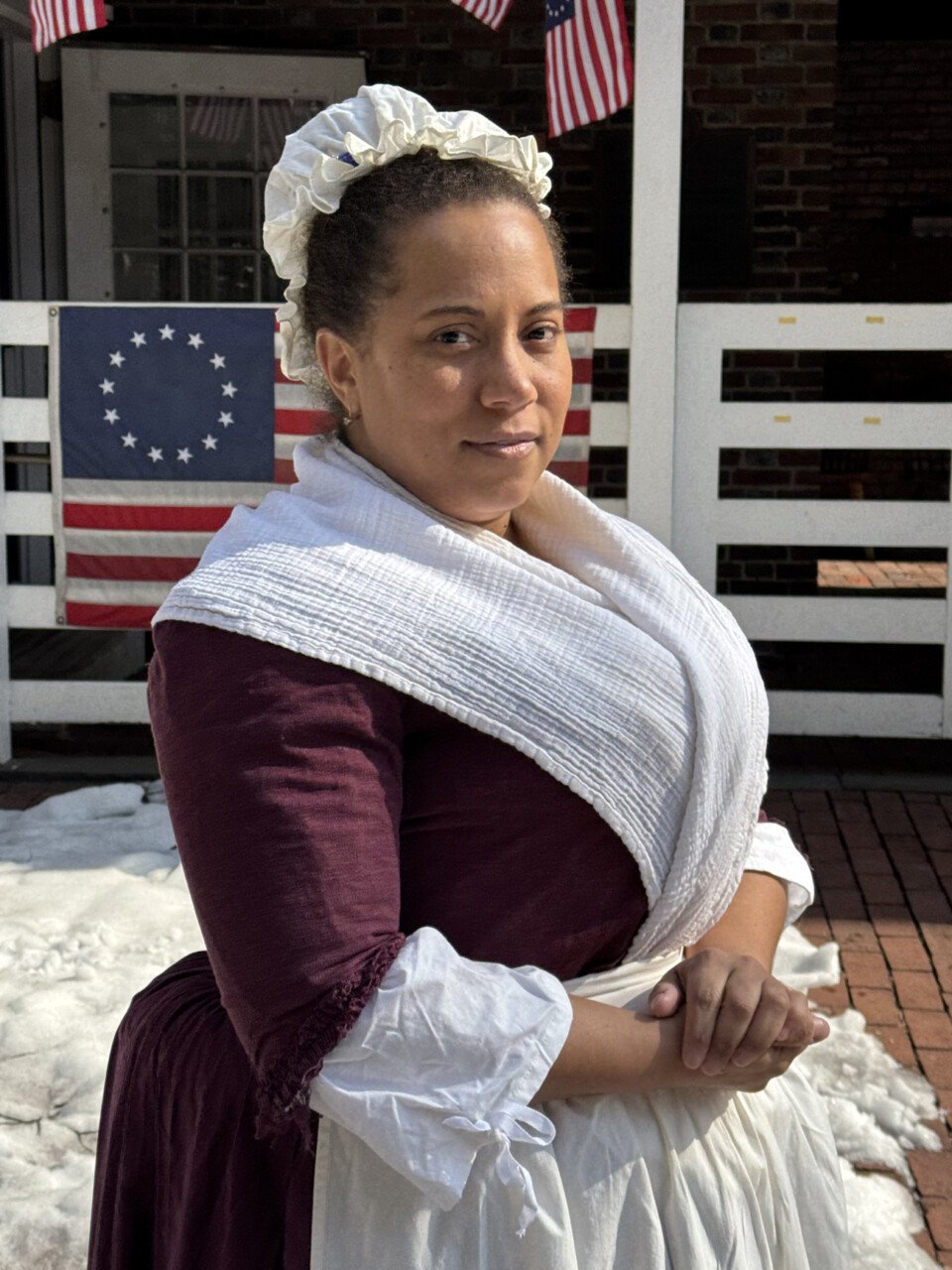
Alex Ford, a Philly-based actor who portrays Ona Judge, at the Betsy Ross House / Photograph by Ronnie Polaneczky
My hope is that Hollywood is also paying attention and creates a sprawling film that does Judge’s life justice, because it’s the stuff of movies. And I know just the book to base it on: Never Caught: The Washingtons’ Relentless Pursuit of Their Runaway Slave, Ona Judge, published in 2017 by Emory University historian and Philly native Erica Armstrong Dunbar. It’s a great read informed by meticulous research, including letters written by Washington about Judge’s escape and his own feelings about the disconnect between espousing liberty for all and owning human property. (In fact, in 2020, the book was optioned by Provenance Films for a feature adaptation, but the project never materialized; the movie rights have since reverted back to Dunbar.)
Maybe, though, with the growing attention on Ona Judge, Hollywood will give the book another look. I know someone who’d be delighted to take part: Alex Ford, a Philly-based actor with Historic Philadelphia Inc., who for years has portrayed Judge in and around the region. I met up with her in early February as she greeted visitors at the Betsy Ross House, a regular gig for her during Black History Month.
“I think of Ona as one of the bravest people I’ve never met,” says Ford. “It’s an honor to play her. She outran one president. She can outlast another.”
Every year, on May 21st, let’s say as much. Let’s finally declare Ona Judge Day, a day that recognizes bravery and truth. Celebrate it at the site where Judge was enslaved, in our school classrooms and church pulpits, in the corridors of City Hall and the hallways of the state Capitol — whether the slavery memorial is ever restored and protected at the President’s House or not.
Her spirit was always bigger than that place anyway.
Published as “We Need an Ona Judge Day” in the April 2026 issue of Philadelphia magazine.