
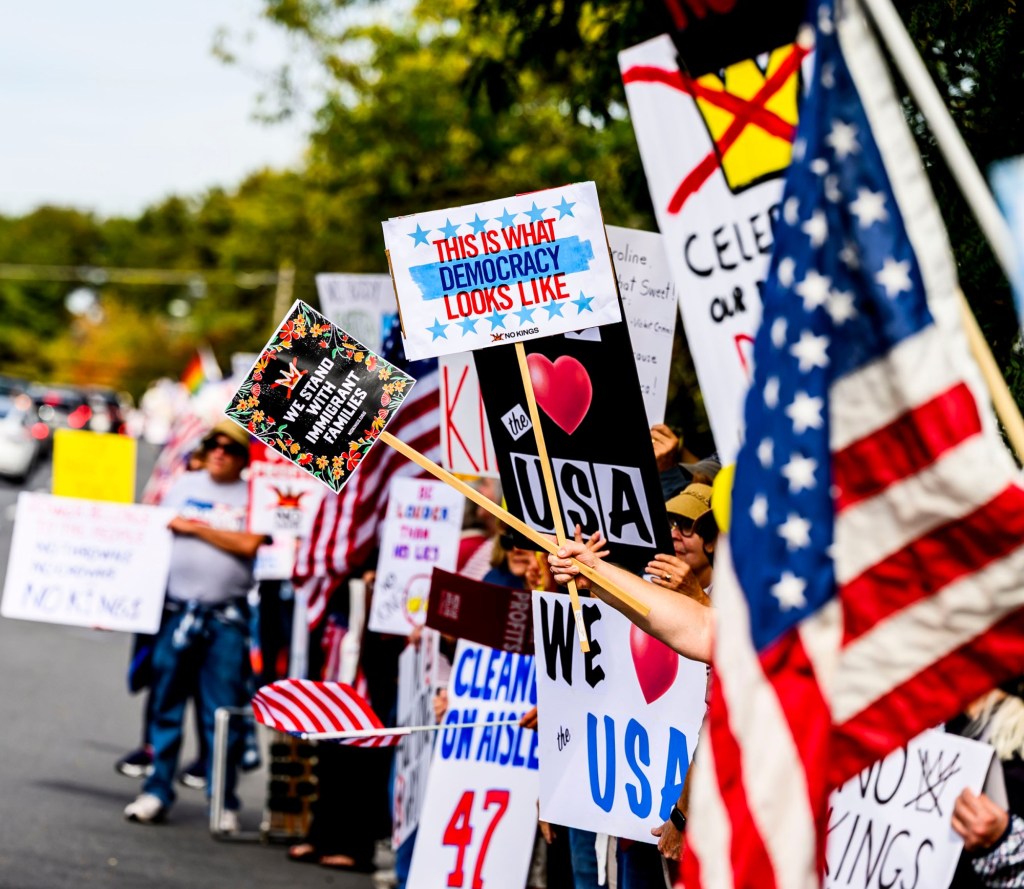
Lehigh Valley activists hope that the third iteration of No Kings Day protests Saturday becomes a tipping point in the anti-Trump movement, as opponents of the president’s agenda project over 9 million people will participate nationwide.
According to a news release from local No Kings Day organizers, more than 3,000 protests are planned nationwide to “denounce the increasing authoritarian excesses and corruption of the Trump administration.” The demonstrations are organized by national Democratic, progressive and pro-civil rights groups including the ACLU, 350 Action and 5 Calls. The protests attracted millions of Americans in June and October, including thousands in the Lehigh Valley.
The Lehigh Valley No Kings protests have been organized by relatively new activist groups that have formed early in Trump’s second term. They largely oppose policies like Trump’s crackdown on immigration, the war in Iran and perceived inaction on inflation, among other issues.
The protests comes as support for Trump’s agenda has waned across the United States — just 37% of Americans approve of his job performance, down three points since the fall, according to a January Pew Research poll. His declining support could be a warning sign for Republicans running for election in November, including GOP Rep. Ryan Mackenzie, who represents the Lehigh Valley in Congress.
Brooke McDermott, a lead organizer with Indivisible Lehigh Valley, is organizing the No Kings Day Palooza at the Bethlehem Rose Garden, which will feature remarks from Allentown Mayor Matt Tuerk as well as live music and poetry.
Indivisible, a nationwide progressive organization, opened its first chapter in the Lehigh Valley in 2025 after activists like McDermott reached out to the national organization for help putting together protests and actions that oppose Trump.
“It does not escape anybody’s realization that this is the 250th anniversary of the Constitution of the United States, and apparently our president, he really knows little about it, clearly, but he regards it even less,” McDermott said. “That is just like a dealbreaker, I think, at heart for most Americans, no matter what part of the political spectrum they are on.”
The goal, McDermott has said, is to achieve a critical mass of people who oppose Trump, which they hope will lead to meaningful resistance and change.
She cited research by Harvard professor Erica Chenoweth, which purports that when 3.5% of the population engages in sustained, nonviolent protest, their social movement is more likely to succeed.
That 3.5% — which amounts to 12 million people in the United States — is the ultimate, long-term goal for the No Kings and anti-Trump movements, several organizers said. It will require more than just numbers at protests, but sustained, long-term nonviolent resistance like that of past civil rights movements.
“Once there was enough movement of people in the streets being able to protest, [3.5%] seemed to be the magic tipping point, and that is what we are working toward,” McDermott said. “And once there is that investment of the population, things seem to shift, things like general strikes are possible in the United States.”
Chris Borick, professor of American politics at Muhlenberg College, said that organizers of movements across the United States have aimed for a “critical mass” of people that support their goals.
With the No Kings event seemingly growing with each iteration, it seems conceivable that protesters could reach such a high level of support, Borick said.
During the first Trump administration, the largest and most visible anti-Trump event was the 2017 Women’s March after Trump’s inauguration day, which brought nearly 500,000 people to Washington and over 7 million worldwide.
But subsequent Women’s Marches were smaller in scale, as opposed to now, when interest and participation in No Kings are only growing as time goes on and Trump’s popularity wanes. The second No Kings Day protest in October brought out an estimated 7 million attendees nationwide, an increase of 2 million compared with the June events.
The Saturday protests are projected to be the biggest day of domestic political protest in history, according to Time magazine.
“It wasn’t that opposition to President Trump went away during his first term, but in this case, it just seems like it’s intensifying over time, which is, I think, important to the organizers to display, because it gives them a sense of energy and direction of where they are headed,” Borick said.
But winning popular support — and meaningfully rolling back policies like immigration crackdowns and a war in Iran — is challenging when a sizable amount of the population continues to back Trump. cq ] His 37% approval rating correlates to more than 110 million Americans who support Trump’s job performance.
“While far-left radical Democrats continue to waste their time and energy planning pointless astroturfed protests, President Trump and Republicans like Congressman Ryan Mackenzie will continue to lower costs and improve community safety for families in the Lehigh Valley,” National Republican Congressman Committee spokesperson Reilly Richardson said in a statement to The Morning Call.
Trump has shown he is less than sympathetic to the protesters’ demands — he shared mocking videos and messages on Truth Social during the protests in October — so it is unlikely the protests will lead to the kind of direct response they might want from the administration.
But organizers say that is not their goal; rather, they say, protests are just a “jumping-off point” to engage further action, including voting for Democrats in the midterm elections, signing a petition opposing local data center construction, or joining a local advocacy group.
“It doesn’t start or end with major events like this, it’s just one way to come together, get more people in, get organized and keep momentum going,” said Katy Kiefer, digital director for Food and Water Watch and organizer of No Kings Day on Cedar Crest Boulevard in Salisbury Township, outside Mackenzie’s office. “Each of these events in Allentown keeps getting bigger and bigger.”
Another key goal for organizers is simple — awareness of their grievances with Trump, at a time where a majority of people get their news from social media algorithms, which often tailors the content users see based on their personal preferences.
Rosemary Morgan organizes the Easton Visibility Brigade, a smaller-scale group that brings together over a dozen or so people weekly that hang large anti-Trump signs against an overpass over Route 22.
Between 3,000 and 4,000 cars see messages like “ICE camps kill,” “One nation under fraud,” “End political violence” and “Can’t afford gas food rent war” on a weekly basis, Morgan said. It is an alternative type of protest to marches and rallies — but one can still spread its message effectively, she said.
The visibility brigade was active for the last two No Kings Day protests and will be again on Saturday, she said, with a sign bearing the message “No crowns no kings” for thousands of passers-by.
“What’s nice about the visibility brigade is we can tailor our messages to everyday concerns like affordability, immigration, women’s rights, if it’s a voting season — we did ‘vote to retain’ the five Pennsylvania judges [in November]. When Renee Good and Alex Pretti were murdered, it was ‘ICE kills’ and so things like that,” Morgan said. “What’s nice is that when you’re at a protest you’re holding one sign one time, but every week we can get out there, and put these issues in front of people’s faces on a weekly basis and change the message based on what’s going on.”
Morgan said she began to organize the visibility brigade late last year — she had never been politically involved before Trump’s second term, but said her retirement freed time to do so.
“Just, every day, the chaos that’s coming out of this administration, it’s ‘flood the zone,’ it’s, ‘make the chaos so that you can’t concentrate on more than one issue at a time,’ and I felt it was succeeding and it was really making me angry,” Morgan said, going on to list women’s rights, the Epstein files and immigration as some of her concerns.
Tim Martin, a local filmmaker and volunteer with Indivisible Bethlehem, has attended and documented each No Kings protest for Indivisible Bethlehem’s social media page.
Martin, who said he has been politically active since the 1990s, said he was inspired to join Indivisible’s efforts because he is worried about the world his two young daughters will inherit when they become adults.
“My main goal for my fight is to keep democracy alive and to hopefully keep a separation between church and state as well,” Martin said. “I believe in that as far as a founding principle is important.”
Organizers did not give estimates for attendance in the Lehigh Valley Saturday, except to say that they anticipate an even stronger turnout than in October, when they reported 6,000 in attendance in Bethlehem, 1,000 in Bethlehem Township and 3,000 in Salisbury Township. Indivisible expects over 9 million to turn out across 3,000 protests nationwide, which McDermott said is likely an undercount.
“We are hoping to hit that tipping point.”
Reporter Lindsay Weber can be reached at Liweber@mcall.com.