
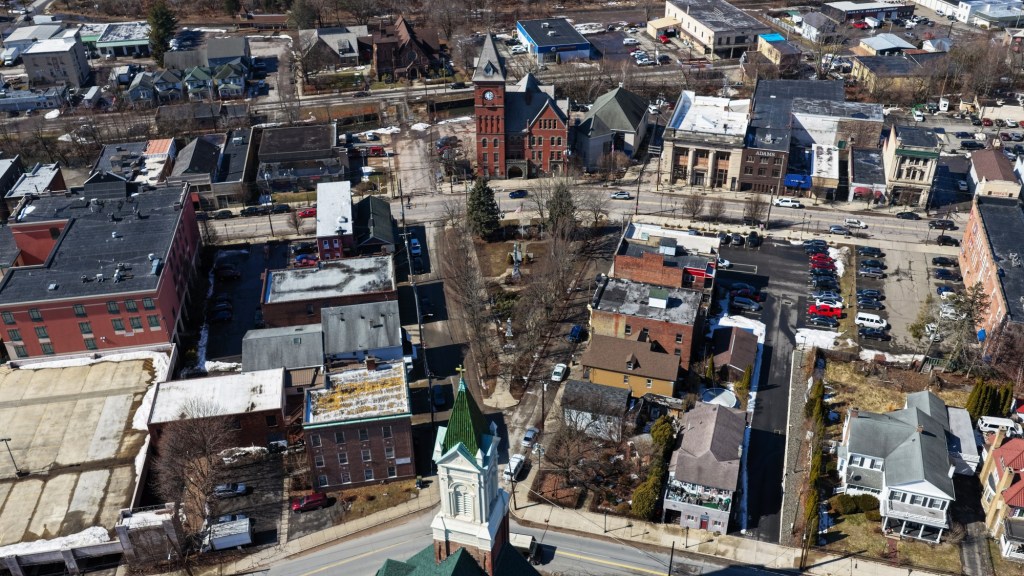
Downtown Carbondale’s revitalization is all according to plan.
More than 20 years after Carbondale’s earliest revitalization efforts took shape, city officials and community partners dedicated much of the past decade to enhancing the downtown, from murals to events to citizen engagement to long-term planning.
Mayor Michele Bannon summarized her goal for downtown Carbondale with five words: thriving, united, joyful, safe and sustained.
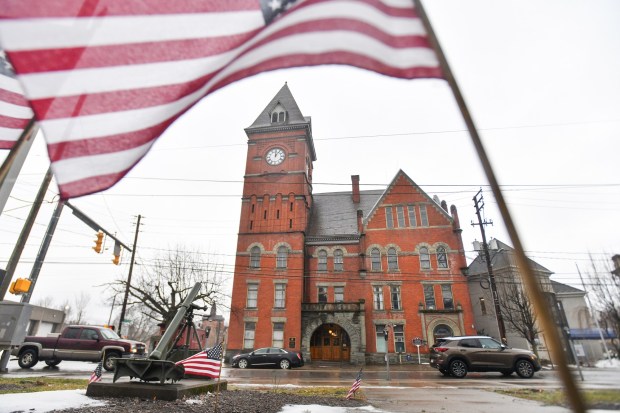 An American flag from the veterans’ memorial in Patriot Park frames Carbondale’s City Hall Friday, February 20, 2026. (SEAN MCKEAG / STAFF PHOTOGRAPHER)
The key to that is having a plan, she said. Grant funding is also key to develop those plans, she added.
“It’s not hocus-pocus, it’s not this big ephemeral thing that we need to figure out,” she said. “It’s as simple as that — getting a plan and working a plan.”
The downtown is the center of community life where people gather, entrepreneurs invest and where the character of the city is most visible, Bannon said, calling it Carbondale’s “front parlor.”
“By concentrating our efforts on revitalizing and strengthening the downtown district, we can attract new businesses, support existing ones and encourage private investment that fuels long-term growth,” she said.
‘Build community’
The roots of Carbondale’s revitalization efforts date back to around 2004 when the Greater Carbondale Chamber of Commerce worked with the city to create a development plan for the downtown, Bannon said. The plan was in part prompted by talks of Marian Community Hospital closing, she said. The hospital, which formed from the merger of Carbondale General Hospital and St. Joseph’s Hospital in 1992, eventually shut down eight years later in February 2012.
The plan would become the catalyst for the construction of the Hotel Anthracite at 25 S. Main St.; it led to infrastructure development with new sidewalks and streetscape work, including the installation of Victorian-style street lights; and it tied into a $14 million improvement project at the Greater Carbondale YMCA, Bannon said.
“It made (the downtown) more quaint, it made it more cute,” she said.
While the early revitalization encompassed infrastructure development, it would take another decade to address community development, Bannon said.
The city began to focus on community development in the late 2010s, starting around 2017, she said.
Bannon, who has served on the board of NeighborWorks Northeastern Pennsylvania for 17 years, credited the nonprofit organization with showing her that “community development isn’t just bricks and mortar.”
“It’s actually developing a community for us to be sustainable, and that means us relying on one another and building our community from there,” she said. “A lot of the projects that we do and we have are all volunteer driven — they’re all just to build community within the city of Carbondale.”
NeighborWorks, whose director of community development recently left the position to become Carbondale’s economic development director, describes its mission online as creating “stable, vibrant communities by amplifying the voices of residents and providing critical housing assistance, financial guidance, community development services, and proactive partnerships.”
Bannon pointed to events like the Tinsel Trail, where local businesses sponsor and decorate Christmas trees at Memorial Park in the downtown; the Lighted Christmas Parade; and Pioneer Nights, a four-day block party in the downtown, with helping to build that community.
“It’s just building the framework around the community itself and trying to keep up with what people want,” she said.
Even using grant funding to set up and restore a century-old caboose outside City Hall contributes to that community building, Bannon added.
‘What we need to do’
As the city took its redevelopment more seriously, officials applied to participate in a state Department of Conservation and Natural Resources and Pennsylvania Environmental Council pilot program to become a “Pennsylvania Outdoor Town,” Bannon said. The city joined the program in 2021.
Carbondale created six goals through that program: improve the appearance of Main Street; recruit new businesses and expand existing ones that benefit from an outdoor town; enhance existing events to bring new ones into the community; establish a marketing and communications program; improve walkability, bikeability and access to the Lackawanna River; and develop a community of residents, businesses and partners who recognize the natural value of the area and support outdoor towns, Bannon said.
Those goals manifested in projects including placing flowerpots throughout the downtown maintained by the city’s Shade Tree Commission; painting murals; launching an annual block party with NeighborWorks; relaunching the Greater Carbondale Chamber of Commerce’s NEPA Valley Wine Train; kicking off the Carbondalien Festival; creating a marketing and communications program with a city newsletter and future plans for a text notification program for residents; using more social media to keep residents informed; and working to tie the Lackawanna River Heritage Trail into downtown Carbondale, she said.
Further enhancing river access, the Lackawanna Heritage Valley Authority built a Lackawanna River boat launch in the city last year, and Carbondale plans to eventually build a pocket park next to the Sixth Avenue bridge at the site of the former Hotel Chellino, Bannon said.
“Outdoor Town was like the catalyst that got us started,” she said. “We had a lot of input from people, so it was easy for us to see what people wanted, and then we thought, ‘This is exactly what we need to do.’”
Those Outdoor Town goals and projects dovetail into the city’s work as a “Blueprint Community,” Bannon said.
In November, Carbondale graduated from a free, 18-month Blueprint Communities program where it worked to develop a 10-year plan intended to “activate local leaders, deploy a community-developed strategic plan, and revitalize communities.”
That program directly ties into the Outdoor Town goals, namely improving Main Street as well as recruiting and expanding businesses, Bannon said.
With the use of grant funding, Carbondale had local artists paint six murals throughout its downtown last year as part of Blueprint Communities.
The program involved forming a 10-member team with representatives from the city and Lackawanna County, United Neighborhood Centers of Northeastern Pennsylvania, the Greater Carbondale Community Development Corporation, Valley in Motion, Peoples Security Bank & Trust, NeighborWorks, Pennsylvania Department of Military and Veterans Affairs and a real estate agent.
As part of its 10-year plan, Carbondale wants to revitalize and strengthen its downtown by promoting economic development, preserving cultural and architectural heritage and fostering a vibrant community, Bannon said.
They use the tagline, “Main Street, Carbondale, is the heart of our city where community, commerce and history intersect,” Bannon said.
The plan looks to create new events based around art and culture, create a stewardship team, get student involvement, build partnerships, hold regular cleanups and other sustainable practices, form committees, fundraising and a facade project, Bannon said.
City officials also want to increase upper-floor housing in the downtown with residents living above businesses, she said.
To learn what residents want, Carbondale participated in a Community Heart & Soul initiative that involved surveying residents about the city.
It was humbling, Bannon said.
“Rather than letting people tell you what’s wrong or what’s not working,” Bannon said. “This was our way of finding out what people want, what they love about Carbondale, why do they choose to stay here?”
The goal was to involve everyone, focus on what matters the most and work on it long-term, she said.
“People talked about their values, their hopes, their concerns and their ideas for action,” she said.
Organizers hosted core team meetings, put out surveys, interviewed residents and even had children do drawings, Bannon said.
“We have so many different resources with the Lackawanna River, the trails, our parks. We just live in such a beautiful area — that small-town feel,” Bannon said. “Nobody can really put their finger on that, but that’s what everybody talked about.”
Bannon noted the links between plans, like Heart & Soul showing residents enjoy mom-and-pop stories in the city with a focus on shopping local while Outdoor Town looked at promoting businesses. Residents also told the city they wanted more art, coinciding with the mural project, she said.
Heart & Soul ultimately left Carbondale with short-, medium- and long-term goals, Bannon said. It also showed city officials that they need to focus on neighborhoods and the downtown.
Bannon pointed to the “Carbondale Core Neighborhood Plan” that the city compiled with NeighborWorks and coincided with the Blueprint Communities program that looked at major upgrades in the city. The Core Neighborhood Plan proposes to enhance pedestrian and bike connectivity to the downtown, improve recreation with trailhead enhancements off Main Street, establish a gateway welcoming people to Carbondale at the intersection of North Main and North Church streets — potentially putting up an arch similar to one in old city photos near the site of the YMCA, and an amphitheater and pickleball courts at Carbondale’s Belmont Street skatepark while cleaning up the skatepark itself.
Other elements of the plan look at removing blight, restoring historic buildings, increased river access, improving building facades and increased wheelchair accessibility with Americans with Disabilities Act-compliant work, she said.
She credited Pittson Mayor Michael Lombardo and other officials with sharing their expertise from their own cities’ downtown development.
“They’ll tell you, ‘Oh, this worked’ or ‘That didn’t work,’” Bannon said. “They’ve done it before, so calling on their wisdom and their experience is invaluable.”
Bannon has noticed more traffic in the downtown, and she receives more feedback from the community about what the downtown needs.
She aspires to open a retail-type incubator behind the former Ben-Mar on North Main Street, and city officials are looking at funding to aid downtown businesses with physical upgrades.
“It’s hard for them to pay that,” she said.
To help with that, Carbondale received two grants through the state Department of Community and Economic Development’s Main Street Matters program, she said.
‘Positive momentum’
Following the COVID-19 pandemic, the Greater Carbondale Community Development Corporation shifted its focus from residential development and the redevelopment of dilapidated buildings to downtown development, said John Brennan, the nonprofit development corporation’s president of seven years.
“With COVID and a lot of people moving to the area, market conditions took care of that,” he said. “You used to be able to pick up a house in Carbondale or in the area for $30,000 or $40,000. Now, you can’t touch that for five times the price.”
The development corporation dates back about three decades, with its early work involving the city’s housing stock about 25 years ago, Brennan said.
The organization became a bit inactive, but new board members rejuvenated it around the onset of the pandemic, which “put a damper on plans,” he said.
“You want to create an environment where investors and people want to invest their money and feel comfortable investing their money,” Brennan said.
While critics contend, “Painting a mural on the side of a building isn’t going to get people to open a business downtown,” Brennan said it shows people care, that there’s a sense of pride and that there’s work going on behind the scenes.
“There’s a lot of positive momentum heading that way,” he said.
Brennan said they’re fortunate for Carbondale’s layout with new urbanism and discussions of walkable communities.
“It’s basically about having a community that’s walkable, livable, and where you can have a sense of community,” he said. “Geography wise, the way Carbondale is set up with its downtown and its residential areas surrounding that, we’re perfectly situated.”
Like Bannon, he pointed to the importance of holding events in the city, from the Carbondalien Festival to a breakfast with Santa.
“We don’t have to travel out of the area to have nice things,” he said.
When Carbondale native Mike Moran purchased the Peanut Bar on Cottage Street from his aunt and uncle in 2018, he wanted to help revitalize his hometown.
“Make this a great place to live, work, do business, all of the above,” he said.
To contribute to that revitalization, he expanded his restaurant with the Cashew Lounge in 2023, complete with a deck overlooking the Lackawanna River to attract people from outside the city.
Moran’s family has owned the Peanut Bar since the early 1990s; the restaurant has been in existence since the 1940s.
Moran chose to purchase the business after moving back to Carbondale.
“Knowing that this was a landmark staple in the town, I knew I had a great opportunity to elevate it even further,” he said. “I took the chance. I love Carbondale.”
Moran lauded the ongoing development in the city.
“There’s a lot of really amazing things happening in the city, and I am a huge fan of everything Michele is doing,” Moran said. “Carbondale is heading in the right direction, and some people want to see it yesterday — as fast as we can.”
The restaurant owner said he has traveled to 40-plus states and 20-plus countries around the globe, experiencing vibrant downtowns.
He pointed to Carbondale’s easy access with Business Route 6 and the Casey Highway, making it the ideal spot to become a hub.
“Do I think Carbondale is next on the list of places to be revitalized? Absolutely,” Moran said. “Carbondale is ripe for the picking.”