

A proposed Lackawanna County policy would set protocols for potential interactions with federal immigration agents and other law enforcement officials, but it’s not the “Protect Our Neighbors Act” ordinance Democratic Commissioner Bill Gaughan proposed and continues to push.
The policy commissioners are expected to consider Wednesday “establishes uniform guidelines” aimed at ensuring such interactions “occur in a lawful, consistent, and coordinated manner” within county facilities. It “does not purport to enact a sanctuary ordinance or otherwise extend beyond the scope of commissioner authority as constrained by federal and state law.”
And while Democratic Commissioner Thom Welby described it as an alternative to Gaughan’s proposed ordinance — legislation seeking to bar county cooperation in federal immigration enforcement absent a judicial warrant signed by a judge — he said it achieves many of the same goals. It would effectively restrict working county employees from interacting with immigration agents without consulting a superior and the county solicitor, Welby contends.
“It does prohibit interaction with them without consult of (the employee’s) department head or director, but primarily counsel,” he said. “They can’t do anything without speaking to counsel.”
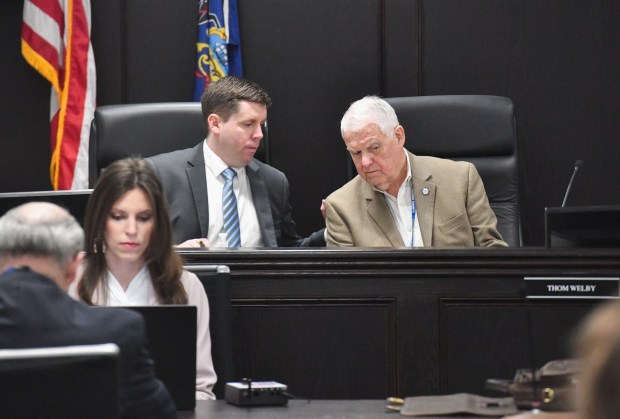 Lackawanna County Commissioners Bill Gaughan and Thom Welby confer before the commissioners’ meeting held at the county government center in Scranton Wednesday, March 18, 2026. (SEAN MCKEAG / STAFF PHOTOGRAPHER)
Gaughan, who proposed his ordinance in early February, expressed some misgivings Tuesday about the alternative policy.
“The ordinance that I proposed, I think, sets clear, enforceable standards and it draws a bright line that protects our residents and our employees from being placed in legally uncertain situations,” Gaughan said. “What concerns me the most about this policy is that the … original policy that (Welby) had sent out about a week ago was much stronger and more closely aligned with the ordinance that I had put forward.”
The version that appeared on Wednesday’s meeting agenda as of Tuesday afternoon does not include language, present in an earlier version, explicitly stating that local government participation in “formal immigration enforcement partnerships” is voluntary. Other apparently removed language acknowledged that “ICE administrative detainers are requests, not mandatory commands,” and noted that detaining individuals “on the basis of an administrative detainer alone — without a judicial warrant — may expose the County to Fourth Amendment civil liability.”
Gaughan did not say Tuesday whether he’ll support the policy in its current form. Efforts to reach Republican Commissioner Chris Chermak were not immediately successful.
The protocol
The policy as proposed specifically establishes a series of steps for employees to take if immigration agents or other law enforcement officials appear at a county facility, beginning with requesting their full names, agency associations, official credentials and badge numbers.
Employees would then ask about the purpose of the visit — executing a warrant or requesting access to records, for example — and request a copy of any warrant, court order, subpoena or other legal document the agents or officers present. Employees should not return original documents and should note whether any document presented is signed by a judge or issued by an official, the policy notes.
The next step requires employees to contact their direct superior and, “as appropriate,” their department director, as well as the county chief of staff.
The policy says the county solicitor should always be contacted when agents present a judicial warrant, subpoena or court order; request access to restricted areas or confidential records; request a “detainer hold” at the county prison; request records by phone, email or other informal means; and when there’s uncertainty about the legal validity or scope of a request.
“If Law enforcement agents conduct enforcement activity in an area open to the public, County employees should remain calm and professional, do not physically interfere with lawful enforcement activity, notify supervisors, Chief of Staff and security personnel, and take reasonable steps to maintain the safety of clients and staff,” per the proposed policy.
It also says departments should ensure employees receive relevant training and document any law enforcement activities that occur at county facilities. They should specifically document the date and time of the encounter; the agency involved; the names and badge numbers of officers, if available; the types of legal documents presented; the stated purpose of the visit; actions taken by county staff; and the names of the “supervisor and/or County Solicitor notified.”
Among other purposes, the policy is designed to ensure county operations comply with applicable law and constitutional protections, protect confidential and legally protected information and maintain the “safety, security, and orderly operation of County facilities serving the public.”
It also recognizes the authority of the county Court of Common Pleas over “court-controlled facilities and proceedings,” and notes commissioners’ inability to direct or bind elected county row officers “in the exercise of their independent statutory functions.”
“This policy establishes procedures to ensure that County employees respond appropriately, refer enforcement officers to proper County authorities when necessary, and maintain compliance with all applicable legal requirements,” it reads. “This policy is also made with the explicit understanding that effective law enforcement requires cooperation among agencies at all levels of government.”
The meeting
Wednesday’s meeting at the county government center in downtown Scranton begins at 10 a.m. and is likely to feature debate and a potential vote on the policy proposal.
Without committing to supporting it, Gaughan acknowledged “something is better than nothing.”
“But the something that I was willing to compromise on was the original version that he (Welby) had sent out,” Gaughan said. “At the end of the day I think it’s important to get something done, but … we’re still talking about it so, at this point, hopefully we can get something accomplished before 10 a.m.”
Welby noted earlier Tuesday that the policy “can be amended any time going forward should we feel there’s a need to address anything.”
“We want to be clear that this can be amended at any time in the future and as often as might be necessary,” he said.
Meeting agendas are available online at lackawannacounty.org.