
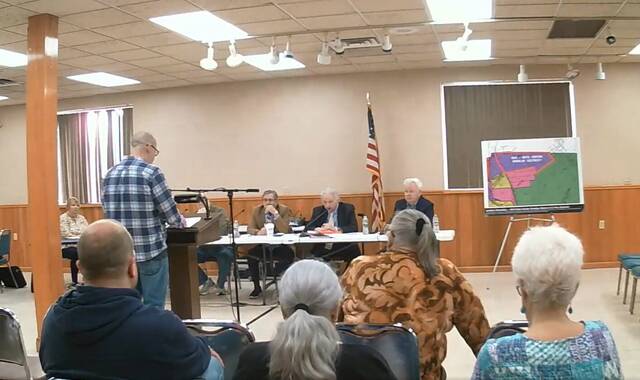
JENKINS TWP. — The Jenkins Township Board of Supervisors held a hearing Monday at the Jenkins Township Hose Company to gather public comment on a proposed amendment to the township’s zoning ordinance regulating data centers and their accessory uses.
Shepstone Zoning and Management Group was hired by the township to help draft the proposed amendment. At the hearing, the company’s president, Tom Shepstone, explained what data centers are and gave an overview of the ordinance to the board and residents.
If revisions are made to the ordinance following Monday’s meeting, the revised version will be presented to the public before the board votes to approve it.
Before Shepstone’s presentation, board solicitor Joseph Blazosek explained to the audience that the purpose of the amendment was to recognize data centers as a legal use, as municipalities are required to do by law.
“But if we have in our ordinance no place or no definition for a legal use, then that would create a problem,” Blazosek said.
As data center development has soared across the country, especially in Pennsylvania, other municipalities in Luzerne County are facing questions about whether their zoning codes address data centers.
In Dorrance Township, for example, The Brewster Land Company filed a substantive validity challenge against their zoning ordinance last year, claiming it unlawfully excluded data centers.
To date, no data center proposals have been submitted to Jenkins Township.
According to Shepstone, the proposed ordinance limits data centers to an overlay district within the I-2 Flex Industrial District.
Data centers would only be allowed as a conditional use, subject to review by the township planning commission and the board of supervisors, who then make the final decision.
A master site plan would have to be submitted, along with the conditional use application. The plan would include: a feasibility study, financial feasibility, conceptional layout of the data center campus, anticipated development schedule.
If approved, construction of the data center would have to be done within five years, Shepstone said.
Some dimensional requirements include:
• Minimum of 25 acres with a minimum lot width 500 feet and minimum setback of 200 feet on all sides.
• Data centers must cover no more than 75% of the lot.
• Building height is limited to three stories, or 1,000 feet
• 500-foot setback from any residential district or residents.
In Shepstone’s opinion, the most important part of the ordinance is the requirement of a community and fiscal impact analysis.
“It provides that there has to be an analysis that addresses short-term and long-term environmental, economic, fiscal, and other community impacts on Jenkins Township. That includes community institutions, emergency services, and so on,” he said.
Any experts hired to provide services for the project must be paid for by the developer. Any cost incurred by the township would be reimbursed.
Also, under the proposed ordinance, the board of supervisors may accept community impact fees as mitigation for impacts on water supply, water and sewer services, and firefighting capacity, etc.
In terms of sound regulations, Shepstone said: “We’ve set a pretty strict standard here.”
There can’t be more than five decibels above the ambient sound level, with exceptions for lawful operation of public utilities, periodic testing of generators, and emergency uses.
Additionally, coordination with the local fire department is required to develop a comprehensive emergency plan.
In terms of water usage, Shepstone said that it’s “not as much of an issue today” because data centers are moving away from open-loop systems to closed-loop systems, meaning the facilities are recirculating the same water, similar to a car wash.
Prior to the hearing on Monday, the Jenkins Township Planning Commission reviewed the draft of the ordinance and offered the following recommendations:
• Distance from residential properties/structures should be 100 feet or more.
• More stringent regulations on utilities, mainly power supply and water.
• There should be no supply or financial impact on any resident or business.
• A water loop system should be imposed to conserve water, regulation on batters, used for backup and stringent matters on noise and generator noise.
Public Comment
Resident Morgan Steiner asked whether the ordinance could require facilities to use closed-loop systems.
“Maybe that’s something we can look at,” Shepstone replied.
Resident Dino Rodeghiero asked what would happen if something like the closed-loop system breaks. Shepstone said that the developer would be required to come up with a plan for what to do if that were to happen, and an expert would have to review it.
Rodeghiero also asked about mitigating air pollution, and Shepstone said the facility would have to comply with the Clean Air Act.
Additionally, Corrine Milazzo suggested the ordinance include a building coverage standard, along with a lot coverage standard.