
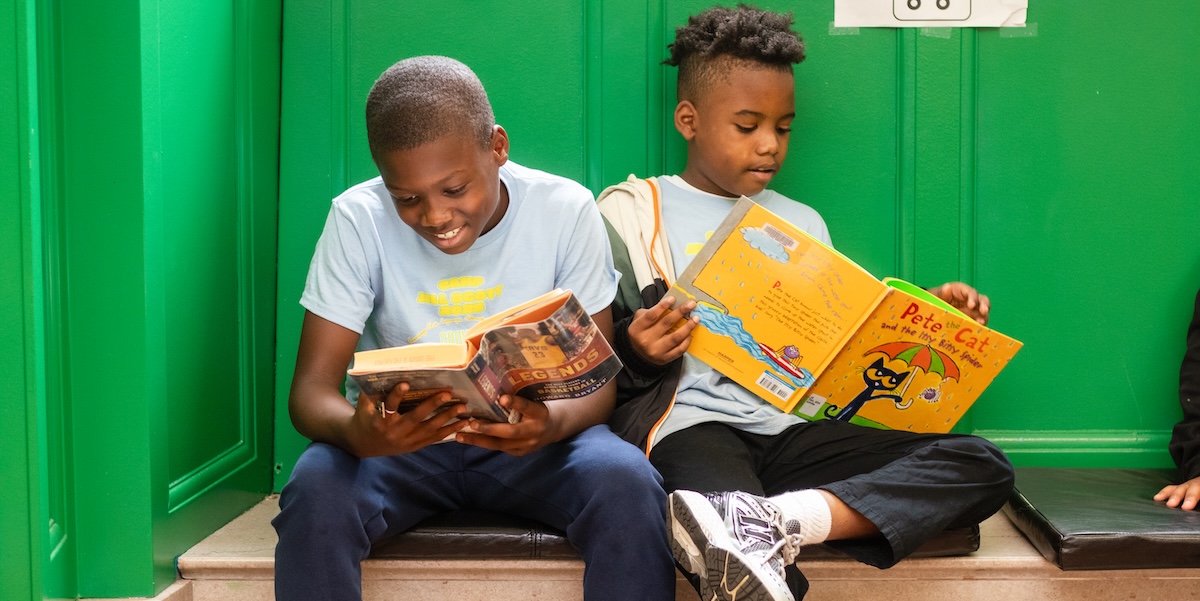
The Citizen’s Larry Platt is angry about Philadelphia’s literacy crisis. Good. So are we.
In fact, we’ve been angry about it for over a decade. Angry enough to build a movement of more than 115 partner organizations and 1,000 community leaders who have spent years refusing to let this city look away.
Read by 4th is an independent, collective impact campaign convened and managed by the Free Library of Philadelphia Foundation. We’re a coalition of educators, nonprofits, health organizations, librarians, families, and community members who have come together around one core belief: that every child in Philadelphia deserves to read at or above grade level by fourth grade.
While the District is a partner, we do not report to the Superintendent. We do not answer to the School Board. We exist because we refuse to wait for any single institution to solve a systemic crisis. We exist because partnership accelerates change.
The lives behind the numbers
Let’s be honest about what literacy scores “rebounding to near pre-pandemic levels” actually represents, and why it matters.
The Covid-19 pandemic was not just a bad school year. It was a world-disrupting, civilization-shifting event. By the end of the 2020–21 school year, students in majority Black and low-income communities had lost six months or more of learning in both reading and math. Our children didn’t just lose instructional time. They lost family members, stability, and the sense of safety and peace of mind that make learning possible.
Think back to those years. The stress, the grief, the disruption. Consider what that meant for a kindergartner trying to learn to read. Phonics can’t be easily taught over a Zoom call while a parent works an essential job and a grandparent lies sick in the next room. The building blocks of literacy are relational and cumulative. Students who start off behind need intensive support to catch up, and without it tend to stay there. Many of the children who lived through the pandemic’s worst disruptions are still living with its consequences, and we will be seeing its impact for years to come.
When we acknowledge that those scores show resilience, it’s not spin. It is a recognition that Philadelphia’s students, teachers, and families clawed back from a near-catastrophic blow to education. Returning to pre-pandemic levels is not the goal. It is the floor. And we’ve been clear about that. A few lines down in that very same report, we say we must imagine and demand more for our children.
Calling that “Trumpian gaslighting” doesn’t just miss the point. It erases the exhaustion of every teacher who held a virtual classroom together, every parent who coaxed a distracted six-year-old to sit still through another Zoom lesson, and every child who learned to read against extraordinary odds.
What happened in Mississippi was no miracle
The piece points to the “Mississippi Miracle” as a model Philadelphia should learn from. That state climbed from the bottom of the nation in reading to first in the nation for economically disadvantaged fourth graders. Yes. A thousand times, yes. And it’s already happening.
On Monday, March 22, Read by 4th advocates were at the Pennsylvania State Capitol fighting for that exact same approach at the PA Literacy Coalition’s 2026 PA Literacy Summit. We learned from and stood alongside Dr. Kymyona Burk, one of the driving forces behind Mississippi’s growth, pushing for structured literacy and the laws and funding that lead to transformative change.
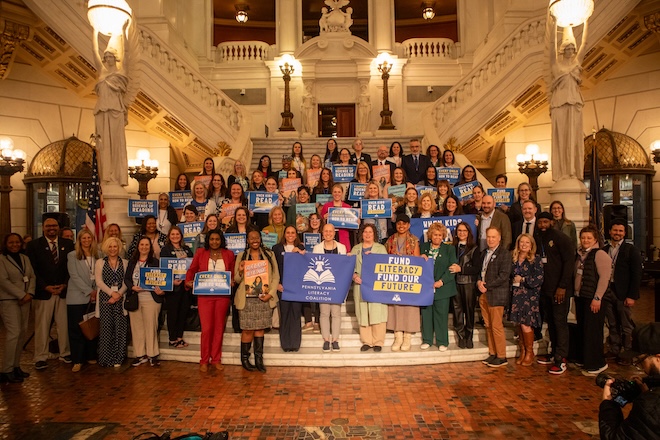 The 2026 PA Literacy Advocacy Summit.
What happened in Mississippi was no miracle. They say so themselves. It was a decade of hard work: strategic advocacy, political will, and a refusal to accept mediocrity. Mississippi passed its landmark Literacy-Based Promotion Act in 2013. Read by 4th partners have been fighting for early literacy, family engagement, community mobilization, and systems change including the Science of Reading for just as long. Our legislative wins are just happening now. Pennsylvania passed its most comparable literacy bill, Act 47, in November 2025. And in the 2024–25 school year, ahead of state mandates, the School District of Philadelphia adopted a new evidence-based reading curriculum grounded in the Science of Reading.
That is real progress. But passing a law and changing what happens in a classroom are two different things. Many educators report feeling underprepared and overwhelmed by this massive shift in teaching practice. And that is not a criticism of Philly’s teachers; there’s a serious resource and support problem. The state dollars we’re fighting for at the Capitol go toward addressing exactly that: training for teachers, stronger curricular materials, early assessment tools, and real on-the-ground support for the educators showing up for our kids every day.
The anger we share can become a solution
Philadelphia has a literacy crisis. Two-thirds of our students are not reading at grade level by fourth grade. That’s not a number we can reframe or feel good about. It is a moral emergency, an economic imperative, and a civil rights issue with lifelong consequences for children and our city.
The roots of this crisis run deep: inadequate teacher training at schools of education, the collapse of public school libraries, insufficient early childhood education, lack of affordable high-quality tutoring services, doomscrolling taking over reading for pleasure, and painfully high adult illiteracy rates. This is a system of interlocking failures, and understanding it requires the very skill we are fighting to protect: deep reading. Not skimming or hot takes.
But there are people in this city working hard to fix it. Tutors. Teachers. Reading Captains. Parents who show up. Advocates who have turned their frustration into action, their outrage into solutions. Countless people we are proud to call partners.
Larry Platt is right about one thing: We need more Philadelphians to get angry. Fired up about literacy in a way that demands more.
This crisis is not one any organization can solve alone. It is Philadelphia’s responsibility. All of ours. So if you made it this far, don’t stop here. Learn more about the literacy crisis and the research behind it. Fight for Act 47. Download a literacy advocacy poster and make some noise. Apply to the Neighborhood Literacy Fund, a community grant for ideas to support young readers. Become a Reading Captain and get free literacy resources like our beloved Philly ABCs poster to share with families in your community. Join the Read by 4th movement at readby4th.org.
Because reading is the key to the life our children deserve.
Julia Cadwallender is the Managing Director of Read by 4th. A former classroom teacher with 15 years of experience in Philadelphia schools, she leads the city’s early literacy movement with a focus on community collaboration, the Science of Reading, and educational equity.
The Citizen welcomes guest commentary from community members who represent that it is their own work and their own opinion based on true facts that they know firsthand.
 MORE ON LITERACY
A scene from the Jill Scott Camp at the Free Library. Photo courtesy of Read by 4th.