
On March 24, Erie Town Council advanced drought planning and cut fire sprinkler mandates, amid heated public debate over immigration and mineral rights transparency.
Public comment dominated the meeting, with roughly six speakers raising concerns about immigration enforcement and a similar number addressing the town’s handling of a potential mineral rights sale.
Multiple residents described a growing climate of fear among local families, particularly children. Erie resident Anna Clark told the council that her daughter had wept at the thought of ICE taking her classmates. ”
Clark urged the council and local leaders to respond, calling the fear “real” .
Other speakers echoed her concerns and called for more visible leadership. Shannon Milikin said recent outreach from council members was a step in the right direction but emphasized the need for clearer public action.,
“Families of color in your community are living with real fear because of ICE activity,” She pointed out.
Several speakers identified a nearby federal immigration facility in Frederick as an area of interest. The Frederick site is part of a network of short-term federal holding facilities that have drawn scrutiny over conditions and transparency, according to reporting from KUNC.
Laurel Okasaki criticized the facility’s detentions.
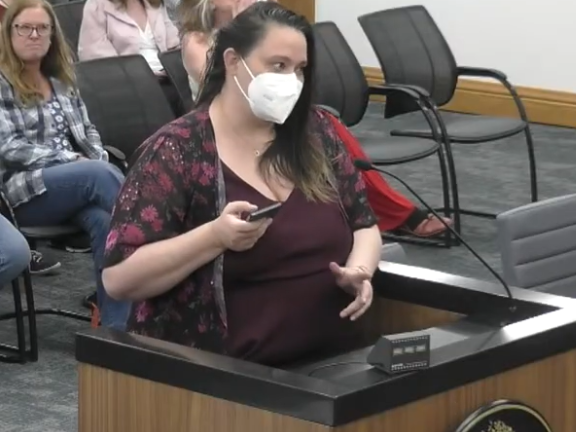
Resident Laurel Okasaki speaking about ICE.
“Less than 10 miles from where you are sitting now, a man was held in the Frederick, Colorado ICE ERO location for 34 days. The youngest person detained at the Frederick Ice ERO location was 6 years old […] These spaces are designed to be temporary, short-term. They frequently lack beds and access to showers.”
Residents repeatedly asked council to issue a formal statement acknowledging the impact of ICE on the community and to take a more proactive approach to community safety.
A second major theme of public comment focused on the town’s consideration of a potential municipal mineral rights sale.
Residents said they have been unable to access key information about the proposal, including its scope, intent and potential impacts. One speaker said “there have been no dedicated meetings to this topic” and questioned why information has not been made publicly available.
Others criticized the prevalence of executive sessions, arguing that they limit transparency. Speakers called for public hearings, impact studies to evaluate which properties would be affected and what the sale would mean for property values, environmental damage, and public health, and a commitment not to move forward with any agreement before broader community engagement.
Tonia Sharp, an Erie resident, said “The Draco Pad, as I understand it now, is an unprecedented project. A lot of what they’re doing in the drilling has not been done in Colorado before. Five miles of drilling, and everything else. I would hate for our mineral rights to give them an even bigger reason to expand it.”
Several residents also questioned potential environmental and financial impacts, including effects on home values, public health and future development.
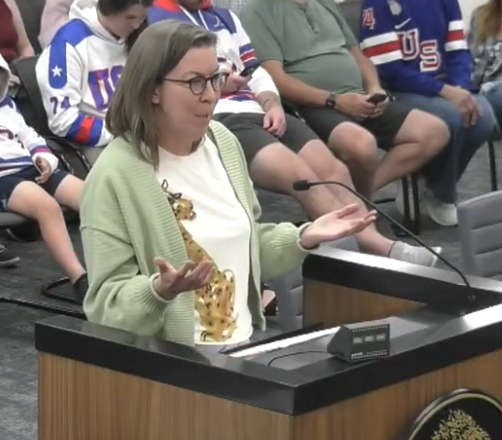
Resident Tonia Sharp, speaking about mineral rights.
The debate follows ongoing reporting on the town’s mineral rights discussions, including concerns about transparency and potential conflicts tied to negotiations with oil and gas operators.
Later in the session, the Council received a drought and water supply update under Resolution 2026-2022.
Town staff outlined pressure on Erie’s water system following an unusually dry winter and historically low snowpack along the Front Range. Officials reported limited seasonal reserves and an early spike in demand driven by warm weather and irrigation use, conditions that have strained system capacity earlier than typical.
The town is encouraging residents to begin conserving water early, including adopting a voluntary two-day-per-week watering schedule, and warned that additional restrictions could be put in place if conditions worsen. The discussion follows earlier reporting that Erie implemented some of the region’s earliest irrigation limitations amid drought conditions.
Council also approved changes to the town’s building code removing a requirement for fire sprinklers in new residential construction (Item 2026-185).
The decision came despite opposition from fire officials, who raised concerns about increased safety risks. The discussion reflected broader tensions between development costs and public safety standards as Erie continues to grow.
Earlier in the evening, the Erie Urban Renewal Authority approved Resolution 26-007, a supplemental budget request to carry forward funding for several incomplete 2025 projects, including the Colliers Hill pedestrian bridge, pedestrian safety improvements and historic Old Town upgrades. Officials said the request does not include any budget increases and that some projects may come in under budget.

During the council meeting, members also approved Resolution 2026-214, recognizing Dave Sullivan of the Erie High School Education Foundation as the town’s Outstanding Resident of the Year, and a proclamation designating April as a month honoring Olympian Jaccob Slavin for his achievements as a part of the 2026 U.S. Men’s Hockey Team.
Like journalism like this? Consider becoming a sustaining supporter — and get our print edition delivered to your home each month.
Democracy needs journalism more than ever. For 25 years, we’ve told the truth — your support helps us keep doing it for the next four and beyond. Administrations come and go. Our team stays, ready to lead no matter who’s in charge.