
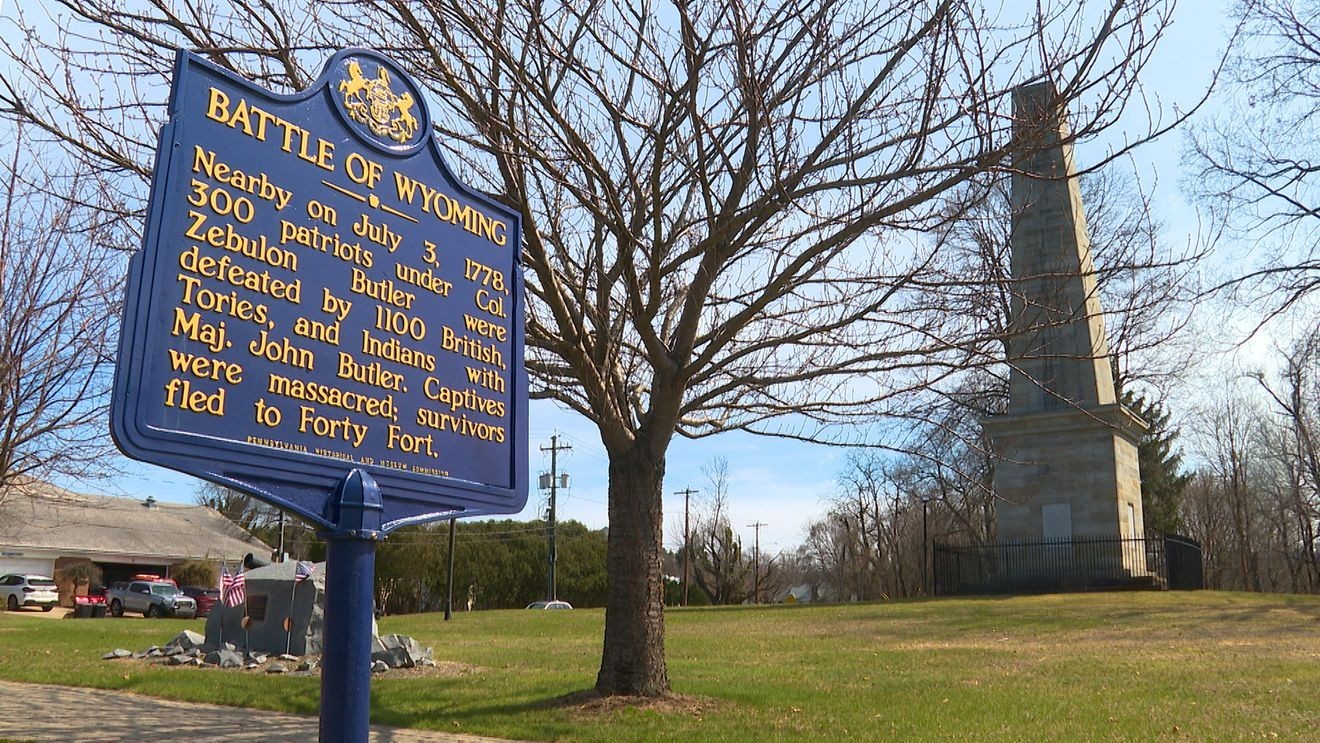
WYOMING, LUZERNE CO. (WOLF) — 250 years ago, the US fought a war for its independence. We’d end up winning that war, but the cost was great. Many gave their lives in pursuit of the ideal we live in today, and one of the worst defeats for the fledgling Continental Army was the Battle, or massacre, of Wyoming, where hundreds lost their lives. Now, the Wyoming Monument stands to honor those men who gave their lives to try to make America amazing.
It’s July of 1778, and after three years of war with England, troops from Westmoreland County, Connecticut, which is modern day NEPA, hear that their homes are going to be attacked so they leave the front lines and assemble in the Fort of Forty, modern day Forty Fort, to make a game plan. The Tories, Crown supporting colonists, faked a retreat, and on July 3rd, the Americans decided to pursue, thinking they could secure the valley.
“Some of the younger men accuse (Colonel) Butler of cowardice, and he utters the famous line, ‘Well, I’m brave enough to lead if you’re brave enough to follow.’ And they go out and of course, it’s a trap,” explains Mark Riccetti Jr., director of operations and programs at the Luzerne County Historical Society. “The Tories and the Iroquois fall back to the Schooley farm, which is now Schooley Avenue in Exeter roughly, and they fire three volleys and lead the Americans into a trap. And then the Iroquois come out of the swamp, and now they’re immediately behind the line and 90 plus percent casualties in less than 20 minutes in essentially 3 to 5 volleys. And it’s over.”
Out of roughly 400 Americans, more than 300 are killed with the survivors escaping to try and reach nearby settlements and forts.
“It’s a long terrifying run back, with Native Americans who know the land better than you and I know our names, in every corner chasing you,” said Riccetti Jr. “So, it really is a nightmare scenario.”
The Iroquois forces would go on to scalp, torture, and kill many of the fleeing soldiers and on July 4th, the Wyoming Valley was surrendered to the British. “Remember Wyoming” would become a battle cry for the remainder of the revolution and even into the war of 1812.
The horrors of the battle and massacre enraged the colonists and when the news hit Great Britain months later, the general public was horrified.
“That is when you start to see a shift that if this is what we have to do to keep the colonies, let them go,” continued Riccetti Jr. “And Wyoming really was the beginning of England’s almost Vietnam moment. And the popular opinion really changed on the war after that.”
In the 1830s, the remains of the slain would be collected and the Wyoming Monument would start to be built in honor of the hundreds killed that day and as a final resting place for the soldier’s bones, but there was an issue, they had no money to build it.
“The men tried; they had different committees,” explained Wyoming Monument Association Vice President Marian Czarnowski. “They were going back to Connecticut because most of these were Connecticut settlers. So, they went back to Connecticut trying to raise money, and they were just denied. So, the women decided they were going to do it.”
Many women in the area had ancestors that survived, or more likely, were killed in the battle, so the construction of the monument was important to them. In a time before women could even vote, they formed a movement and using bake sales, embroideries, festivals, and more raised $8,000, or over $350,000 today, and in 1841 fully funded the construction of the monument.
“The ingenuity of the women,” said Czarnowski. “These women were not working outside the home, there were no jobs for women, these women, the men always handled everything. But this time, the women took control. And they started this and they finished it.”
That group would become the Wyoming Monument Association in 1860 and to this day, the group is still women run, and it still holds the deed to and continues to own and care for the site and will in perpetuity.
The Wyoming Monument would be registered on the National Historic Registry in 2002 and today, it still stands as a testament to the men who died, and the women who carried on their legacy to always remember Wyoming.