
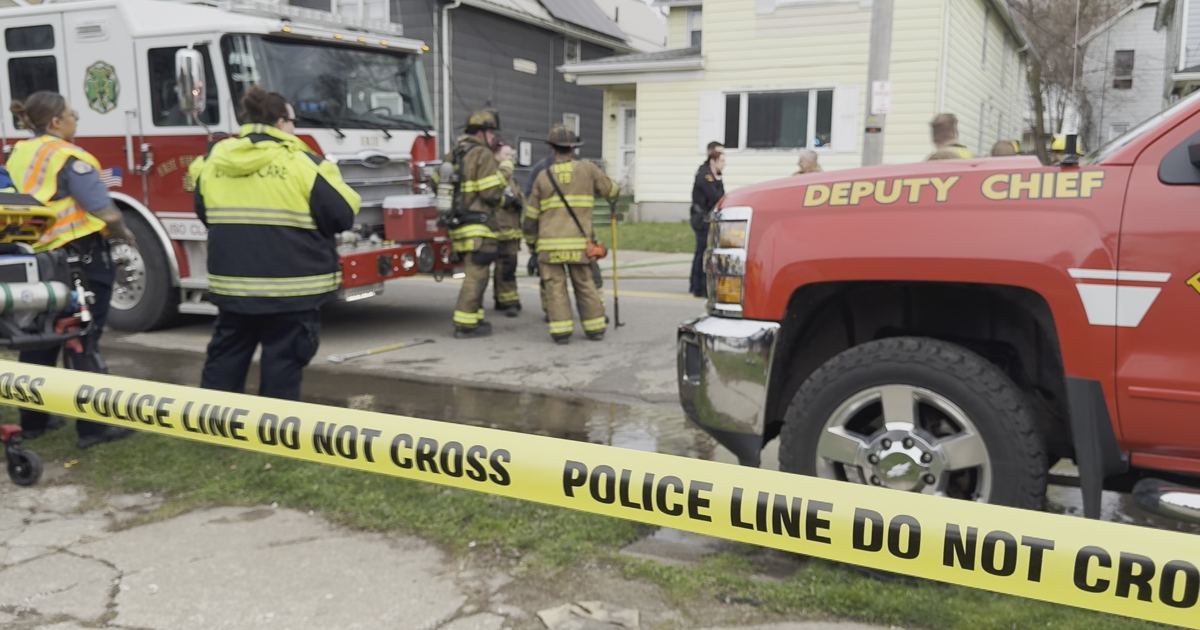
The office of the Erie County Coroner has released the names of the two children who died after being trapped in their burning apartment on Sunday afternoon. They are 5-year old Tobias, and 3-year old Da’Liyla Huff. The Davis-Garr Funeral Home on East 12th Street in Erie will be handling funeral arrangements for the siblings.
Coroner Cook will wait for toxicology test results to confirm smoke inhalation as the likely cause of death. Cook said the children did not suffer thermal injuries (burns).
We’ve shown you that the smoke was intense when the house at 535 and a half East 26th went up in flames. And we’ve reported that according to witnesses and investigators, apparently there was no adult at home when fire erupted in the kitchen.
Even though Tobias, Da’Liyla, and their 5-month old sister were found in a bedroom on the other side of the house, they still breathed in a lethal dose of smoke. The infant remains in critical condition at UPMC Children’s Hospital in Pittsburgh.
Erie News Now talked with ER physician Dr. Anthony Unger at UPMC Hamot Trauma Center to learn what makes inhaling smoke so dangerous, and how it can take over a body so quickly. “There’s smoke inhalation that causes burns to the airway,” Dr. Unger said. “It can cause swelling of the airway, can close off the airway completely or even cause swelling and fluid in the lungs.” He went on to say, “That’s specifically from the smoke, it has to do with the compounds in the smoke.”
Dr. Unger said the most worrisome compound is carbon monoxide, because it’s pushy. “It has the highest affinity for oxygen, so what it does is it binds to your red blood cells and displaces the oxygen so it can’t deliver the oxygen to your body — it’s about 200 times more powerful that oxygen.”
So when a smoke inhalation victim arrives at the hospital, the first steps in the ER are to quantify levels in the blood, do neurological and cardio-pulmonary examinations, and then doctors and nurses can start to wash out the carbon monoxide with a high flow of oxygen through a mask, or even in a hyperbaric oxygen chamber.
The doctor said concerns are high for patients who have had a seizure, passed out, or lost their pulse briefly. “Especially also pediatric patients, pregnant patients, we have a lower threshold to be more aggressive with them, some even include doing a hyperbaric oxygen chamber. For the most part thankfully, patients just require an oxygen mask and high flow oxygen to help wash all that carbon monoxide off their blood cells.”