

The Pittsburgh Steelers were in the bottom quarter of the league in explosive passing plays last year, but even their 41 completions of 20-plus yards felt like an overachievement given the unusual circumstances surrounding their downfield attack.
With a 41-year-old quarterback eager to get the ball out quickly and an Arthur Smith offensive scheme that did little to neutralize that tendency, the Steelers were outliers in multiple aspects of their offense. Nothing came easy, and a large majority of the explosive plays were heavily manufactured into existence.
Is that sustainable if the Steelers sign up for another year of Aaron Rodgers under center? And will Mike McCarthy’s offense nudge things in the right direction to carve out a better path?
Here’s the raw data for 2025 explosive passing around the league sorted by the number of explosive plays. The other three values are stats specifically on explosive passing plays. We’ll dive into the specifics of each stat below as it pertains to the Steelers.
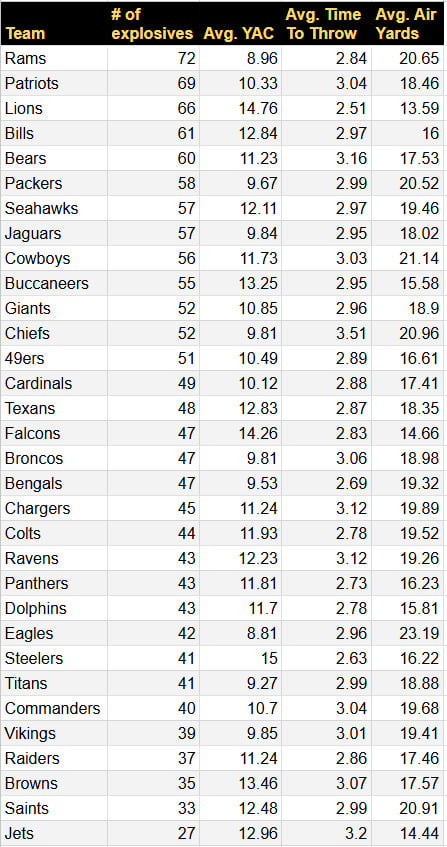
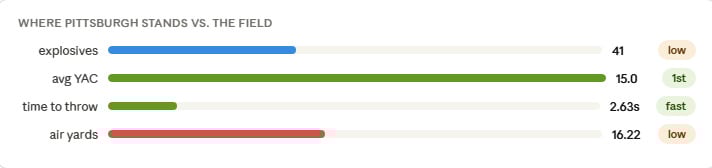
Most of this data was evident to anybody that watched the Steelers throughout the 2025 season. The gist of it? The Steelers’ explosive passing plays were primarily generated with a quick time to throw, lower-than-average air yards, and the best YAC in the league.
None of the three stats (Avg. YAC, Avg. TTT, or Avg. Air Yards) have a strong correlation to a team’s total number of explosives. The “strongest” trend was a correlation coefficient of just 0.155 when comparing Avg. YAC against the total number of explosive plays. That’s practically nothing. Interestingly, that trend is converse to conventional logic where more YAC actually meant slightly fewer total explosive plays.
Where we see more correlation is with each of the three major stats plotted against each other. Time to throw and YAC both show a strong correlation to air yards, and the Steelers were outliers in both last year.

The Steelers had the best YAC value per explosive play, which had a strong correlation with the average air yards. The shorter the throw, the more YAC. If you looked at the Russell Wilson-George Pickens offense, the Steelers would be on the other end of the spectrum with Wilson’s moon balls creating a lot of air yards and very little YAC.
While some of the YAC can be attributed to athletes like DK Metcalf and accurate passers like Aaron Rodgers, we probably shouldn’t count on an abnormally high value like 15 in 2026.

Time to throw also has a strong correlation to air yards. When quarterbacks get rid of the ball quickly, there is less time for routes to develop. The Steelers placed an emphasis last season on slants, swings, and screens, while other routes were seldom if ever used due to their slow-developing nature.
If you combine the three stats into a composite metric, the Steelers are in a peculiar spot at the top of the league in terms of their efficiency. Low time to throw, high YAC, and below-average air yards. They are orders of magnitude higher than many of the other teams.

The bottom line is that type of performance isn’t sustainable. If Aaron Rodgers returns, one of the primary variables will be back in the equation, but how much will Mike McCarthy’s presence change things?
Over his final two seasons with the Dallas Cowboys in 2023 and 2024, his offense averaged 55.5 explosive passing plays with an average time to throw of 2.87, average air yards of 18.01, and average YAC of 11.88. Even with Cooper Rush starting half of the Cowboys’ 2024 games, they had 47 explosive passing plays that season compared to just 41 for the Steelers in 2025. McCarthy’s scheme should help generate more explosives.
There are other factors to consider as well, like a young Steelers young offensive line that should continue to improve. That means more trust from the quarterback with longer times to throw and thus more air yards on explosive plays. The unsustainable part of the equation (15 Avg. YAC) can be leveled out by that alone. Pittsburgh also added a real WR2 in Michael Pittman Jr., which should help the entire offense.
Last year’s version of the Pittsburgh Steelers passing game was an outlier by design—and by necessity. With Mike McCarthy now in the picture, the goal shouldn’t be to chase that same efficiency, but to build something more repeatable. Even if the numbers regress, the process should improve.