
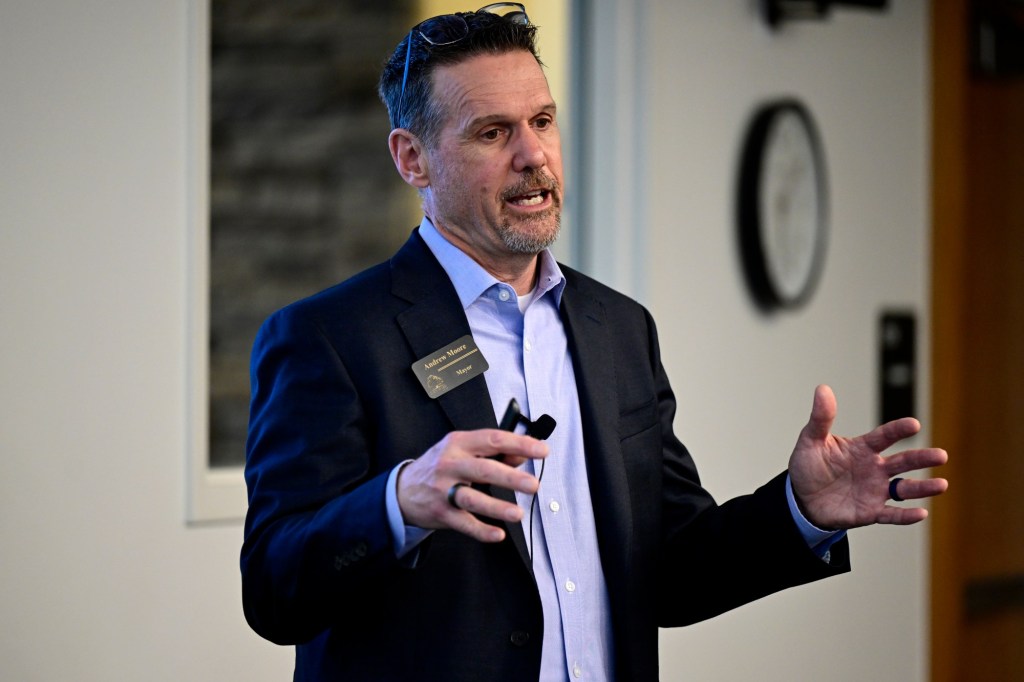
Erie Mayor Andrew Moore opened his remarks at Thursday evening’s State of the Town event with a familiar topic: growth.
With a population exceeding 41,000 by the end of 2025, Erie has more than doubled in size since 2010, when it had about 18,000 residents.
That growth forces the community to strike a balance, Moore told a room of more than 50 people during the event.
“There’s always this constant tension between the small-town feeling,” he said. “How do we preserve that small-town feeling and still grow?”
For him, Moore said that vision includes expanding Old Town. A planned development at Wells and Kattell streets, he said, is one effort to “get Old Town as productive, with as many businesses, as we can down there.”
“I’m a believer that Old Town is maybe our only walkable community,” Moore said, adding that he would “love to see Old Town expanded on the north side of Briggs Street and to the south as well.”
Growth is also raising questions about resources.
The town recently directed residents to turn off their sprinklers as water usage neared capacity — a directive driven by unseasonably warm early spring temperatures, Moore said. But the situation brings to the forefront a broader concern about long-term water supply.
“The challenge of new growth coming in is, what are we doing with water?” Moore said.
Erie relies largely on Colorado-Big Thompson water, which flows from Lake Granby to Carter Lake before reaching the town’s treatment system. The town also holds rights to Windy Gap water, but without storage, that supply can’t be captured.
“When the water comes down out of the mountains, if we don’t have a place to store it, it goes on, and we’ve lost that water,” Moore said.
A planned solution, the Chimney Hollow Reservoir Project, has been delayed after elevated levels of uranium, a naturally occurring mineral, were detected.
Town leaders are now weighing whether the town should continue participating in the Northern Integrated Supply Project, which has seen other communities drop out due to costs.
“We’re continuing to invest in NISP, and we’re hopeful in about another year we will know what the full costs are,” he said. “Then the council will make a decision.”
The Page Property and mineral rights
Parks and recreation projects, transportation initiatives and more development were among the topics Moore broached Thursday evening. But public comment repeatedly returned to two issues: the Page property and a potential mineral rights deal.
The Page property — also known as the Village at Coal Creek — is a town-owned parcel just north of Old Town that has been the subject of debate for months.
Some residents want the land preserved as open space. Others have proposed affordable housing. Moore also floated a proposal in December that could see St. Scholastica Catholic Church acquire the property.
Conversations between Moore and the church have been criticized for a lack of transparency. More than 20 residents protested outside Town Hall for about an hour before the event, and several raised concerns during the meeting.
One resident questioned why other council members did “not know (he) was talking with St. Scholastica for six months.”
“Every idea starts somewhere. I have people talking to me about all kinds of things,” Moore responded. “Until they have enough to talk about, I don’t go out sharing that with people. Why? Because it creates this uncertainty.”
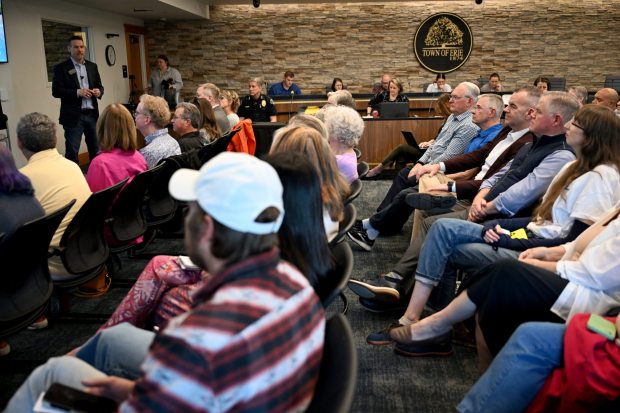 Over 50 people attended Thursday evening’s State of the Town event in Erie. (Joel Solis/Staff Photographer)
Residents also pressed Moore for more transparency around negotiations involving the town’s mineral rights tied to the Draco well pad, many of which have occurred in executive session.
Some claimed the deal could amount to an expansion “expansion of Civitas’s activity” in Erie, referring to the company at the helm of the planned Draco project. Others repeated concerns about the consultant hired by the town to broker a potential deal, who previously served as Civitas’s chief operating officer.
“Will you commit … to dedicated meetings associated with this? Not a sidebar — fully dedicated meetings with Q&A, letting us know the plans, and then that feedback is taken?” one resident asked Moore.
Moore told the room he is “constrained legally” from sharing details about any potential negotiations, but said the public will have opportunities to weigh in, including a future public hearing.
‘Decisions in isolation’
Erie resident John McAllister said the State of the Town event “did not resolve” his concerns about the town’s leadership.
“Personally, I thought that the audience voiced a lot of issues that they just didn’t feel comfortable with the mayor about,” McAllister told the Daily Camera.
Residents who stood outside Town Hall with cardboard signs before the event said they are opposed to several council decisions made last year, including the removal of Pride flags from town-owned flagpoles and approval of residential development at Redtail Ranch, a site with a long history of oil and gas activity and nearby landfills.
“It seems like the council is often voting 4-3 and making some really bad decisions. It started with the no Pride flags,” said Erie resident Carol Campbell.
“The better thing would be to have good enough discussion that you could come to some kind of consensus … rather than steamrolling people by majority rule.”
Another resident, Charlotte Christ, said she is concerned that “our mayor is making decisions in isolation, and we want to be part of the discussion.”
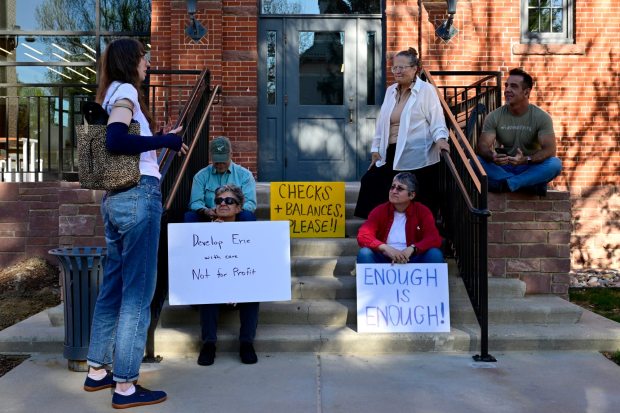 Protesters sit outside the Erie Town Hall leading up to the State of the Town. (Joel Solis/Staff Photographer)
Erie looks ahead
The State of the Town event called attention to more initiatives on Erie’s agenda this year.
The town is continuing work on a police facility expansion and is searching for a new town manager after Malcolm Fleming was dismissed earlier this year.
Development is also planned at the Town Center site near Erie Parkway and County Line Road.
At Schofield Farms, construction on new community spaces — including a makerspace — will continue, while new parks are expected to break ground this year in the Compass and Morgan Hill neighborhoods, according to Parks and Recreation Director Luke Bolinger.
The town is also preparing to launch Erie Bee, a rideshare-style service expected to begin this month.
Looking ahead to November, officials are considering potential ballot measures, including a lodging tax for future hotels and a possible sales or property tax to fund improvements to the Erie Community Center. Erie currently has no hotels, though one is planned at the Town Center site.