
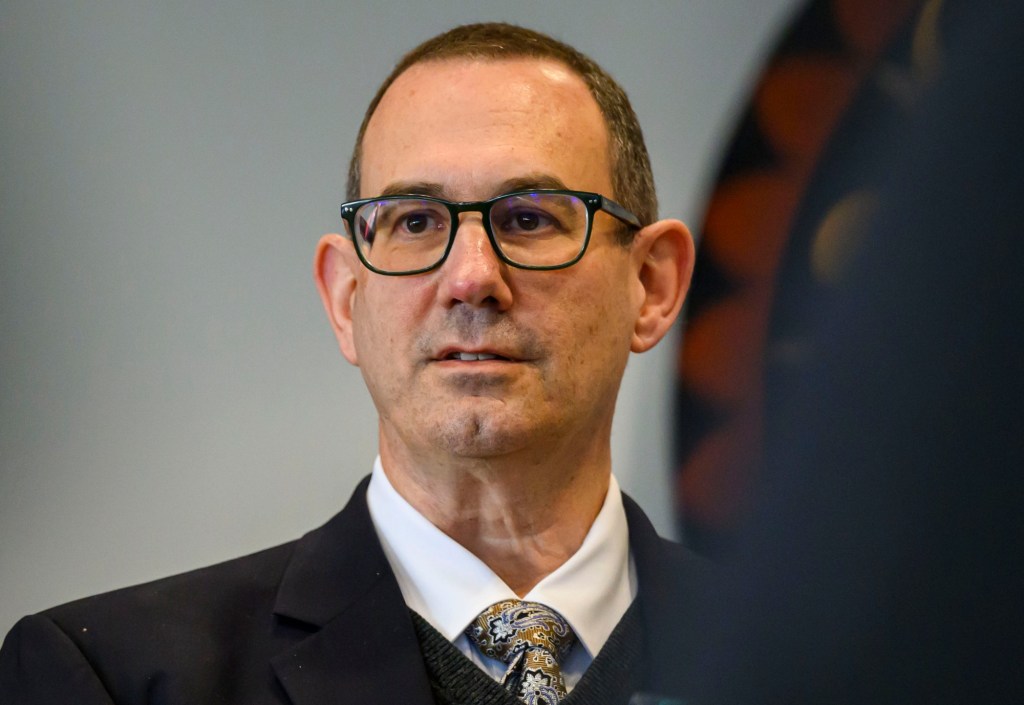
Lehigh County Controller Mark Pinsley says the county should think twice before hiring law enforcement officers who have been trained as ICE agents under the second Trump administration.
Citing potentially expensive use-of-force lawsuits and the U.S. Immigration and Customs Enforcement’s “terrible culture” that has led to violence in cities like Minneapolis, Pinsley wants a policy in place that would flag candidates with recent ICE experience as potential liabilities.
“We should at least take a look at this and realize that there is financial risk to hiring someone who is a former ICE agent,” he said. “These guys, I don’t know, they seemed to have been given a license to kill, maybe not literally.”
While several cities have sought so-called “Ice Out” ordinances, which seek to limit where agents can operate, Pinsley’s proposal appears to be among the first in the nation aimed at limiting former agents’ employment. A proposed New Jersey law would prevent former ICE agents from landing a public job in that state.
An email seeking comment from the Department of Homeland Security, which oversees ICE, was not returned Friday.
Pinsley has targeted ICE before, announcing in January that the agency failed to pay $115,000 in rent for a county-owned office, prompting County Executive Josh Siegel to call for the agency’s eviction. The action was criticized by District Attorney Gavin Holihan and anti-human trafficking agencies who said the agency served a vital function in the Lehigh Valley.
If implemented, the policy would primarily affect people seeking jobs as corrections officers and deputy sheriffs.
Lehigh County Sheriff Joe Hanna said Pinsley’s proposal would not apply to his hires, who must complete a rigorous 19-week course under Pennsylvania’s Act 2 for sheriffs, or a similar course for police officers. They’re also subject to a full background investigation and panel review, Hanna said.
The sheriff noted that, as a row officer, he has the unfettered ability to hire, fire and supervise his employees without input from other row officers. He said Pinsley’s proposal could expose the county to civil liability for possibly precluding candidates for employment without good reason.
“Bottom line, I really don’t believe it’s applicable to my office, or any other sheriff’s office in Pennsylvania,” Hanna said.
Janine Donate, acting warden of the Lehigh County Jail, could not be reached for comment Friday.
Pinsley said he chose now to introduce the measure because the county is looking at its hiring process and creating manuals.
Siegel said he supports the proposal. No date has been set for county leaders and the Board of Commissioners to discuss or vote on the policy change.
“Lehigh County is no place for undisciplined, poorly trained and frankly dangerous agents more suited to paramilitary organizations then legitimate law enforcement,” Siegel said.
Pinsley said his proposal is not a blanket ban on former ICE agents, but a broader, risk-based approach to hiring candidates with prior law enforcement experience that would require evaluating potential hires using consistent, measurable criteria.
In a 14-page memo explaining his proposal, Pinsley cited the Southern Poverty Law Center watchdog group, which found that ICE recruitment campaigns skewed toward extremism. He also noted that since Jan. 20, 2025, ICE cut basic training from five months to as little as six weeks and more than doubled its workforce.
Retraining former ICE agents isn’t sufficient, Pinsley said in his memo, pointing to scientific studies on institutionally formed behavioral patterns. Officers trained by one agency on what constitutes a threat, and when to escalate or deescalate a situation, may not easily forget that training under stress, the studies concluded.
“When Lehigh County hires a former ICE agent, it is not simply hiring an individual with a measurable skills gap. The available evidence indicates it is also accepting exposure to institutionally formed behavioral patterns that retraining has not been shown to reliably correct,” Pinsley said in his memo.