
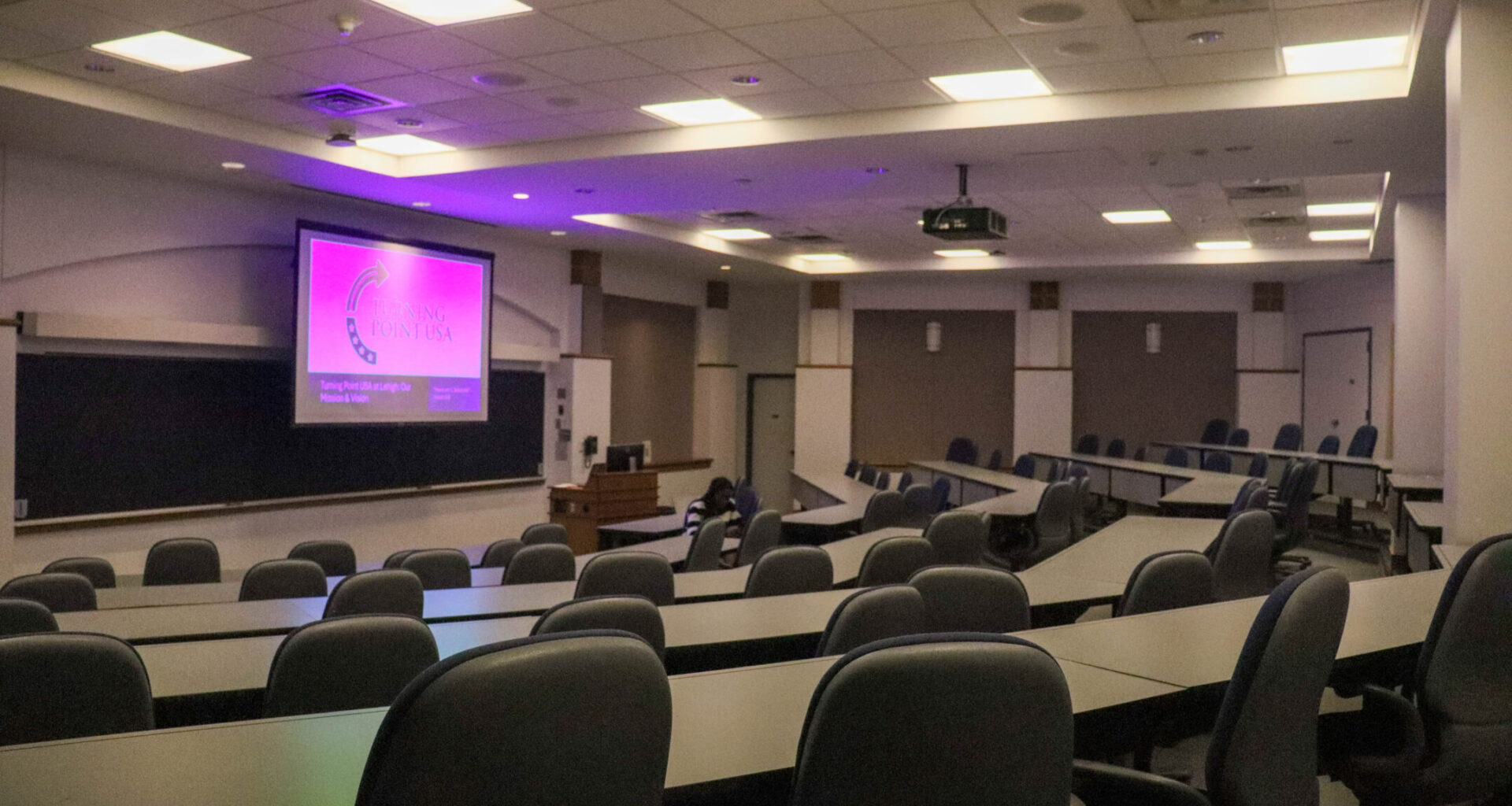
Student senators reported administrators spoke in favor of approving a Lehigh chapter of Turning Point USA during a Student Senate club approvals meeting on March 3.
Provost Nathan Urban, Katherine Lavinder, the vice president for student affairs, and Donald Outing, the vice president for equity and community, encouraged senators to grant the chapter a trial run, according to four senators who spoke with The Brown and White.
Senators said administrators emphasized that all clubs should have an equitable chance of approval, citing The Chicago Principles — a free speech policy Lehigh adopted in October.
Drew Smith, ‘27, the Senate’s vice president of internal affairs and president-elect, said administrators told senators the principles support free expression on campus and TPUSA’s mission doesn’t directly conflict with the university’s mission.
Tasfia Ahmad, ‘27, the Senate’s facilities and services chair, said Urban spoke most at the meeting, with Lavinder and Outing present but speaking less.
TPUSA, a national right-wing political organization founded by activist Charlie Kirk, says it seeks “to defend and promote conservative values on campuses across the country…by challenging the narrative and stopping the brainwashing through open dialogue,” according to the organization’s website.
However, chapters nationwide have drawn criticism and generated backlash from those who say the organization promotes discrimination and hostility.
Ibtihal Gassem, ‘27, the Senate’s Bethlehem outreach chair, said administrators typically notify senators in advance when they plan to attend meetings. In this case, she said senators were informed the day of.
The Brown and White emailed Urban, Lavinder and Outing asking what was said and why they attended.
Urban wrote that members of university leadership were added to the agenda by the Senate Executive Board. He wrote the Senate twice voted to extend discussion beyond the allotted 10 minutes and that administrators left before the final vote.
Urban also wrote that Lehigh is committed to advancing its mission through exchanging varied ideas, which requires a range of perspectives represented on campus.
“The discussion focused on the importance of fostering and supporting a diversity of viewpoints on campus and how decisions about club recognition generally should not be based on the political viewpoints endorsed by the groups applying,” he wrote.
Urban wrote the administrators emphasized the Senate should follow its established processes and that Lehigh staff regularly meet with students to discuss topics of interest.
“Academic freedom, freedom of expression, and viewpoint diversity are essential elements of a Lehigh education,” he wrote. “Therefore we work to foster an environment of openness, debate, curiosity and belonging.”
Urban also wrote the club-approval process is student-led and that recognition provides funding and institutional support.
According to the Senate’s Club Affairs Committee rubric, prospective clubs must earn sufficient points across eight categories, including mission, community benefit and goals for the trial period. Groups that pass committee review are then presented to the full Senate for a vote.
Smith said for the first time in his three years on the Senate, members voted against the committee’s recommendation.
Gassem said the Senate voted three times after motions to reconsider, and each vote rejected the chapter.
Following administrators’ comments, Noe Kourtzidis, ‘27, the Senate’s student outreach chair, said many senators expressed frustration. He said Urban “danced around” responding to his and others’ commentary.
Kourtzidis said Urban didn’t clearly answer where the line should be drawn between combatting hate speech and upholding the First Amendment or respond to his hypothetical question of what would happen if a club promoting neo-nazism sought recognition.
Smith said many senators referenced broader concerns about racism on campus, which prompted the Senate to pass a resolution calling for actionable steps. He said some worried that recognizing a TPUSA chapter could worsen campus school climate given the organization’s national messaging.
Ahmad said she also considered student opposition in her vote.
She said a petition opposing the chapter gathered 700 signatures in the days leading up to the vote.
“Considering what’s been happening on campus the past few weeks, (it would) just be very hypocritical for the Senate to make a statement on racism on campus, and then to approve a club that further perpetuates racism on campus,” Ahmad said. “(Administration) tried to put their opinion in, but students were louder than that.”
Political science professor Dean Caivano said he has several senators in his classes and has discussed potential Senate restructuring with administrators.
Caivano said it’s not unusual for administrators to attend meetings or speak on policy, but senators told him it was atypical for administrators to express opinions on how they should vote.
“What appears concerning to me and to many students is a very clear directive about how an autonomous student voting body should vote for a particular application,” he said.
While support for TPUSA centered on free speech, Caivano said senators he spoke with didn’t find that argument sufficient to approve a group they view as polarizing.
“The fact that we are in this situation is proof enough that the systems in place have failed in prohibiting racism on campus,” Smith said. “(Regarding) Turning Point, reinforcing the principles of our equitable community and promoting a campus climate where everyone feels safe to exist is necessary as elected representatives. If that cannot be achieved, people can’t comfortably exist on campus, and we have failed as a government.”
Caivano said the situation could represent administrative overreach, particularly as discussions continue about the Senate’s role and how faculty can support it.
“It’s my belief that a Student Senate needs to be fully autonomous, but also needs to be richly supported by faculty and by administration in ways that do not compromise the decision-making powers of the student, but rather augment and provide resources to help them realize the goals they’re seeking out,” he said.
Gassem said the timing — amid reports of racist rhetoric on campus — raises concerns about whether the university is upholding its nondiscriminatory policies.
She said while she supports individuals’ rights to political beliefs, recognizing a TPUSA chapter could set a precedent for allowing harmful or discriminatory organizations.
“It sends a very conflicting message to the Lehigh community and to everybody outside of Lehigh looking inwards — it looks like we don’t have a strong stance when we do say, ‘zero tolerance for discrimination,’” Gassem said. “Anybody should have their own political views, but it shouldn’t cross the line of hate speech if we do have the Chicago Principles.”
Smith said the Senate will vote again Tuesday after a senator who previously voted against the chapter introduced a motion to rescind, repeal or annul the decision.
Gassem said the motion was submitted privately, which she found unusual since Senate voting procedures are typically public. She said the senator will present the motion at Tuesday’s meeting.
She also said in her three years on the Senate, it’s highly unusual for a club rejected three times in one meeting to return for another vote.
“This is very new and has not happened at all,” Gassem said. “It also just doesn’t make sense in terms of our own protocol.”
Smith said the motion complies with the Senate’s constitution and bylaws.
The Senate will vote again on granting TPUSA a trial run from 4:30 to 6 p.m Tuesday in the Clayton University Center boardroom.